TitanFX
True ECN broker on Equinix NY4 colocation with same-day withdrawals and zero deposit fees. Among the lowest-latency execution environments for active EAs in the catalogue.
- Min deposit
- $200
- Max leverage
- 1:500
- EUR/USD spread
- 1.0 pips
- Commission
- $0 on Standard / $7 on Blade
- Withdrawal time
- Same day days
- HQ
- Port Vila, Vanuatu
Regulation
Licences and oversight
| Regulator | Licence number |
|---|---|
| VFSC Vanuatu | 40313 |
Strengths
What works
- True ECN execution with Equinix NY4 server colocation — among the lowest latencies in the catalogue.
- Same-day withdrawals on most methods (= matches Exness, beats XM/HFM).
- Zero deposit and withdrawal fees on most methods.
- Blade account (0.0 base spread + $7/lot commission) is the catalogue's strongest scalping environment.
- No requote policy — orders fill at displayed price or rejected, never re-priced.
Caveats
What to weigh
- Single regulator (VFSC Vanuatu) — narrower oversight than HFM, Exness, or XM multi-jurisdiction setups.
- Higher minimum deposit ($200) than entry-level offshore brokers.
- Smaller asset universe (60+ forex vs HFM's 1000+ stock CFDs) — pure-FX broker by design.
- $7/lot Blade commission is higher than competitor ECN accounts ($3-3.5).
Account & platform
How accounts and platforms break down
- Account types
-
- Standard
- Blade
- Platforms
-
- MT5
- MT4
- Funding methods
-
- Bank wire
- Visa / Mastercard
- Skrill
- Neteller
- Crypto (BTC/USDT)
- FasaPay
- Supported assets
-
- Forex (60+ pairs)
- Indices
- Metals
- Commodities
- Crypto
Worth noting
Notable features
- Equinix NY4 colocation is a genuine technical differentiator vs other offshore brokers.
- Bridge connectivity to Tier-1 liquidity (= multiple bank LPs aggregated).
- MAM / PAMM support for managed-account operators.
Updated · How we test ↗
TitanFX is the catalogue’s specialist choice for one job: getting an order to the market faster than anyone else here. The broker runs a no-dealing-desk True ECN model with order matching colocated at Equinix NY4 — the same data centre that houses major institutional forex venues — and for a latency-sensitive strategy that single architectural fact outweighs everything else. This profile is written for one reader: someone about to point an automated system at a live TitanFX account, and specifically someone whose EA is fast. It focuses on the decisions the data tables above don’t make for you — which of the two accounts your EA actually needs, what your real cost per round-turn works out to, and where TitanFX’s execution edge earns its keep versus where another broker fits better. We rank brokers on EA-relevant data, not on what they pay us; see how we choose in our best MT5 brokers for EA trading guide.
Why TitanFX’s ECN and NY4 execution matters for an EA
For most EAs trading on M5 and higher timeframes, execution speed is invisible — the broker fills the order, the candle closes, and the difference between a fast venue and a slow one is rounding error. TitanFX exists for the EAs where that is not true. A scalper firing dozens of orders a day, or a high-frequency system reacting to a tick rather than a bar close, lives or dies on two properties: how quickly the order reaches liquidity, and whether the price it asked for is the price it gets. This is where colocation stops being marketing.
TitanFX’s order matching sits at Equinix NY4 — a New York data centre that physically houses the servers of major Tier-1 liquidity providers. Routing an order from a matching engine in the same building as the banks supplying the price removes the network distance that adds slippage and delay at a non-colocated broker. Paired with a documented no-requote policy — orders fill at the displayed price or are rejected, never silently re-priced — this gives a fast EA the one thing it needs most: execution it can model. A backtest assumes fills at or near the signal price; the closer live execution tracks that assumption, the more a fast system’s edge survives contact with the market. For the catalogue’s scalping strategies, TitanFX’s ECN routing is the venue where the gap between test and reality is structurally smallest.
The honest boundary: this advantage is real but narrow. If your EA trades on the H1 or the daily, NY4 colocation buys you almost nothing a stable STP broker doesn’t already give you. TitanFX earns its place for fast systems specifically.
Match the account type to your EA
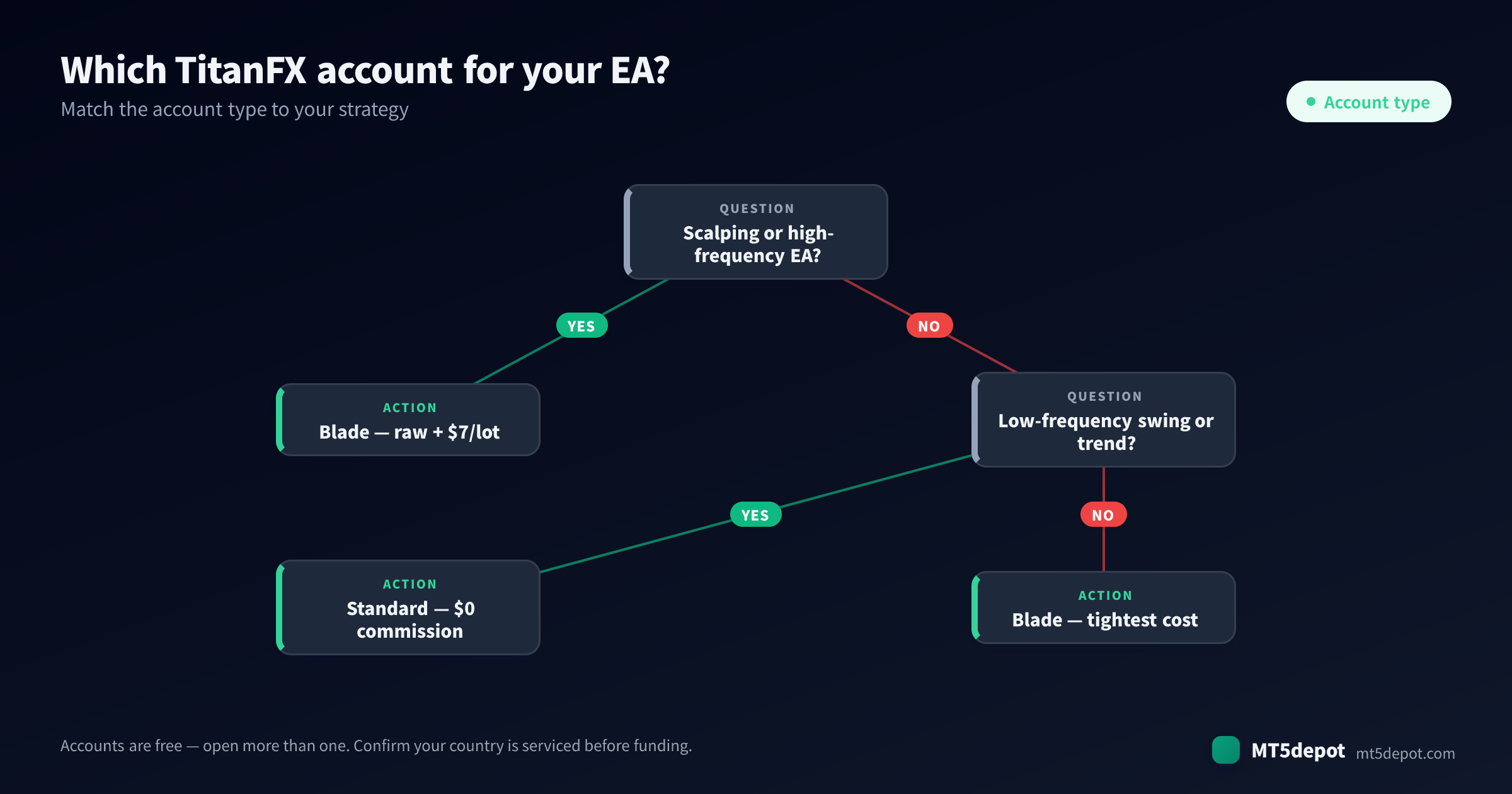
TitanFX keeps it simple — two accounts, and the choice maps cleanly to one question: does your EA trade often enough that commission-plus-raw-spread beats an all-in spread? The account decides your cost structure, and for anything that trades frequently, cost structure is the difference between profit and loss. Use this picker, then read the account notes below it:
Standard — commission-free for lower-frequency systems
The Standard account charges $0 commission and builds cost into a typical ~1.0-pip spread on EUR/USD. For a swing or trend EA that trades a few times a week and targets large moves, a 1.0-pip all-in spread is a rounding error against the size of the move, and the zero-commission simplicity is genuinely easier to reason about — there is no per-lot maths to track. It is the cleaner choice for any system whose edge is not measured in fractions of a pip. What it is not is a scalper’s home: a 1.0-pip spread on a strategy taking hundreds of trades a month erodes a fast edge that the Blade account would preserve.
Blade — the raw-spread home for scalpers and high-frequency EAs
The Blade account is TitanFX’s reason to exist for this catalogue. It offers raw spreads from 0.0 pips plus a $7/lot commission, and it is the strongest scalping environment here — not because the headline number is the lowest, but because raw pricing colocated at NY4 stays tight precisely when an all-in spread widens most: during fast, news-driven markets where a scalper makes or loses its month. For scalping, grids, and anything trading more than ~50 positions a month, raw-spread-plus-commission is both cheaper and more predictable than a wider all-in number once frequency climbs. If your EA’s edge lives in fractions of a pip, Blade is not optional.
Spreads and total cost: Standard vs Blade, calculated
This is the calculation most traders skip, and it decides which TitanFX account is cheaper for your EA. Total cost per round-turn is spread (in account currency) + commission — never spread alone.
- Standard: ~1.0 pip spread, $0 commission. On a standard lot that is roughly $10 per round-turn, all in.
- Blade: raw spread near 0.0 on majors (call it ~0.1 pips, ≈ $1) plus $7/lot round-turn commission ≈ $7–8 per round-turn — on the tightest, most stable raw pricing in the catalogue.
For a swing EA taking 10 trades a month, the two are within a few dollars and Standard’s simplicity wins. For a scalper taking 200 trades a month, the picture inverts: Blade’s ~$2–3 lower cost per round-turn compounds to roughly $400–600 a month, and — more importantly — the stability of raw NY4 pricing during fast markets is where a scalper’s real money is made or lost. Run the maths on your EA’s documented trade frequency before you pick. Note that Blade’s $7/lot commission is higher than the $3–3.5/lot at some other ECN accounts like Exness Raw; you are paying a premium for the colocated execution, which is worth it for a latency-sensitive system and not worth it for a slow one. The published backtest figures in the EA catalogue are measured on Exness retail-spread tick data — each EA profile documents how its spread compatibility holds up across the participating brokers, so treat those numbers as a costed hypothesis your demo week confirms on your chosen account.
What ECN execution means when your EA fires an order
TitanFX runs a True ECN model: your orders are matched against aggregated Tier-1 bank liquidity through a bridge, never filled against an in-house dealing desk. The contrast with an STP broker like HFM is worth understanding, because both are no-dealing-desk in the sense that matters to most traders. STP routing passes your order straight through to liquidity providers — fast and clean, and invisibly so for the vast majority of EAs. True ECN goes a step further: orders are matched in a central pool of aggregated quotes, with the no-requote policy meaning a market order fills at the displayed price or is rejected rather than re-quoted at candle close. For a sub-second scalper that distinction is the whole game; for an M5-and-higher EA it is a refinement you will rarely feel. The execution model is the single technical reason a fast-EA trader chooses TitanFX over an otherwise comparable broker.
Platforms: MT5, MT4, and the VPS that is not optional
TitanFX supports MT5 and MT4. The MT4 support matters more than it looks: a large number of older EAs are compiled as .ex4 for MetaTrader 4 only and cannot run on MT5, so if your system is a legacy MT4 EA, TitanFX runs it without forcing a rebuild. For MT5-native EAs you get the modern terminal with its better strategy tester and native economic calendar. The mobile apps monitor positions but, like every mobile terminal, cannot run an EA.
For a TitanFX account the VPS is less a recommendation than a requirement, and the reasoning is the same architecture that makes the broker attractive: there is no point paying for NY4-colocated execution if your terminal is running on a home machine that adds tens of milliseconds of network distance and can sleep, update, or lose its connection mid-trade. A latency-sensitive EA on TitanFX should run on a low-latency VPS sited near the broker’s servers — see our VPS for MT5 EAs guide. Without one, you are buying a fast venue and then throwing the speed away.
Funding and withdrawals on an active EA account
TitanFX processes withdrawals same day on most methods, across bank wire, cards, e-wallets (Skrill, Neteller), crypto (BTC/USDT), and FasaPay, with zero deposit and withdrawal fees on most rails. For a high-frequency EA this matters more than it does for a buy-and-hold trader: same-day withdrawals let you cycle profits out of a fast account without waiting on a business-day delay, which is exactly the cadence a scalper or grid operator often wants. It matches Exness’s instant rails closely and beats the 1-business-day processing at HFM. For a trader compounding inside the account it is a convenience rather than a necessity, but combined with no fees it is a genuinely clean operational profile.
Running EAs as a managed account — MAM / PAMM
TitanFX supports MAM and PAMM account structures, which matters if you do not just run an EA for yourself but operate it across several accounts — a money manager allocating one EA’s signals to a pool of investor capital, or a trader running the same system on a set of family accounts. A MAM (multi-account manager) setup lets one master EA distribute trades proportionally across all linked accounts in a single execution, rather than copy-trading each account separately with the lag and slippage that a copy bridge introduces. For a latency-sensitive strategy that is entirely consistent with the rest of TitanFX’s pitch: if execution speed is the reason you are here, the last thing you want is a copy-trade layer quietly re-introducing the delay at the allocation step that the NY4 colocation just removed at the order step.
The practical caveat is the same as with any managed structure — confirm the current MAM/PAMM terms, fee splits, and minimums with TitanFX directly before building a managed-account operation on them, because those terms sit outside the standard retail account and can change without affecting your individual trading conditions. For a solo EA trader none of this applies; for an operator scaling one tested system across capital, it is the difference between a clean institutional allocation and a fragile copy-trade workaround.
Is TitanFX the right broker for your EA?
TitanFX is the strongest choice for a latency-sensitive scalper or high-frequency EA, and the case is specific: True ECN execution colocated at Equinix NY4, a no-requote policy, the Blade account’s raw-spread-plus-commission structure, and same-day fee-free withdrawals add up to the lowest-friction trade-execution layer in this catalogue. If your EA’s edge depends on fast, predictable fills, nothing here matches it.
Where it is not the first pick, and this is worth being honest about. TitanFX is a single-regulator broker (VFSC Vanuatu, 40313) — narrower oversight than the multi-jurisdiction setups at HFM or Exness — so a trader who wants maximum regulatory breadth behind a 24/7 automated account should weigh that. It has a $200 minimum deposit and no cent account, so a beginner who wants to learn live execution for the price of a coffee is better served by HFM’s $5 Cent account. Its asset universe is pure FX-plus (60+ pairs, no 1000+ stock-CFD breadth), and the Blade commission is higher than competing ECN accounts. For a slow EA, a beginner, or a trader who wants regulatory reassurance first, those caveats point elsewhere. For a fast EA, none of them outweigh the execution.
How TitanFX compares to the rest of the catalogue
Briefly, against the other catalogued brokers: TitanFX beats every one of them on execution latency thanks to NY4 colocation, and matches Exness on same-day withdrawals while conceding tighter headline economics — Exness’s 0.7-pip Standard and $3.5/lot Raw undercut TitanFX’s 1.0-pip and $7/lot. It trades regulatory breadth away to HFM’s six-licence footprint and gives up a low-cost on-ramp to HFM’s $5 Cent account, and it carries narrower oversight than newer multi-asset brokers like FXGT while offering cleaner, faster pure-FX execution than Axiory. The full side-by-side is in our best MT5 brokers for EA trading comparison, and the criteria behind these judgements are set out in how to choose a broker for EAs.
Opening a TitanFX account for EA trading, step by step
- Open the account through the link on this page. Using our IB link costs you nothing extra and is how mt5depot funds this catalogue (see the transparency note below).
- Choose your account by strategy — Blade for scalping and high-frequency systems, Standard for lower-frequency swing and trend EAs. You can open more than one.
- Download the MT5 (or MT4) desktop terminal from TitanFX after registration. The mobile app cannot run EAs.
- Fund the documented minimum for your EA (the account minimum is $200), not your full bankroll, and run a one-week demo first to confirm symbol names and execution behaviour.
- Set up a low-latency VPS before going live — on TitanFX this is mandatory, not optional, so the EA runs 24/7 next to the broker’s servers rather than throwing away the NY4 latency edge on a home machine.
How mt5depot earns money
A money page should state how it is funded, so plainly: when you open a TitanFX account through the IB link on this page, mt5depot may earn an introducing-broker commission from TitanFX on your trading activity. It costs you nothing extra — your spread and commission are identical to opening directly, with no markup on our side.
In TitanFX’s case the disclosure comes with a caveat we would rather be straight about: TitanFX is not a revenue focus for us. It runs no standing CPA programme — only seasonal referral promotions — so it earns its place in this catalogue purely on execution merit, the NY4 colocation and no-requote policy a fast EA actually needs, and not on what it pays. That is precisely why it wins the latency category here despite thinner partner economics than some brokers we do not recommend for that job. We rank on EA-relevant data; an account you keep because the execution suits your scalper is the only outcome that compounds for either of us.
Who can open a TitanFX account
TitanFX onboards offshore clients across most regions, but by regulation it does not accept clients in the United States, Canada, the European Union, the United Kingdom, Japan, Belgium, the DPRK, or Iran. The European and UK exclusions catch most prospective users: the offshore Vanuatu entity documented here is intended for non-EU/UK English-speaking traders, and EU/UK residents are declined rather than routed to a local regulated entity. Confirm your country is serviced before you fund, because an EA can only ever compound the capital you were actually able to deposit. If you are unsure, begin the registration flow and confirm acceptance before transferring any funds — a thirty-second check that saves a bounced deposit and a support ticket.
Risks and what to confirm before you fund
Leverage up to 1:500 is a tool, not a target — size your risk as if it were capped, because an EA that over-positions on high leverage fails by drawdown, every time. Before deploying, confirm three things on your specific account: that negative balance protection is active, that your country is serviced (the restricted regions are listed under who can open an account above), and that your EA’s permitted strategies match how it trades. Because TitanFX sits under a single Vanuatu regulator, a sensible portfolio control is to keep the balance you hold here proportional to its role — use TitanFX as the fast trade-execution layer and hold longer-duration capital at a multi-jurisdiction broker. The detailed testing process behind every figure we publish is on our methodology page.
FAQ
Is TitanFX good for EA / automated trading? Yes, and especially for fast ones. TitanFX allows EAs on MT5 and MT4, runs True ECN execution colocated at Equinix NY4, and enforces a no-requote policy — the combination a latency-sensitive scalper or high-frequency EA needs most. For M5-and-higher systems it works perfectly well too, but its specific edge is execution speed.
Which TitanFX account is best for an EA? Blade ($7/lot, raw spreads from 0.0) for scalping, grids, and any high-frequency strategy; Standard ($0 commission, ~1.0-pip spread) for lower-frequency swing and trend EAs. Match the account to your EA’s documented trade frequency.
Can I run an MT4 EA on TitanFX?
Yes — TitanFX supports both MT4 and MT5, so legacy .ex4 EAs that cannot run on MT5 will work without switching brokers.
Is TitanFX regulated and safe? TitanFX holds a single licence — VFSC Vanuatu (40313) — with segregated client funds and negative balance protection. That is narrower oversight than the multi-jurisdiction setups at HFM or Exness, so size your account here proportionally to its role as a trade-execution venue.
Does TitanFX offer a free VPS? A bundled free VPS is not TitanFX’s headline EA perk — its strength is colocated ECN execution. A low-latency VPS is mandatory on TitanFX to preserve that latency edge; for a broker that bundles free hosting, XM is the catalogue option. See our VPS guide either way.
Next steps
If TitanFX fits your EA — and it fits fast EAs best — open the account by strategy, Blade for scalping and Standard for slower systems, and start with a demo week before funding live. From there, browse the EA catalogue for a system matched to your risk tolerance, set up a low-latency VPS, and compare TitanFX against the full field in the best MT5 brokers for EA trading guide. The traders who last are the ones who verified on a small account first.
EA compatibility
30 EAs verified on TitanFX
| EA | Strategy | Pair | Typical spread | Min lot | |
|---|---|---|---|---|---|
| Almanac | Composite | USD/JPY | — | — | View → |
| Antipode | Mean Reversion | EUR/AUD | — | — | View → |
| Ballast | Mean Reversion | EUR/GBP | — | — | View → |
| Beacon | Mean Reversion | AUD/CAD | — | — | View → |
| Cairn | Composite | EUR/USD | — | — | View → |
| Chronograph | Composite | CHFJPY_DUKA | — | — | View → |
| Chrysalis | Mean Reversion | GBP/JPY | — | — | View → |
| Cloudbank | Trend | USD/JPY | — | — | View → |
| Gyre | Mean Reversion | AUD/CAD | — | — | View → |
| Iridescence | Composite | EUR/USD | — | — | View → |
| Lanternfish | Mean Reversion | USD/JPY | — | — | View → |
| Lattice Weave | Mean Reversion | GBP/AUD | — | — | View → |
| Metronome | Mean Reversion | JP225 | — | — | View → |
| Murmuration | Composite | AUD/USD | — | — | View → |
| Nautical | Composite | EUR/JPY | — | — | View → |
| Orrery | Trend | JP225 | — | — | View → |
| Peregrine | Trend | BTCUSD | — | — | View → |
| Ricochet | Mean Reversion | EUR/USD | — | — | View → |
| Saltpan | Composite | USD/JPY | — | — | View → |
| Serac | Mean Reversion | NZD/USD | — | — | View → |
| Stillwater | Composite | USD/JPY | — | — | View → |
| Sundial | Trend | EUR/JPY | — | — | View → |
| Tessera | Trend | USD/JPY | — | — | View → |
| Thunderhead | Composite | EUR/GBP | — | — | View → |
| Tolling | Composite | GBPJPY_DUKA | — | — | View → |
| Tradewind | Composite | USD/JPY | — | — | View → |
| Windrose | Mean Reversion | AUD/CAD | — | — | View → |
| Zerqon | Trend | US30 | — | — | View → |
| Kestrel Hover | Trend | USD/JPY | — | — | View → |
| Tidewell Slack | Mean Reversion | GBP/JPY | — | — | View → |
Eligibility
Restricted jurisdictions
TitanFX does not accept clients resident in the following jurisdictions. mt5depot reflects this restriction on its IB referral.
- United States
- Canada
- European Union
- United Kingdom
- Japan
- Belgium
- DPRK
- Iran
Risk disclosure
Trading leveraged forex and CFDs carries a high level of risk and may not be suitable for all investors. The high degree of leverage offered by TitanFX can work against you as well as for you. Before deciding to trade through TitanFX you should carefully consider your investment objectives, level of experience, and risk appetite, and seek independent financial advice if necessary.
mt5depot does not give investment advice and does not represent TitanFX. The IB referral on this page generates a commission for mt5depot when you open an account and trade. Spreads, fees, and execution are determined by TitanFX and not by mt5depot.