Exness
Tier-1 offshore broker with industry-leading raw-spread economics, instant withdrawals, and unlimited leverage on Pro accounts. Tightly regulated multi-jurisdiction setup.
- Min deposit
- $10
- Max leverage
- Unlimited (Pro / Raw / Zero)
- EUR/USD spread
- 0.7 pips
- Commission
- $0 on Standard / $3.5 on Raw
- Withdrawal time
- Instant on most methods days
- HQ
- Limassol, Cyprus
Regulation
Licences and oversight
| Regulator | Licence number |
|---|---|
| CySEC Cyprus | 178/12 |
| FCA United Kingdom | 730729 |
| FSA Seychelles | SD025 |
| FSCA South Africa | 51024 |
Strengths
What works
- 0.7 pips typical spread on EUR/USD Standard — best in catalogue for non-commission accounts.
- Instant withdrawals on most methods (= material for active traders).
- Unlimited leverage on Pro / Raw / Zero accounts when account equity is below configurable threshold.
- FCA licence (UK) — strongest single regulator in the catalogue.
- Crypto deposit / withdrawal supported, with reasonable conversion rates.
Caveats
What to weigh
- Higher minimum deposit on Pro account ($200) than other accounts.
- Aggressive leverage requires equally aggressive risk discipline — easy to over-position.
- EEA / UK retail traders excluded by regulation; this is correct for mt5depot's audience but mentioned for clarity.
Account & platform
How accounts and platforms break down
- Account types
-
- Standard
- Standard Cent
- Raw Spread
- Zero
- Pro
- Platforms
-
- MT5
- MT4
- Funding methods
-
- Bank wire
- Visa / Mastercard
- Skrill
- Neteller
- Crypto (BTC/USDT)
- Supported assets
-
- Forex (100+ pairs)
- Metals
- Indices
- Energies
- Crypto
Worth noting
Notable features
- Real-time spread improvement during quiet liquidity periods on Raw / Zero accounts.
- Built-in stop-out protection at 0% (= keeps positions open longer than typical 50% stop-out).
- EA strategies with high trade frequency benefit disproportionately from instant withdrawals (= reinvest profits without weekly delays).
Updated · How we test ↗
Exness is the broker the rest of this catalogue is measured against. Every backtest figure on mt5depot is generated on Exness retail-spread tick data, so for the EAs on this site it is not just one option among six — it is the reference venue, the one where a system’s published numbers and its live behaviour are most likely to line up. This profile is written for a single reader: someone about to point an automated system at a live Exness account. It focuses on the decisions the data tables above don’t make for you — which account type your EA actually needs, what your real cost per trade works out to, and where unlimited leverage helps versus where it quietly ends accounts. We rank brokers on EA-relevant data, not on what they pay us; see how we choose in our best MT5 brokers for EA trading guide.
Why Exness is the reference broker for this catalogue
When an EA’s profile on this site quotes a profit factor or a drawdown, that figure was produced on Exness tick data at retail spreads. That has a concrete consequence for you: of every broker here, Exness is the one where the gap between a backtest and live execution is structurally smallest, because the cost assumptions in the test were modelled on this venue. It does not eliminate slippage or guarantee a result — nothing does — but it removes one large source of the “why doesn’t my live account match the backtest” gap that catches new EA users. Run a catalogued EA on Exness and you are comparing like with like.
The second reason is raw economics. Exness carries a 0.7-pip typical spread on EUR/USD on its Standard account — the tightest non-commission spread in this catalogue — and a $3.5/lot commission on Raw Spread with sub-pip raw pricing. For anything that trades often, cost is the edge, and Exness’s cost structure is as low as offshore retail brokerage gets.
Regulation: what the FCA licence does and doesn’t cover
Exness holds four licences — CySEC (Cyprus, 178/12), FCA (UK, 730729), FSA Seychelles (SD025), and FSCA (South Africa, 51024) — and the nuance matters for an EA trader. The FCA and CySEC entities regulate Exness’s European operation, but EEA and UK retail clients are not serviced; mt5depot’s typical user — a non-EU/UK English speaker — is onboarded under the FSA Seychelles or a comparable offshore entity. So the FCA licence is real, but it is not the entity your account sits under. What you do get under the offshore entity is segregated client funds, negative balance protection on retail accounts, and a multi-regulator parent that has cleared more than fifteen years of audit cycles. For an automated account holding positions around the clock, that operational track record is the part that actually protects you.
Match the account type to your EA
Exness’s account range decides your cost structure, and cost structure is the difference between profit and loss for anything that trades often. Choosing wrong is the most common way a new user underperforms an EA’s published numbers. Use this picker, then read the account notes below it:
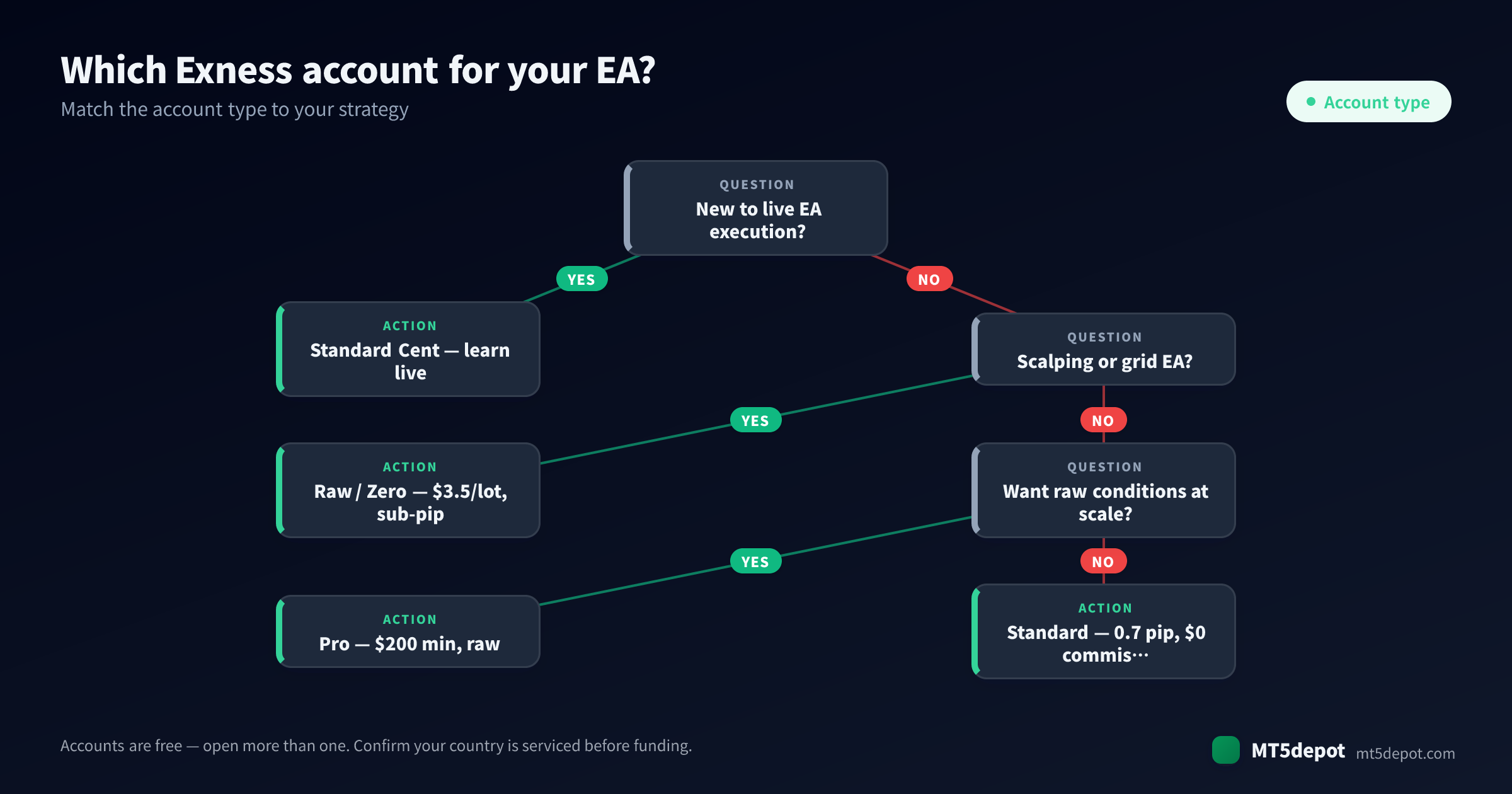
Standard Cent — learn live execution with almost nothing at risk
The Standard Cent account denominates your balance in cents, which makes it the place to run a real EA on real market data with a trivial stake. The value is not the small size itself — it is that live execution surfaces what a backtest never shows: how Exness names its symbols, how the minimum lot interacts with your EA’s risk sizing, and how fills behave around the Friday close. Run a catalogued EA on Cent for a full week, weekend included, before you scale. The getting started guide walks that demo-week routine end to end.
Raw Spread and Zero — the cost-efficient home for scalpers and grids
The Raw Spread account ($3.5/lot, sub-pip raw spread) and the Zero account are the right default for any high-frequency strategy — scalping, grids, and anything trading more than ~50 positions a month. The reason is total cost: a tight raw spread plus a transparent fixed commission is cheaper and more predictable than a wider all-in spread once trade frequency climbs. The Zero account additionally caps spread to zero on a set of major instruments for a share of the trading day, with commission applied — useful for EAs whose edge is measured in fractions of a pip.
Standard — commission-free for swing and trend systems
The Standard account charges no commission and carries the 0.7-pip typical spread on EUR/USD. For low-frequency trend and swing EAs that trade a few times a week and target large moves, that 0.7-pip spread is a rounding error against the move size, and the zero-commission simplicity is genuinely easier to reason about. At 0.7 pips it is also tight enough that some medium-frequency systems run on it perfectly well — but a true scalper still belongs on Raw.
Pro — raw conditions with a higher entry
The Pro account ($200 minimum) gives experienced users market-execution raw conditions without the per-lot commission of Raw Spread, instead building cost into a tight spread. It is the choice once a strategy has proven out on Cent and you want clean conditions at scale. Note the higher minimum deposit — $200 versus $10 on most other accounts.
Spreads and total cost: Standard vs Raw, calculated
This is the calculation most traders skip, and it decides which Exness account is cheaper for your EA. Total cost per round-turn is spread (in account currency) + commission — never spread alone.
- Standard: ~0.7 pips spread, $0 commission. On a standard lot that is roughly $7 per round-turn, all in.
- Raw Spread: sub-pip raw spread (call it ~0.1 pips, ≈ $1) plus $3.5/lot per side (≈ $7 round-turn commission) ≈ $8 per round-turn — but on the tightest, most stable raw pricing in the catalogue.
For a swing EA taking 10 trades a month the two are within a few dollars, so Standard’s simplicity wins. For a scalper, the value of Raw is not a lower headline number — it is the stability of sub-pip raw pricing during fast markets, where a Standard all-in spread widens most. Run the maths on your EA’s documented trade frequency, and remember the published backtest figures in the EA catalogue are measured on exactly this Exness retail-spread tick data — each EA profile documents its spread compatibility, so treat the numbers as a costed hypothesis your Cent-account demo week confirms.
Swap and overnight financing for EAs
Spread and commission are the costs traders calculate; swap is the one they forget. For any EA that holds positions past the daily rollover, swap — the interest debited or credited when a position is carried overnight — compounds quietly into the result, and on Wednesdays it is charged at triple rate to cover the weekend. A grid or swing system that carries baskets for days can watch an unfavourable swap erode an edge that a swap-blind backtest never showed.
Two practical points for an Exness account. First, read each instrument’s swap in the MT5 symbol specification before you deploy — it is listed per symbol, long and short, and varies enough between pairs to change which instruments a carry-sensitive EA should trade. Second, if your strategy is swap-sensitive, Exness offers swap-free conditions on a subset of instruments under specific account terms; confirm whether your instrument and account qualify rather than assuming, because the rules differ by region and symbol. For an intraday scalper that closes every position before rollover, swap is irrelevant — but know which camp your EA is in before it runs live, because the cost is invisible right up until it isn’t. Some carry-sensitive traders go further and pause a swap-heavy EA across the Wednesday triple-swap rollover, then resume once it has passed; whether that is worth the missed signals depends entirely on your strategy’s hold time.
Unlimited leverage: a tool, not a target
Exness offers unlimited leverage on Pro, Raw, and Zero accounts when account equity is below a configurable threshold, plus a 0% stop-out level that keeps positions open longer than the typical 50% stop-out. For a capital-efficient EA — the trend and grid strategies on this site — this lets a smaller account control a meaningful position. That is the upside, and it is real.
The downside is the same feature pointed the other way. Unlimited leverage does not change your risk if you size positions by risk — but it removes the margin ceiling that would otherwise stop an over-positioned EA early, and the 0% stop-out lets a losing basket run further before it is force-closed. The discipline this demands is simple to state and easy to skip: size every position as if leverage were capped at a sane multiple, and let your EA’s stop-loss — not the broker’s stop-out — be what closes a losing trade. An EA that over-positions on high leverage fails by drawdown, every time.
ECN execution: what it means when your EA fires an order
Exness runs an ECN-style execution model: orders are matched against aggregated liquidity rather than filled against an in-house desk. For an EA the property that matters is that market orders fill at available prices without the requote loop a pure market-maker can apply at candle close — important for any system that trades on signals at the bar boundary. Execution is fast enough for the vast majority of this catalogue; only a sub-second, latency-critical scalper would weigh Exness’s routing against a pure NY4-colocated venue like TitanFX, and even then the difference is invisible above the M5 timeframe.
Platforms: MT5, MT4, and instant withdrawals
Exness supports MT5 and MT4, so both modern MT5-native EAs and legacy .ex4 MT4 systems run without switching brokers. The mobile terminals monitor positions but, like every mobile app, cannot run an EA — automation needs the desktop terminal, ideally on a VPS so it runs 24/7 next to the broker’s servers rather than on a home machine that can sleep or disconnect.
The standout operational feature is instant withdrawals on most methods — bank wire, cards, e-wallets, and crypto (BTC/USDT). For a high-frequency EA this is more material than it looks: it lets you cycle profits out of the account the same day rather than waiting a business day or more, which matters if you actively de-risk a fast system week to week. For a trader compounding inside the account it is a convenience rather than a necessity, but it is a genuine edge over the 1-business-day rails at HFM.
Is Exness the right broker for your EA?
Exness is the strongest default for a cost-sensitive, active EA trader, and the case is specific: it is the venue the catalogue’s backtests are measured on, it has the tightest economics here (0.7-pip Standard, $3.5/lot Raw), it withdraws instantly, and its account range covers the full EA lifecycle from a learn-live Cent account to raw conditions at scale. For scalpers, grids, and capital-efficient trend systems, nothing in this catalogue matches its cost profile.
Where it is not the first pick: a trader who specifically wants to sit under a single top-tier regulator with retail oversight will note that the FCA entity does not service offshore clients, so HFM’s six-regulator footprint can feel reassuring in a way Exness’s offshore entity does not. A pure latency scalper will get marginally faster fills from TitanFX’s ECN. And the unlimited leverage that helps a disciplined trader is a liability for one who isn’t — if you cannot trust yourself to size by risk, the feature is a hazard, not a perk.
How Exness compares to the rest of the catalogue
Briefly, against the other catalogued brokers: Exness beats every one of them on raw spread (0.7 vs HFM’s 1.2 pips) and withdrawal speed (instant vs 1 business day), and matches HFM on carrying an FCA licence — though, as noted, that entity does not onboard offshore clients. It concedes pure-ECN latency to TitanFX and broad retail-facing regulatory reassurance to HFM, and it does not bundle a free VPS the way XM does. The full side-by-side is in our best MT5 brokers for EA trading comparison, and the criteria behind these judgements are set out in how to choose a broker for EAs.
Opening an Exness account for EA trading, step by step
- Open the account through the link on this page. Using our IB link costs you nothing extra and is how mt5depot funds this catalogue (see the transparency note below).
- Choose your account type by strategy — Standard Cent to learn, Raw Spread or Zero for scalp/grid, Standard for swing/trend, Pro for raw conditions at scale. You can open more than one.
- Download the MT5 (or MT4) desktop terminal from Exness after registration. The mobile app cannot run EAs.
- Fund the documented minimum for your EA, not your full bankroll, and run a one-week demo or Cent-account trial first.
- Set up a VPS before going live so the EA runs 24/7 next to the broker’s servers.
How mt5depot earns money
A money page should say plainly how it is funded, so: when you open an Exness account through the IB link on this page, mt5depot earns an introducing-broker (IB) commission from Exness on your trading activity. It costs you nothing extra — your spread and commission are identical to opening directly, and there is no markup added on our side.
What that commission does not buy is Exness’s standing in our analysis. It leads the catalogue on cost because its 0.7-pip Standard spread and $3.5/lot Raw commission are the tightest documented here, and because its retail-spread tick data is the venue every EA backtest on the site is measured against — not because of what it pays us. The same figures sit in Exness’s own published terms. Our incentive is to send you to a broker you stay with because it genuinely suits your EA, since an account you abandon in a month is worth nothing to either of us.
Who can open an Exness account
Exness onboards offshore clients across most regions, but by regulation it does not accept clients in the United States, Canada, the EEA, the United Kingdom (retail), or Israel. EEA and UK retail traders are routed to a regulated regional entity or declined — expected behaviour, and the offshore entity documented here is intended for non-EU/UK English-speaking traders. Confirm your country is serviced before you fund, because an EA can only ever compound the capital you were actually able to deposit.
The offshore entity you are most likely onboarded under (FSA Seychelles) carries different obligations from the FCA-regulated European arm, but it still provides segregated client money and negative balance protection on retail accounts. If you are unsure which entity applies to you, begin the registration flow and confirm the servicing entity on screen before transferring any funds — a thirty-second check that prevents a misdirected deposit.
Risks and what to confirm before you fund
Unlimited leverage and a 0% stop-out are tools, not targets — size your risk as if leverage were capped, because an EA that over-positions fails by drawdown. Before deploying, confirm three things on your specific account: that negative balance protection is active, that your country is serviced (the restricted regions are listed under who can open an account above), and that your EA’s permitted strategies match how it trades. The detailed testing process behind every figure we publish is on our methodology page.
FAQ
Is Exness good for EA / automated trading? Yes — and uniquely so for this catalogue, because every EA backtest on mt5depot is generated on Exness retail-spread tick data, so live behaviour is most likely to track published numbers. Exness allows EAs on MT5 and MT4, supports high-frequency strategies, and its Raw and Zero accounts deliver the tightest costs here.
Which Exness account is best for an EA? Standard Cent to learn live execution cheaply, Raw Spread or Zero ($3.5/lot, sub-pip) for scalping and grids, Standard (0.7 pips, commission-free) for low-frequency swing and trend systems, and Pro for raw conditions at scale. Match the account to your EA’s trade frequency.
Is Exness’s unlimited leverage safe for EAs? It is safe only if your EA sizes positions by risk rather than by available margin. Unlimited leverage and the 0% stop-out remove the early margin ceiling, so an over-positioned EA can run a losing basket further. Used with disciplined position sizing it is an efficiency tool; used carelessly it is the fastest route to a blown account.
Is Exness regulated and safe? Exness holds four licences including the UK FCA (730729) and CySEC (178/12), with segregated client funds and negative balance protection on retail accounts. Offshore clients are onboarded under the FSA Seychelles entity rather than the FCA entity, which does not service EEA/UK retail.
Does Exness offer a free VPS? A free VPS is not Exness’s headline EA perk — its strengths are economics and instant withdrawals. For bundled free hosting, XM is the catalogue option. A VPS is mandatory for live EA trading regardless of broker; see our VPS guide.
Next steps
If Exness fits your EA, open the account by strategy — Cent to learn, Raw to scale — and start with a demo or Cent-account week before funding live. From there, browse the EA catalogue for a system matched to your risk tolerance, set up a VPS, and compare Exness against the full field in the best MT5 brokers for EA trading guide. The traders who last are the ones who verified on a small account first.
EA compatibility
30 EAs verified on Exness
| EA | Strategy | Pair | Typical spread | Min lot | |
|---|---|---|---|---|---|
| Almanac | Composite | USD/JPY | — | — | View → |
| Antipode | Mean Reversion | EUR/AUD | — | — | View → |
| Ballast | Mean Reversion | EUR/GBP | — | — | View → |
| Beacon | Mean Reversion | AUD/CAD | — | — | View → |
| Cairn | Composite | EUR/USD | — | — | View → |
| Chronograph | Composite | CHFJPY_DUKA | — | — | View → |
| Chrysalis | Mean Reversion | GBP/JPY | — | — | View → |
| Cloudbank | Trend | USD/JPY | — | — | View → |
| Gyre | Mean Reversion | AUD/CAD | — | — | View → |
| Iridescence | Composite | EUR/USD | — | — | View → |
| Lanternfish | Mean Reversion | USD/JPY | — | — | View → |
| Lattice Weave | Mean Reversion | GBP/AUD | — | — | View → |
| Metronome | Mean Reversion | JP225 | — | — | View → |
| Murmuration | Composite | AUD/USD | — | — | View → |
| Nautical | Composite | EUR/JPY | — | — | View → |
| Orrery | Trend | JP225 | — | — | View → |
| Peregrine | Trend | BTCUSD | — | — | View → |
| Ricochet | Mean Reversion | EUR/USD | — | — | View → |
| Saltpan | Composite | USD/JPY | — | — | View → |
| Serac | Mean Reversion | NZD/USD | — | — | View → |
| Stillwater | Composite | USD/JPY | — | — | View → |
| Sundial | Trend | EUR/JPY | — | — | View → |
| Tessera | Trend | USD/JPY | — | — | View → |
| Thunderhead | Composite | EUR/GBP | — | — | View → |
| Tolling | Composite | GBPJPY_DUKA | — | — | View → |
| Tradewind | Composite | USD/JPY | — | — | View → |
| Windrose | Mean Reversion | AUD/CAD | — | — | View → |
| Zerqon | Trend | US30 | — | — | View → |
| Kestrel Hover | Trend | USD/JPY | — | — | View → |
| Tidewell Slack | Mean Reversion | GBP/JPY | — | — | View → |
Eligibility
Restricted jurisdictions
Exness does not accept clients resident in the following jurisdictions. mt5depot reflects this restriction on its IB referral.
- United States
- Canada
- EEA
- United Kingdom (retail)
- Israel
Risk disclosure
Trading leveraged forex and CFDs carries a high level of risk and may not be suitable for all investors. The high degree of leverage offered by Exness can work against you as well as for you. Before deciding to trade through Exness you should carefully consider your investment objectives, level of experience, and risk appetite, and seek independent financial advice if necessary.
mt5depot does not give investment advice and does not represent Exness. The IB referral on this page generates a commission for mt5depot when you open an account and trade. Spreads, fees, and execution are determined by Exness and not by mt5depot.