Composite USD/JPY Conservative
Almanac
- PF
- 1.52
- Max balance DD
- -3.7%
At a glance
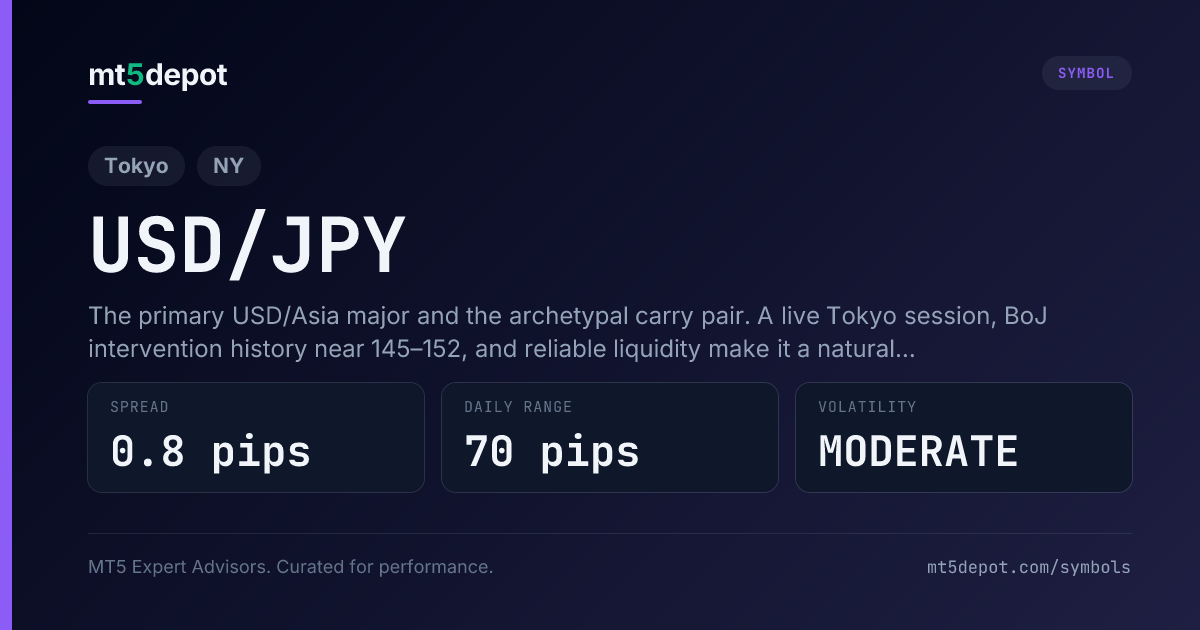
The primary USD/Asia major and the archetypal carry pair. A live Tokyo session, BoJ intervention history near 145–152, and reliable liquidity make it a natural surface for trend, carry and news EAs — but the intervention tail can reverse a long by hundreds of pips in minutes.
Typical values — USD/JPY is not yet measured broker-by-broker; confirm the live spread on your own account.
Data
Session windows, broker spreads, and cost math for this symbol — measured and typical values, not marketing.
Live market
Live market data isn't available right now.
Indicative, delayed prices for context only — not a trading feed or an execution quote.
EA catalogue


Analysis
USD/JPY — universally nicknamed “Gopher” in the dealing room — is the primary USD/Asia major and the pair most retail carry strategies are built on. The first thing to decide is whether your strategy wants its character or merely tolerates it: a live Tokyo session and a positive-carry tilt are an edge for trend and carry EAs, while the Bank of Japan’s intervention history is a tail risk that a system ported from EUR/USD never has to price. Pick the pair to the strategy, not the other way round.
This page covers what USD/JPY gives an automated strategy that EUR/USD does not, the sessions that decide its results, what it costs, the failure modes that catch systems moved over from European majors, and how to build and test a USD/JPY EA when there is no off-the-shelf one to copy.
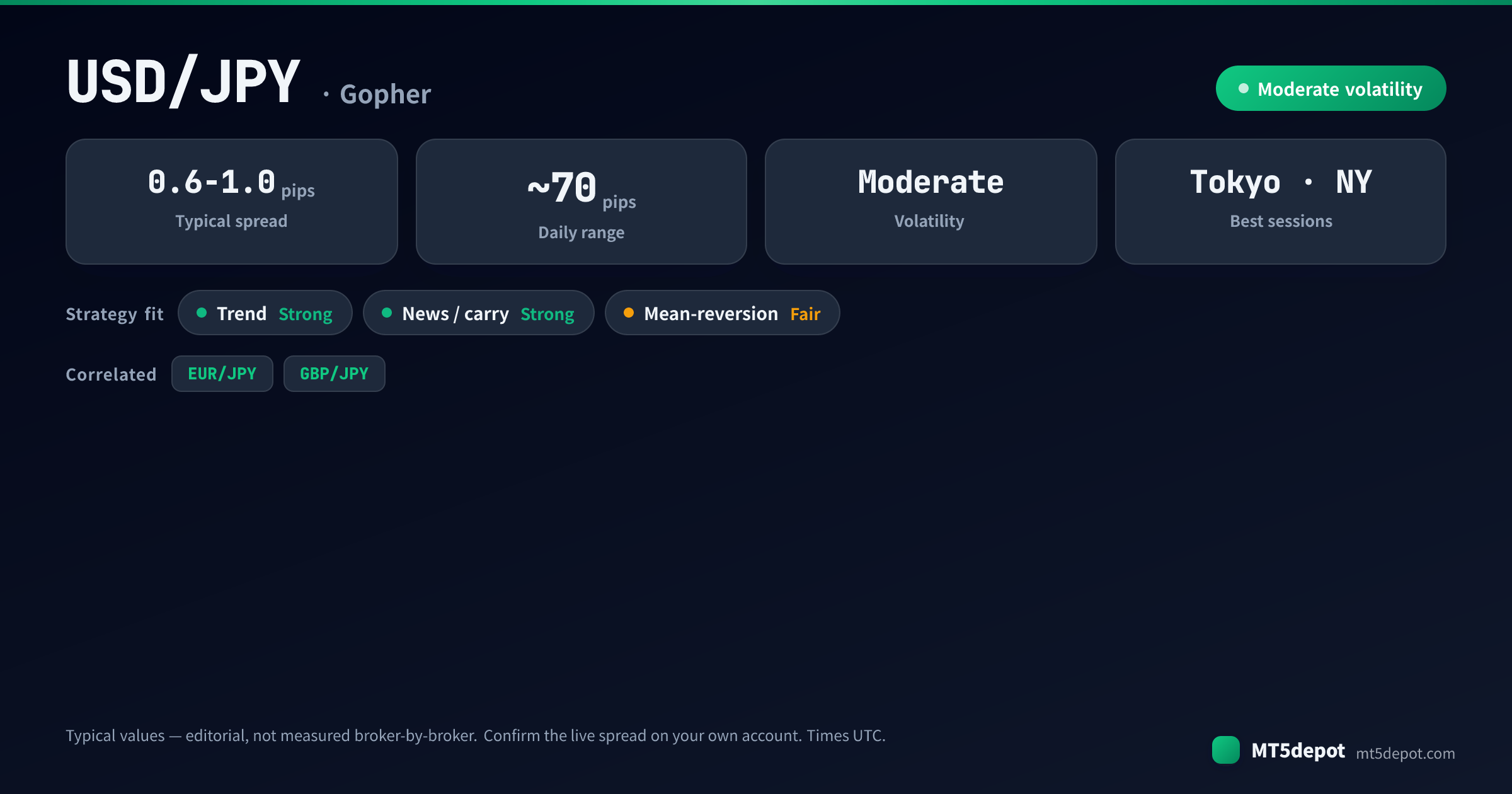
USD/JPY trades a large share of global forex volume and is structurally different from the European majors in one respect that matters for automation: it has an active home session. The Tokyo hours produce genuine USD/JPY range, where EUR/USD and GBP/USD mostly drift, so a 24-hour EA reads real signal overnight here rather than noise.
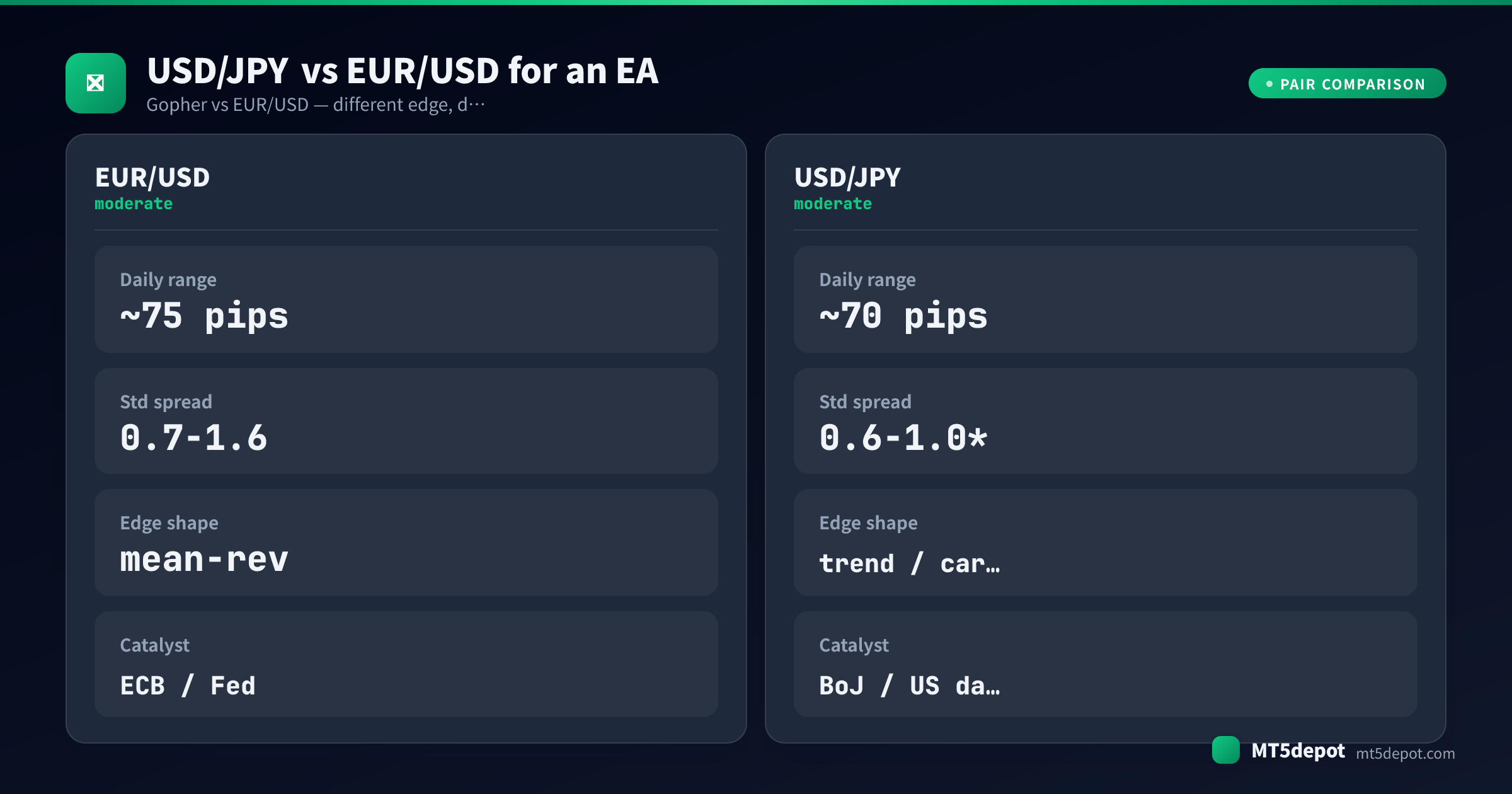
For an EA, that character reduces to three properties:
The trap for automated strategies is that the carry which looks like a smooth edge on a backtest is the same carry that unwinds violently in a risk-off event — and the backtest rarely spans one. Gopher rewards systems that respect its volatility regime and quietly drains ones that assume the trend and the swap will always be there.
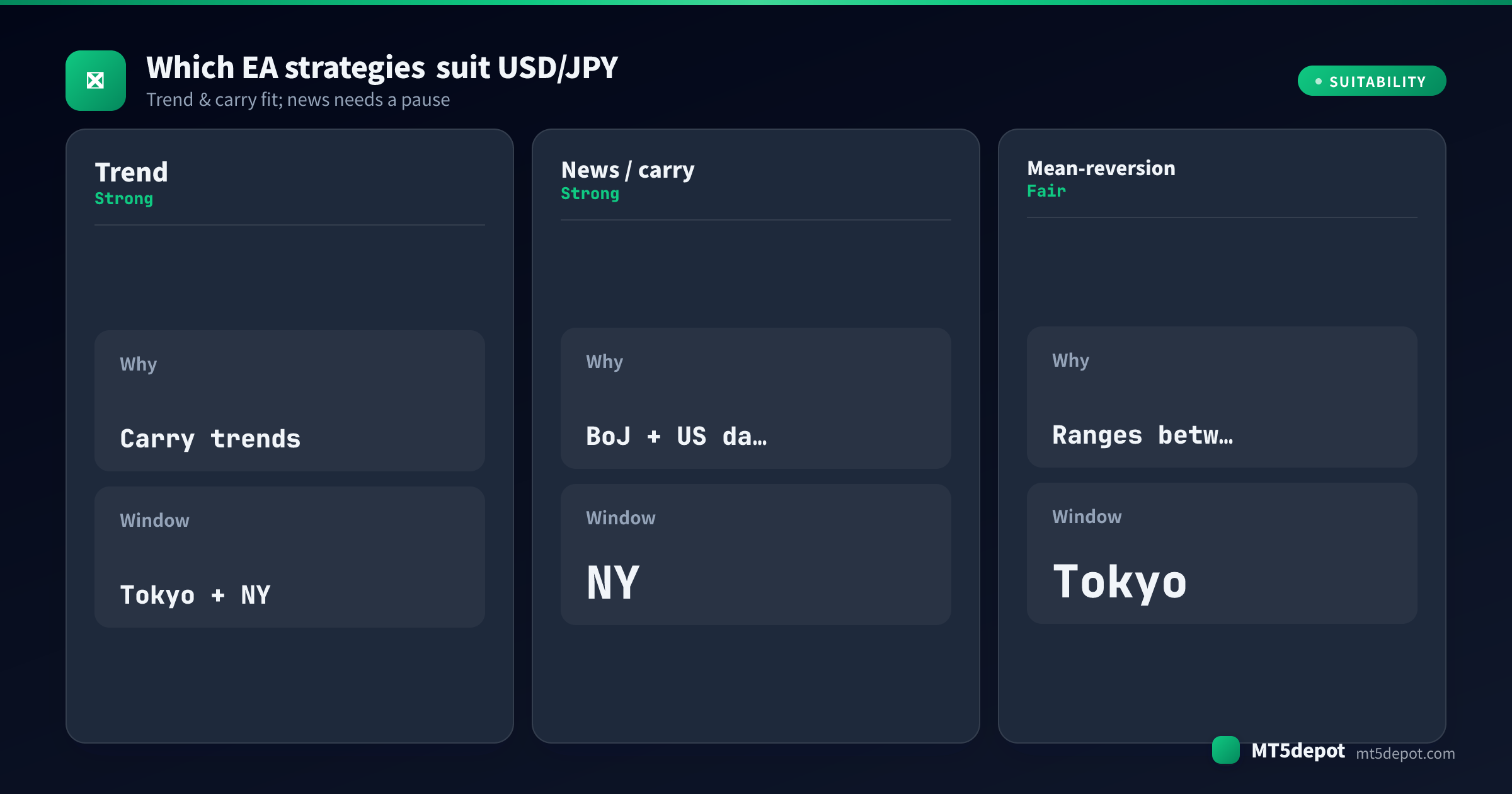
The pair’s profile lists trend, news, and mean-reversion as suitable — but suitability is an editorial assessment, not proof. In a like-for-like template baseline (one year, default inputs, no optimisation), most strategy templates finish below a 1.0 profit factor on the majors; the ones that clear it usually earn it through mechanics — session windows, event pauses — not the indicator on the box. What USD/JPY’s character tends to support:
| Strategy | Fit on USD/JPY | Why |
|---|---|---|
| Trend / carry | Strong | The carry tilt and multi-week directional moves suit momentum systems; a positive swap can pay you to hold the trend. |
| News | Strong (with a pause) | BoJ and US releases move Gopher hard. A news-aware EA can trade the follow-through, but it needs an event pause or the spread and the gap eat the entry. |
| Mean-reversion | Fair | Between catalysts USD/JPY ranges cleanly, but the BoJ tail and carry-unwind risk mean a reversion system must cap exposure and respect the event calendar. |
Trend and carry are the shapes that turn USD/JPY’s structure into an asset; the rest have to fight the tail. Because there is no USD/JPY-specific catalogue EA yet, the practical route is to build one of these shapes yourself — the Builder ships templates that accept USD/JPY and exposes every parameter — and then test it (below) before you trust a single number.
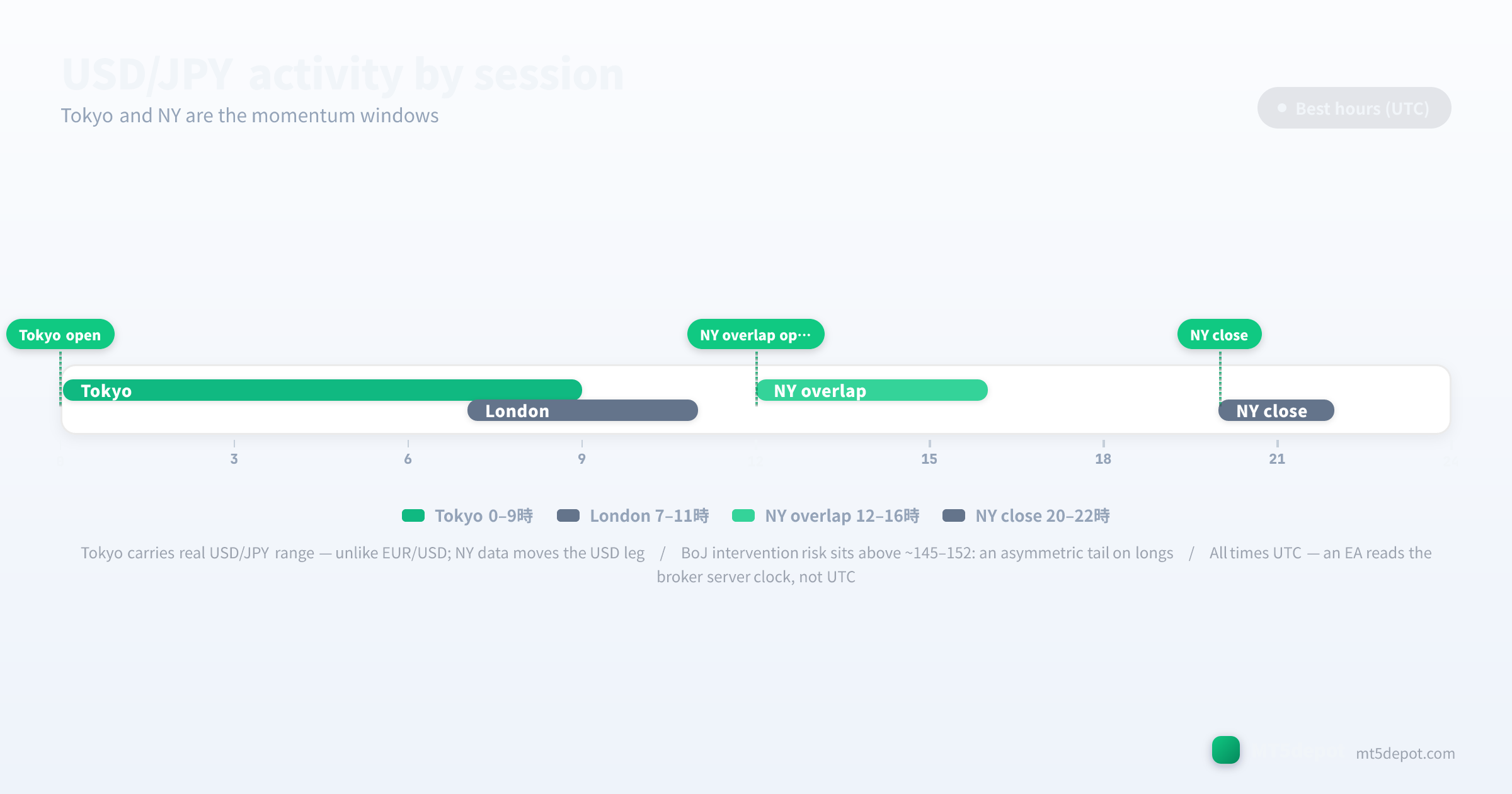
Session structure decides more of a Gopher result than indicator choice does:
EAs that restrict trading to the Tokyo-and-NY windows often out-perform 24-hour variants on USD/JPY, in our editorial assessment, so a session filter here is best treated as part of the strategy definition rather than an optimisation flourish. Two cautions come with it. Scheduled BoJ and US events sit inside those good windows and widen spreads exactly then, so a fast strategy needs a news pause or it pays several times the normal spread at the worst moment. And every clock time above is UTC — an EA reads your broker’s server clock, which is usually not UTC, so a “00:00” Tokyo filter shifts silently when you move the EA between brokers on different server timezones. This is the one clock rule for the whole page; verify it once, in MT5’s Market Watch, and every session boundary lines up.
USD/JPY is one of the cheapest majors to trade. The figures below are editorial reference ranges compiled from broker-published standard and raw conditions (updated July 2026), not broker-by-broker measured numbers — our live spread sampling currently covers EUR/USD and a few reference symbols, so confirm the live spread on your own account before you size a fast strategy:
| Account type | Typical USD/JPY spread | Commission | Who it suits |
|---|---|---|---|
| Standard | 0.6 – 1.0 pips | none | swing / trend / carry EAs |
| Raw / ECN | sub-pip (≈0.1 – 0.3) | $3 – 7 / lot | scalping / high-frequency EAs |
Two cost rules specific to this pair:
USD/JPY’s failure modes are specific enough that a generic risk checklist misses them:
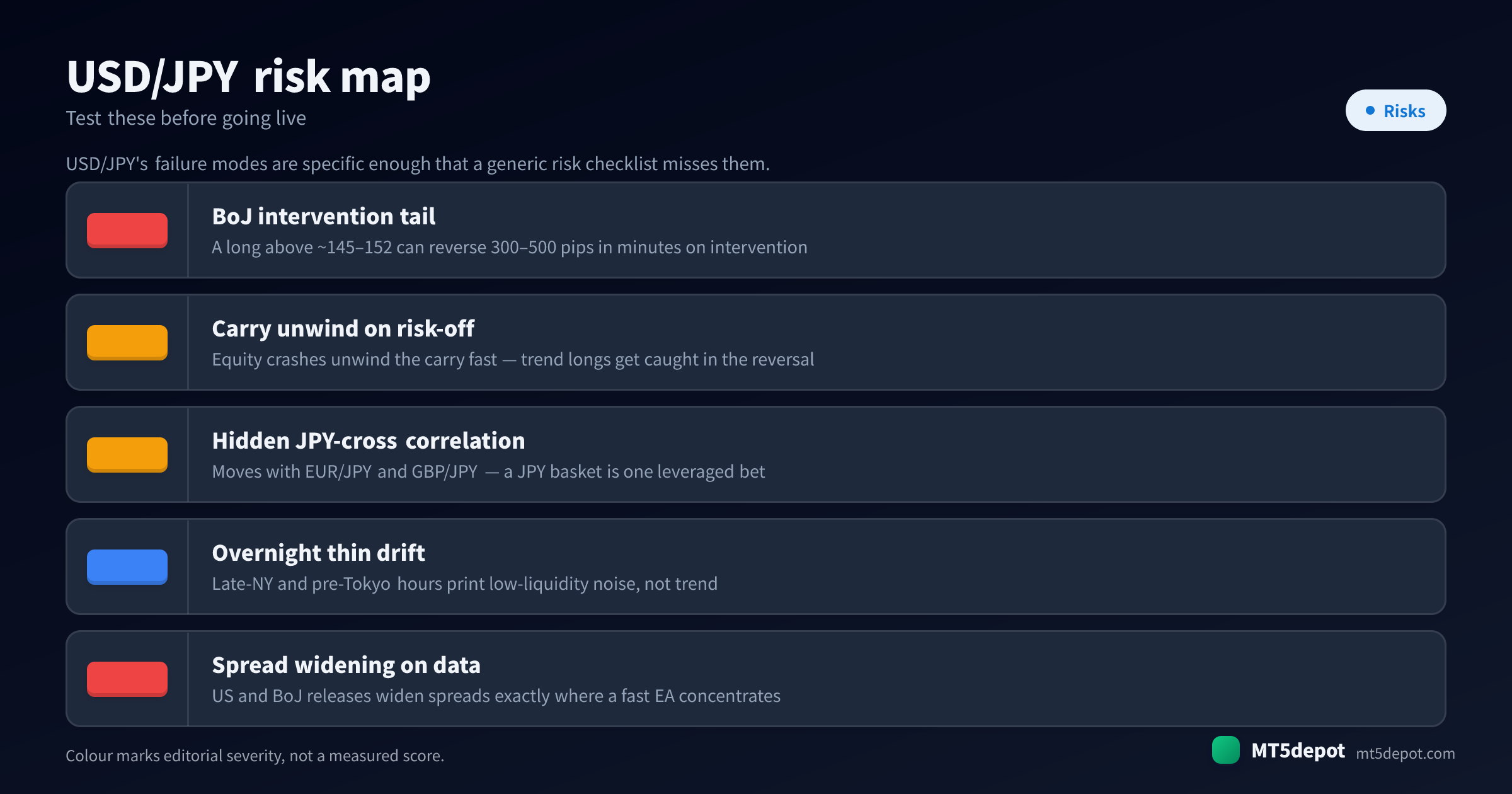
Because there is no catalogue EA to lean on for this pair, the test is the whole edge. Hold anything you build to the same bar our catalogue EAs publish under the site’s methodology:
Every backtest number this produces is a historical measurement, not a forecast — say so in your own notes, and size for the drawdown you measured rather than the return you hope for.
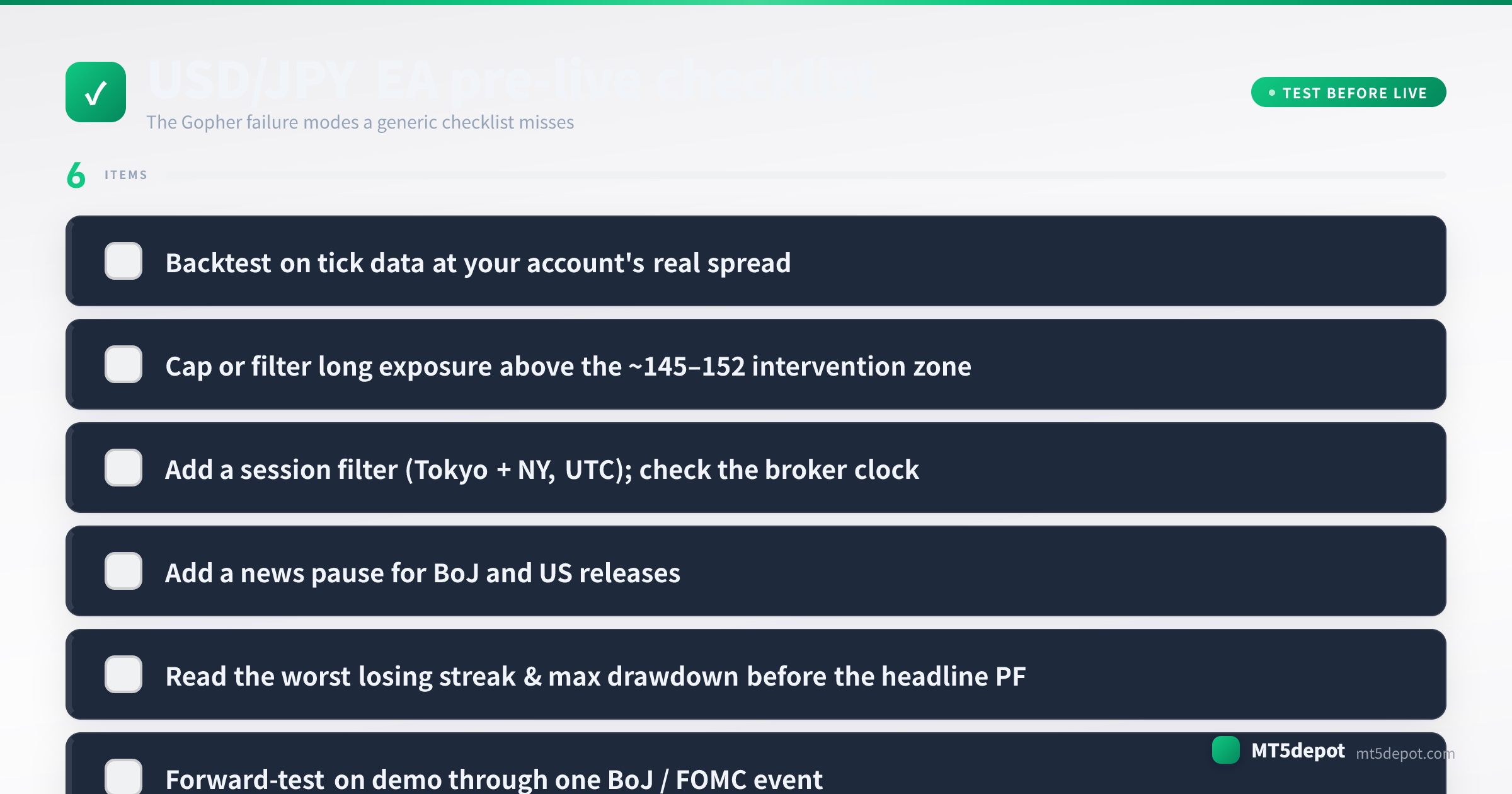
No dedicated USD/JPY EA is currently listed in our catalogue. Rather than point you at a generic recommendation, the honest route to a Gopher EA is to build and verify one:
Glossary