At a glance
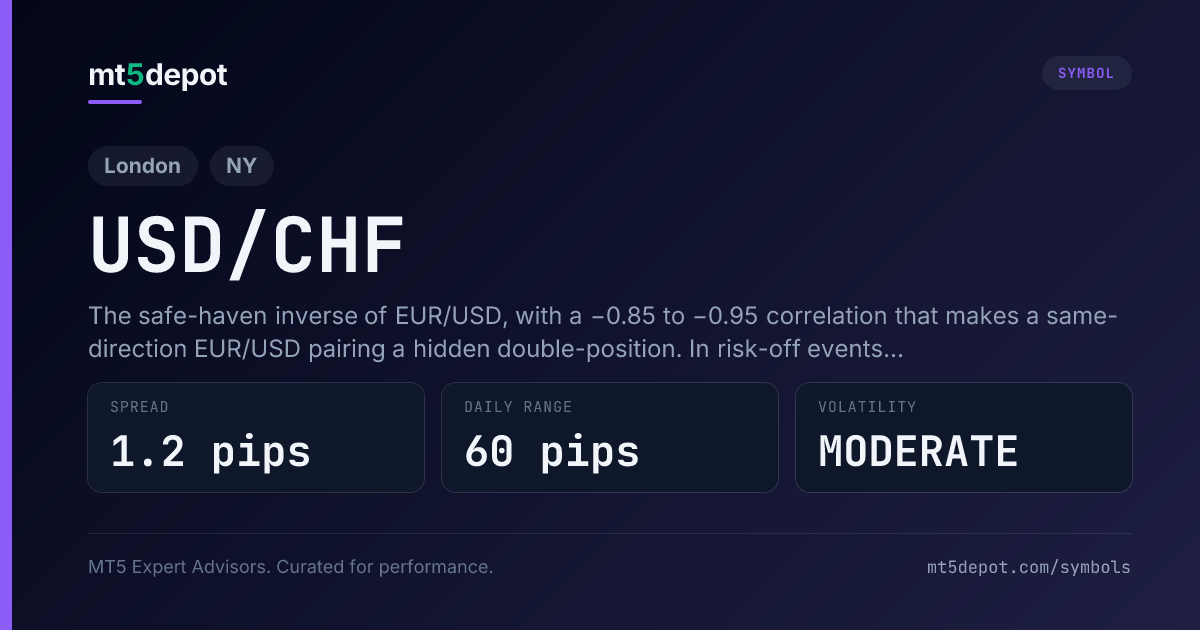
USD/CHF · Swissie
The safe-haven inverse of EUR/USD, with a −0.85 to −0.95 correlation that makes a same-direction EUR/USD pairing a hidden double-position. In risk-off events CHF demand drives sharp drops even when the dollar is strong; in calm markets it oscillates in tight mean-reverting channels.
Typical values — USD/CHF is not yet measured broker-by-broker; confirm the live spread on your own account.
Data
Trading conditions
Session windows, broker spreads, and cost math for this symbol — measured and typical values, not marketing.
EA catalogue
EAs for USD/CHF
Why this list is empty
Our catalogue lists no USD/CHF EA right now. An EA is listed only after it passes our tick-data backtest gate — and the numbers are published either way. Until then, build and test your own below.
- Listing is gated, not editorial — an EA reaches this page only after it passes our tick-data backtest gate.
- The numbers are published either way, including the EAs that failed the gate and were delisted.
- You can build your own USD/CHF EA and backtest it on this symbol before anything goes live.
Analysis
USD/CHF: the full analysis
USD/CHF — the “Swissie” — is best understood not as a standalone major but as the safe-haven inverse of EUR/USD. It runs a −0.85 to −0.95 correlation, which means most of its chart is the euro’s mirror image. The first thing to decide is whether your strategy wants that character or merely tolerates it. A mean-reversion system feeds on the pair’s tight calm-market channels. A trend or basket EA ported from EUR/USD can find itself holding what is really a doubled euro bet without ever setting it up on purpose. Pick the pair to the strategy, not the other way round.
This page covers what USD/CHF gives an automated strategy that EUR/USD does not, the sessions that decide its results, and what it costs. It then covers the failure modes that catch systems moved over from the dollar majors, and how to build and test a USD/CHF EA when there is no off-the-shelf one to copy.
How USD/CHF Behaves: What Swissie Gives an EA
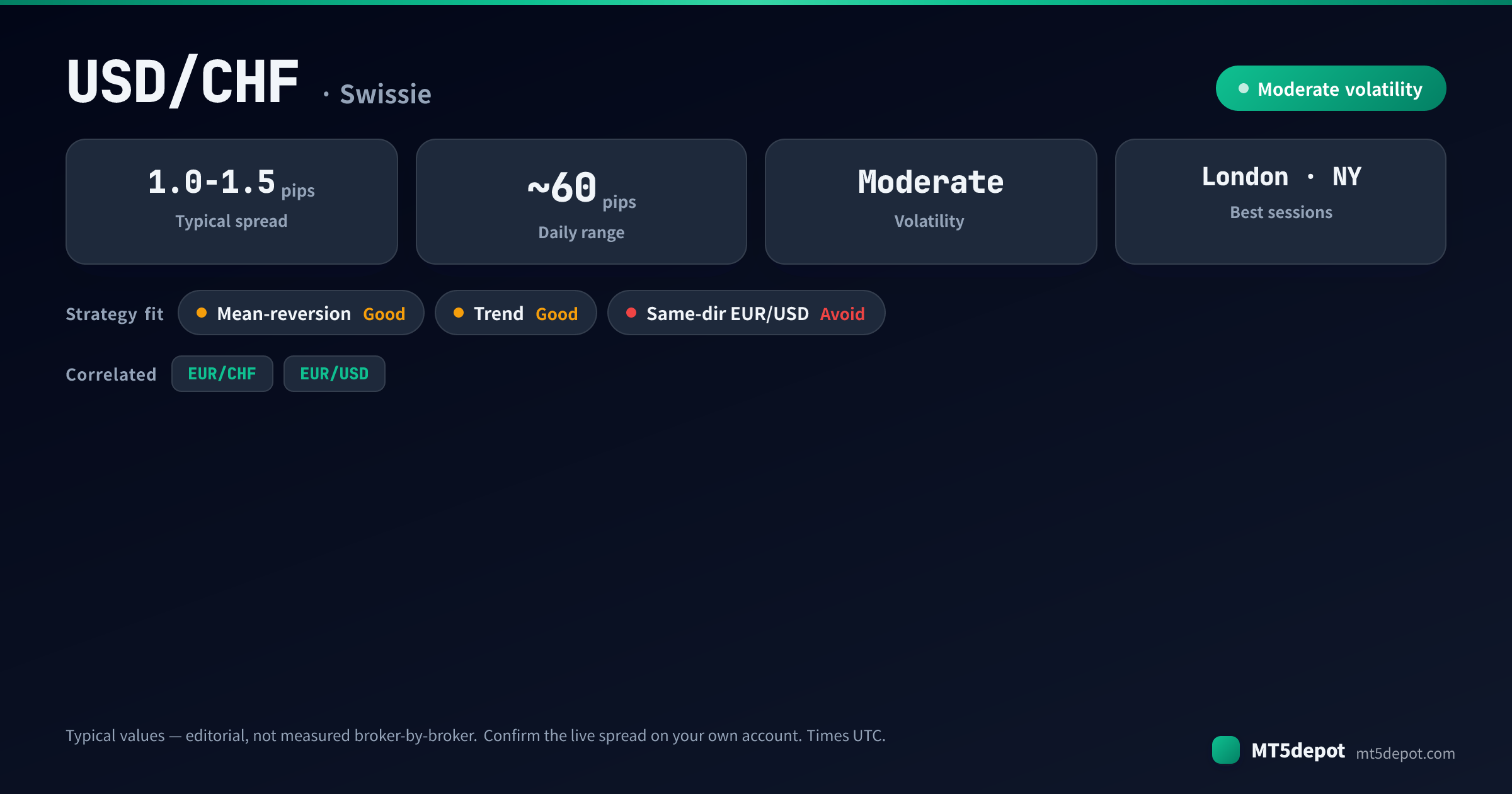
USD/CHF trades a meaningful share of global forex volume, but its defining feature for an automated strategy is not its own behaviour. It is its relationship to two other things: EUR/USD and the market’s appetite for risk. That relationship reduces to three properties an EA has to price.
- A near-mirror of EUR/USD. The −0.85 to −0.95 correlation (a commonly-cited rolling-30-day band, stated as typical rather than measured) means USD/CHF and EUR/USD move in opposite directions most of the time. For an EA this is the single most important fact on the page, because it silently links any USD/CHF position to whatever the account already holds on the euro.
- A safe-haven quote currency. The Swiss franc is itself a haven, so in risk-off events CHF demand can drive USD/CHF down even when the dollar is strengthening against everything else. That decouples the pair from a pure dollar thesis at exactly the moments an EA concentrates its risk, and it is the property a EUR/USD-shaped system never has to model.
- Tight calm-market channels. In quiet regimes USD/CHF’s ~60-pip typical daily range (labelled typical, not measured broker-by-broker) oscillates in cleaner, narrower channels than most majors, which is why mean-reversion shapes tend to fit it. That calm is real edge — right up until a regime flip converts the channel into a trend.
The trap for automated strategies is that these three properties interact. The calm channel that a reversion EA fades is broken by the same safe-haven flow that decouples the pair from the dollar, and both are amplified whenever the account is also carrying a correlated EUR/USD position. The Swissie rewards systems that respect its volatility regime and its correlation, and quietly drains ones that treat it as an independent dollar major.
Which EA Strategies Suit USD/CHF?
The pair’s profile lists trend and mean-reversion as suitable — but suitability is an editorial assessment, not proof. In a like-for-like template baseline (one year, default inputs, no optimisation), most strategy templates finish below a 1.0 profit factor on the majors. The ones that clear it usually earn it through mechanics — session windows, correlation limits, event pauses — not the indicator on the box. What USD/CHF’s character tends to support:
| Strategy | Fit on USD/CHF | Why |
|---|---|---|
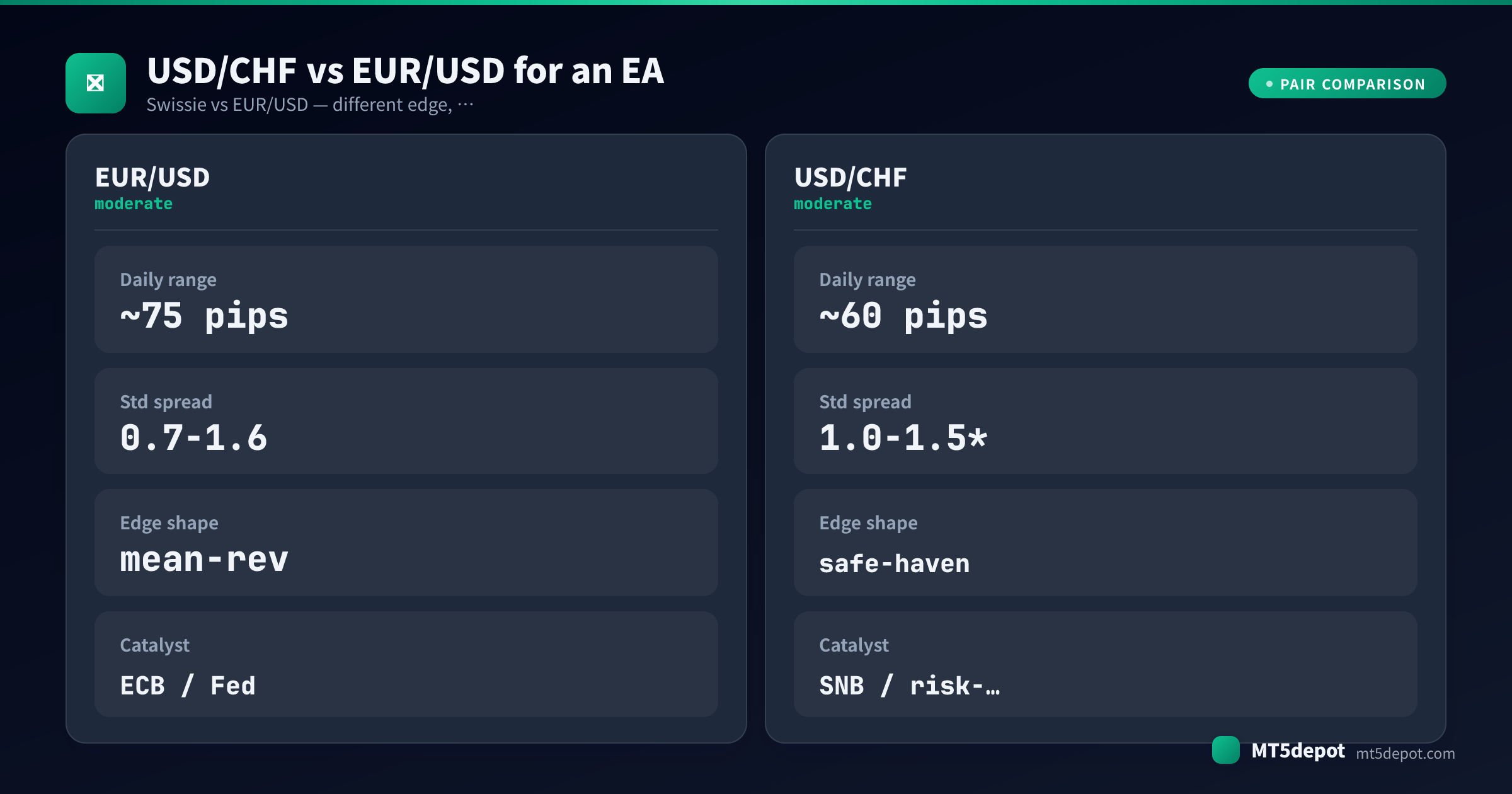
| Mean-reversion | Good | The tight calm-market channels give a reversion system a clean range to fade. That holds only if it caps exposure and pauses through risk-off breaks that turn the channel into a trend. |
| Trend (CHF-led) | Good | SNB-driven and safe-haven moves in the CHF leg produce directional runs that momentum systems can ride, especially in the London window where that flow concentrates. |
| Same-direction EUR/USD | Avoid | A USD/CHF position held in the same direction as a EUR/USD long is roughly one doubled euro bet, not a diversified book. The −0.9 correlation removes the hedge you think you have. |
Mean-reversion in the calm and CHF-led trend in the moves are the shapes that turn USD/CHF’s structure into an asset. Anything run alongside a correlated euro position has to fight the hidden leverage instead. Because there is no USD/CHF-specific catalogue EA yet, the practical route is to build one of these shapes yourself. The Builder ships templates that accept USD/CHF and exposes every parameter. Test it (below) before you trust a single number.
Best Trading Hours for USD/CHF EAs
Session structure decides more of a Swissie result than indicator choice does:
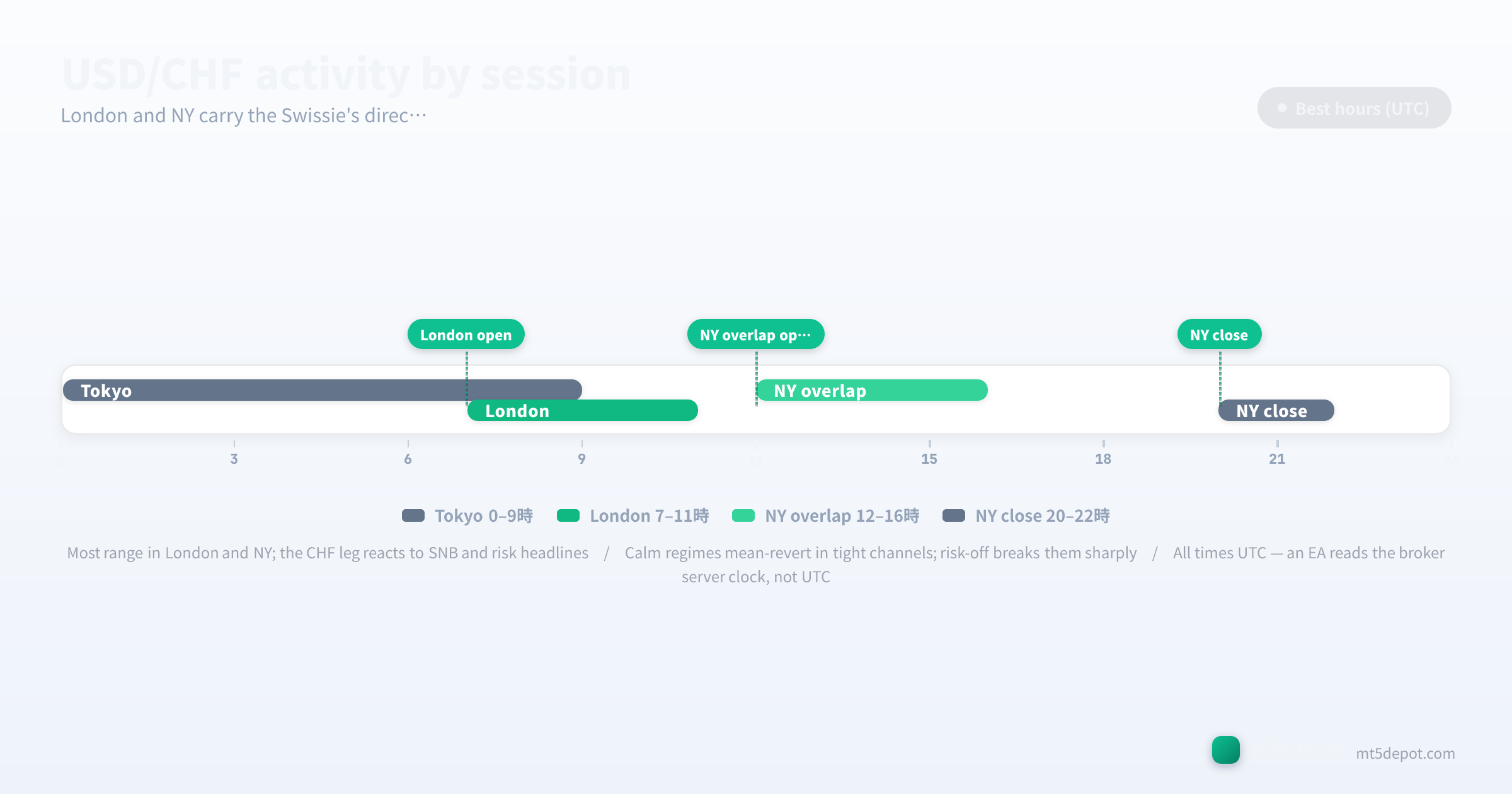
- Tokyo session (00:00–09:00 UTC): thin liquidity and low-conviction drift for USD/CHF. Neither the CHF leg nor the USD leg has its home catalysts here, so signals read in these hours are more likely to be noise than trend.
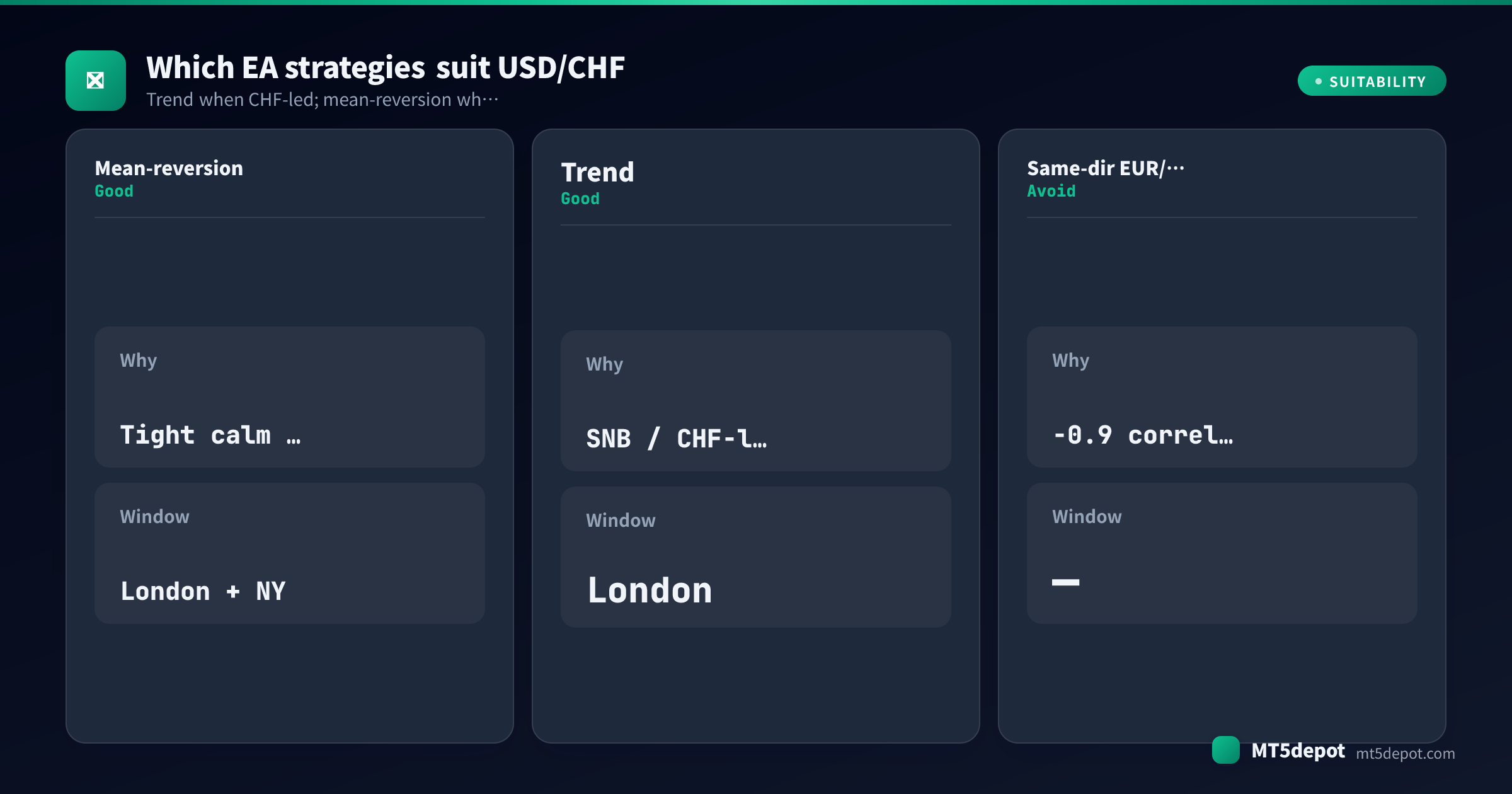
- London hours (07:00–16:00 UTC): the primary directional window. The CHF leg reacts to SNB commentary and European risk headlines here, and this is where a trend or reversion EA on USD/CHF tends to earn most of its result.
- NY overlap (12:00–16:00 UTC): the secondary momentum window. US data releases drive the dollar leg, giving USD/CHF a second daily surge that stacks on the London flow during the overlap.
- Late NY / pre-Tokyo (20:00–24:00 UTC): range contraction and false breakouts; session-quality filters should usually exclude these hours.
EAs that restrict trading to the London-and-NY windows often out-perform 24-hour variants on USD/CHF, in our editorial assessment. A session filter here is best treated as part of the strategy definition rather than an optimisation flourish. Two cautions come with it. Scheduled SNB, ECB and US events sit inside those good windows and widen spreads exactly then. A fast strategy needs a news pause, or it pays several times the normal spread at the worst moment. And every clock time above is UTC. An EA reads your broker’s server clock, which is usually not UTC, so a “07:00” London filter shifts silently when you move the EA between brokers on different server timezones. This is the one clock rule for the whole page. Verify it once in MT5’s Market Watch, and every session boundary lines up.
Spreads, Costs, and Execution
USD/CHF is a little more expensive to trade than EUR/USD. The figures below are editorial reference ranges compiled from broker-published standard and raw conditions (updated July 2026), not broker-by-broker measured numbers; our live spread sampling currently covers EUR/USD and a few reference symbols. Confirm the live spread on your own account before you size a fast strategy:
| Account type | Typical USD/CHF spread | Commission | Who it suits |
|---|---|---|---|
| Standard | 1.0 – 1.5 pips | none | swing / low-frequency trend and reversion EAs |
| Raw / ECN | sub-pip (≈0.2 – 0.5) | $3 – 7 / lot | scalping / high-frequency EAs |
Two cost rules specific to this pair:
- Budget wider than EUR/USD, and confirm on your own account. The tightest EUR/USD standard spread in our broker catalogue is around 0.7 pips; the Swissie’s standard spread typically runs wider, in the 1.0–1.5 range above. That extra width is a rounding error for a swing EA and a recurring tax for a high-frequency one. Fast USD/CHF systems therefore belong on raw-type accounts where the spread compresses to a known number.
- The commission is an account property, not a pair property. The same $3–7/lot raw commission applies whether you trade EUR/USD or USD/CHF; what changes between pairs is the spread on top of it. The overnight swap is likewise account- and rate-dependent. Backtest it with realistic values rather than the platform default, because a reversion or carry-sensitive USD/CHF strategy validated on zero swap is not the one you will run.
Risks to Test Before Going Live
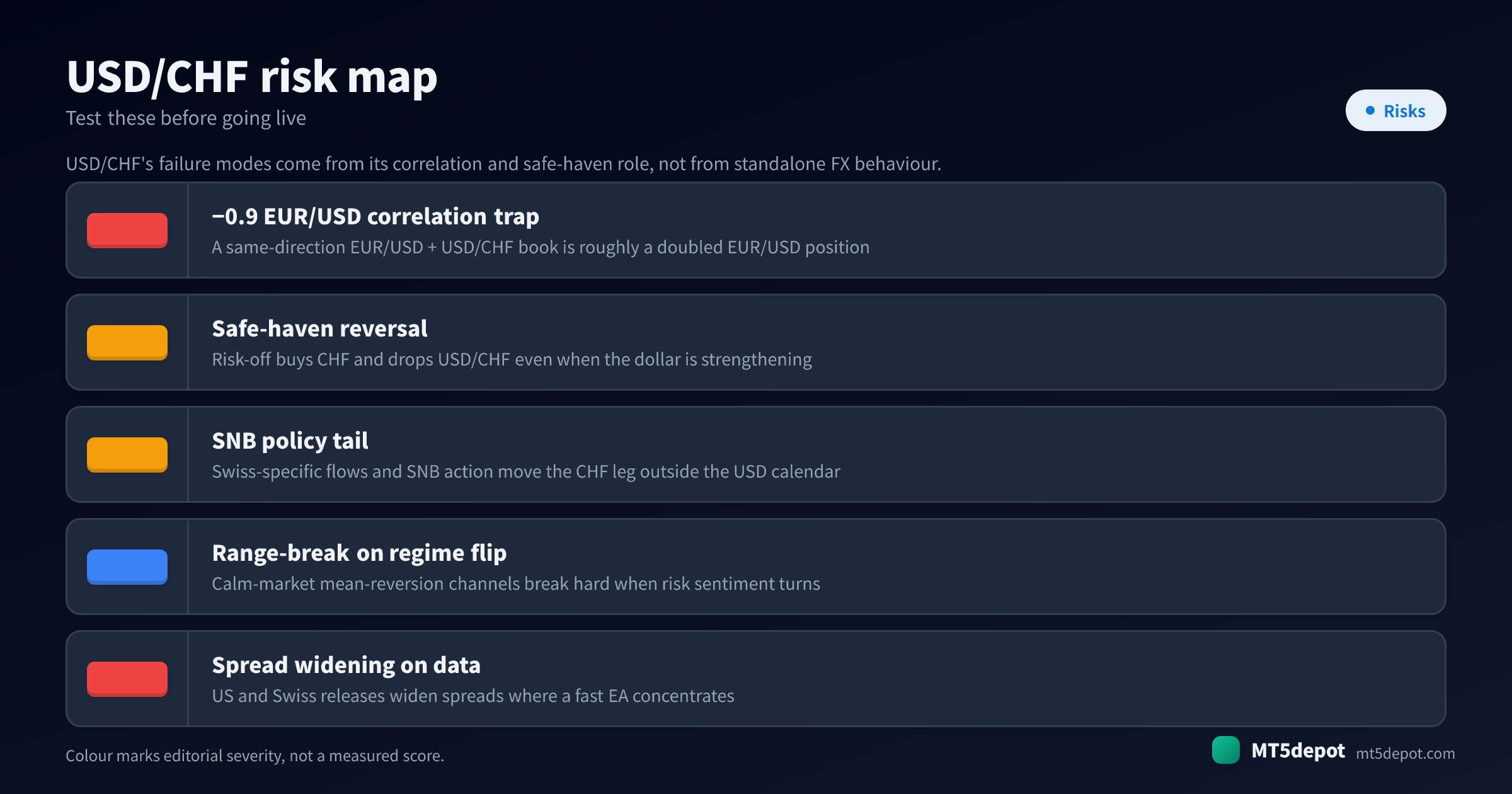
USD/CHF’s failure modes come from its correlation and safe-haven role, not from standalone FX behaviour — specific enough that a generic risk checklist misses them:
- The −0.9 EUR/USD correlation is hidden leverage. A same-direction EUR/USD + USD/CHF book is roughly a doubled EUR/USD position, not a hedge. Two “diversified” EAs across those pairs stack your exposure without appearing in either EA’s risk settings — the single most common way a USD/CHF EA quietly over-leverages an account.
- Safe-haven reversal decouples the pair from the dollar. Risk-off buys CHF and drops USD/CHF even when the dollar is strengthening. A trend EA reading only the dollar side gets caught buying into a franc-led fall, so a volatility or risk filter is not optional here.
- The SNB policy tail sits outside the USD calendar. Swiss-specific flows and Swiss National Bank action move the CHF leg on a schedule an EA tuned to US events does not watch. A system with no awareness of Swiss catalysts can be blindsided by a move its dollar-only model cannot explain.
- Calm-market channels break on a regime flip. The tight mean-reverting range that a reversion EA fades holds only while sentiment is calm. When risk turns it breaks hard, and a reversion system with no regime filter keeps fading a move that has become a trend.
- US and Swiss data widen spreads where a fast EA concentrates. Both legs have scheduled releases that gap prices and widen spreads inside the London and NY windows. Fast strategies need a news pause; slower ones need stops that survive a large event gap.
How to Test a USD/CHF EA
Because there is no catalogue EA to lean on for this pair, the test is the whole edge. Hold anything you build to the same bar our catalogue EAs publish under the site’s methodology:
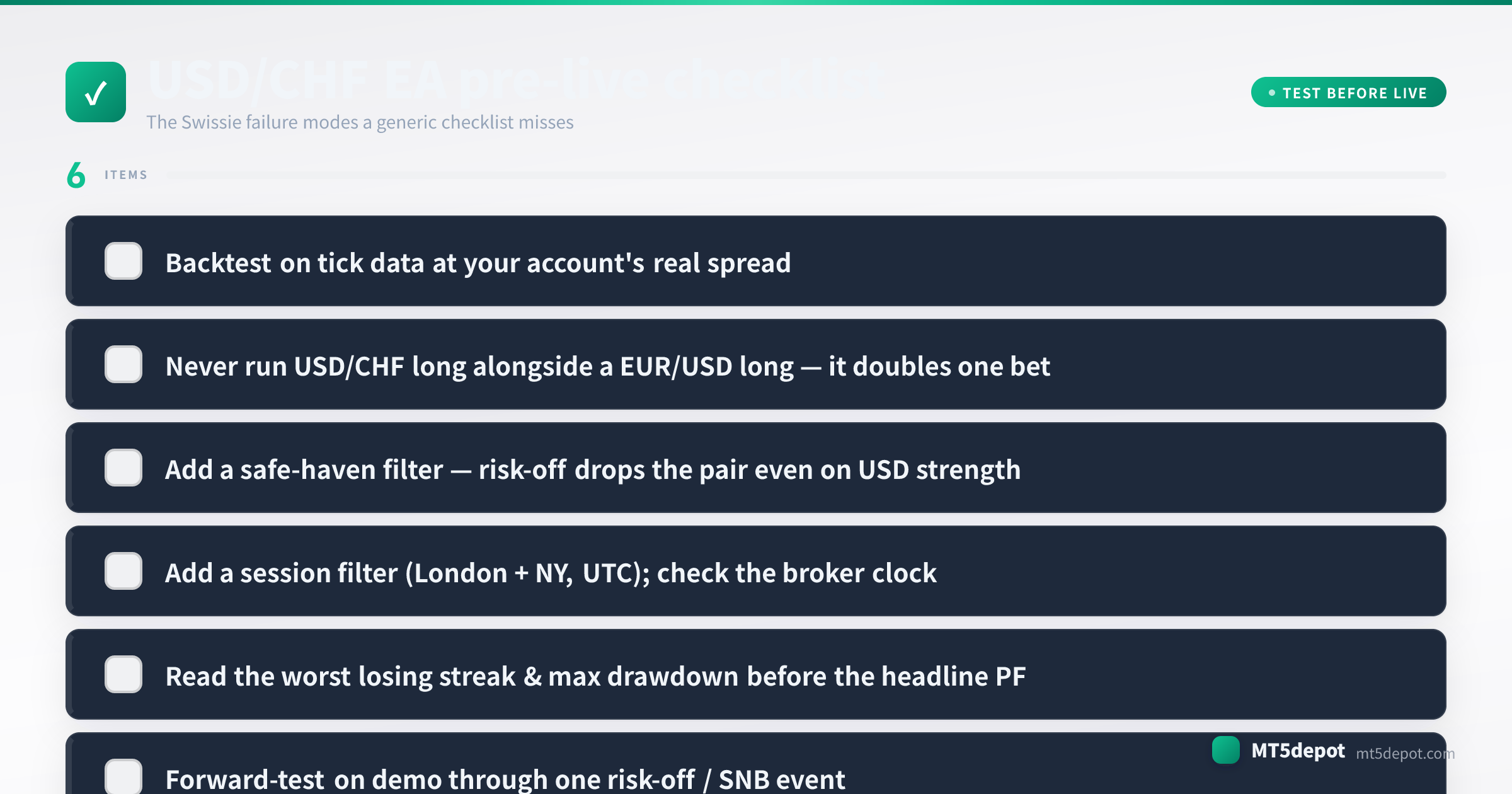
- Backtest on tick data at your account’s real spread and swap. Use an every-tick model with the standard-or-raw spread you will actually trade, not the platform default. A strategy validated at a spread it will never see is a fiction — this is where the typical-vs-measured gap above becomes real money.
- Test the correlation, not just the pair. Run USD/CHF against the EUR/USD position your account already holds, so the backtest measures the combined exposure rather than pretending the two are independent. This is the check that most often reveals a “diversified” book is one doubled bet.
- Read the worst losing streak, not the headline profit factor. The max drawdown and the longest run of losing trades tell you the capital and the patience the strategy demands. Budget for the worst streak before you fund it.
- Forward-test on demo through at least one risk-off or SNB event. The Swissie’s defining risk only shows up around a safe-haven flight or a Swiss policy move, so a demo window that never spans one has not tested the thing that matters most.
- Confirm the server clock before the first live trade. Re-check MT5’s Market Watch time against the UTC session hours above, and re-check it again after any broker migration — a step that is easy to skip and expensive to miss.
Every backtest number this produces is a historical measurement, not a forecast — say so in your own notes, and size for the drawdown you measured rather than the return you hope for.
USD/CHF EAs and Builder Templates
No dedicated USD/CHF EA is currently listed in our catalogue. Rather than point you at a generic recommendation, the honest route to a Swissie EA is to build and verify one.
- The Builder (open it here) accepts USD/CHF in its trend, mean-reversion and multi-symbol templates. The EA you deploy is built on your own numbers, and — importantly — you can set the correlation limits this pair demands. The CTA below covers exactly what it produces.
- Related-pair reference. EUR/USD is the pair USD/CHF mirrors, and EUR/CHF shares its CHF leg without the dollar inversion. Studying how a strategy behaves across all three is the fastest way to see the correlation trap before it costs you. Our broker catalogue is where you confirm the real spread each will trade at.
- The concept canonicals. If a term above is unfamiliar, the spread, swap and volatility entries define the mechanics a USD/CHF EA depends on.
Frequently asked questions
- Is USD/CHF just the inverse of EUR/USD?
- Close, but not identical. USD/CHF's correlation to EUR/USD is typically −0.85 to −0.95 (a commonly-cited rolling-30-day band, stated as typical rather than measured), so most of its moves are a mirror of the euro's. The practical warning is that a EUR/USD long and a USD/CHF long in the same account are not a hedge — they are roughly one doubled EUR/USD bet. The residual −5% to −15% of movement comes from Swiss-specific flow, which is exactly the part a same-direction pairing hides.
- Why does USD/CHF fall when the US dollar is strong?
- Because the Swiss franc is itself a safe-haven currency, and in a risk-off event demand for CHF can outrun demand for USD. When equities sell off, capital rotates into the franc, which pushes USD/CHF down even while the dollar is firm against other majors. An EA that reads only the dollar side of the pair mis-times these moves; a safe-haven or volatility filter is what keeps a trend system from buying into a franc-led drop.
- Which sessions should a USD/CHF EA trade?
- London and NY carry most of the Swissie's directional flow. The CHF leg reacts to SNB commentary and European risk headlines during London hours (roughly 07:00–16:00 UTC), and the NY overlap adds a dollar-driven window when US data lands. The thin overnight hours print low-conviction drift, so session-filtered USD/CHF EAs often out-perform 24-hour variants. Check the filter against your broker's server clock, not your local time.
- How does USD/CHF spread compare to EUR/USD?
- It is wider. Budget roughly 1.0–1.5 pips on a standard account against EUR/USD's ~0.7–1.6, and sub-pip on raw plus the account's per-lot commission. These are typical reference ranges compiled from broker-published conditions, not broker-by-broker measured figures, so confirm the live spread on your own account before you size a fast strategy.
- Is USD/CHF good for mean-reversion EAs?
- In calm regimes it can be, because the pair oscillates in tight channels that a reversion system is built to fade — its ~60-pip typical daily range (labelled typical, not measured) is narrower than most majors. The catch is that those channels break hard when risk sentiment turns, so a reversion EA that assumes the range persists gets caught fading a safe-haven breakout. Treat any USD/CHF reversion edge as unproven until a tick-data test that spans at least one risk-off event says otherwise.
Related symbols
Related articles
Glossary