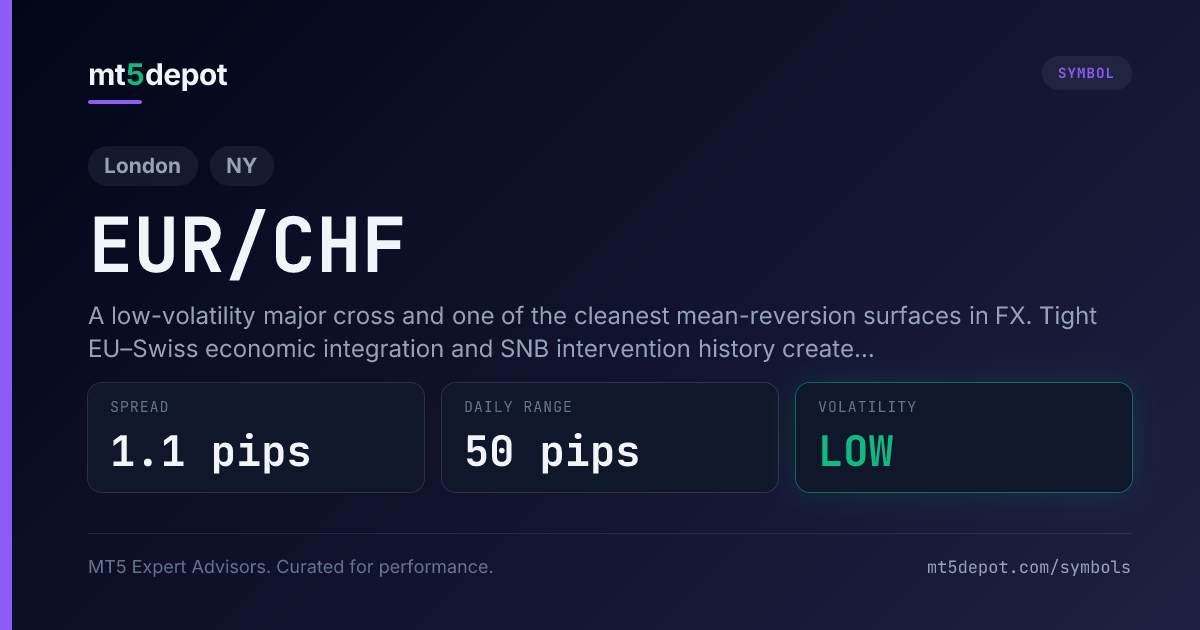
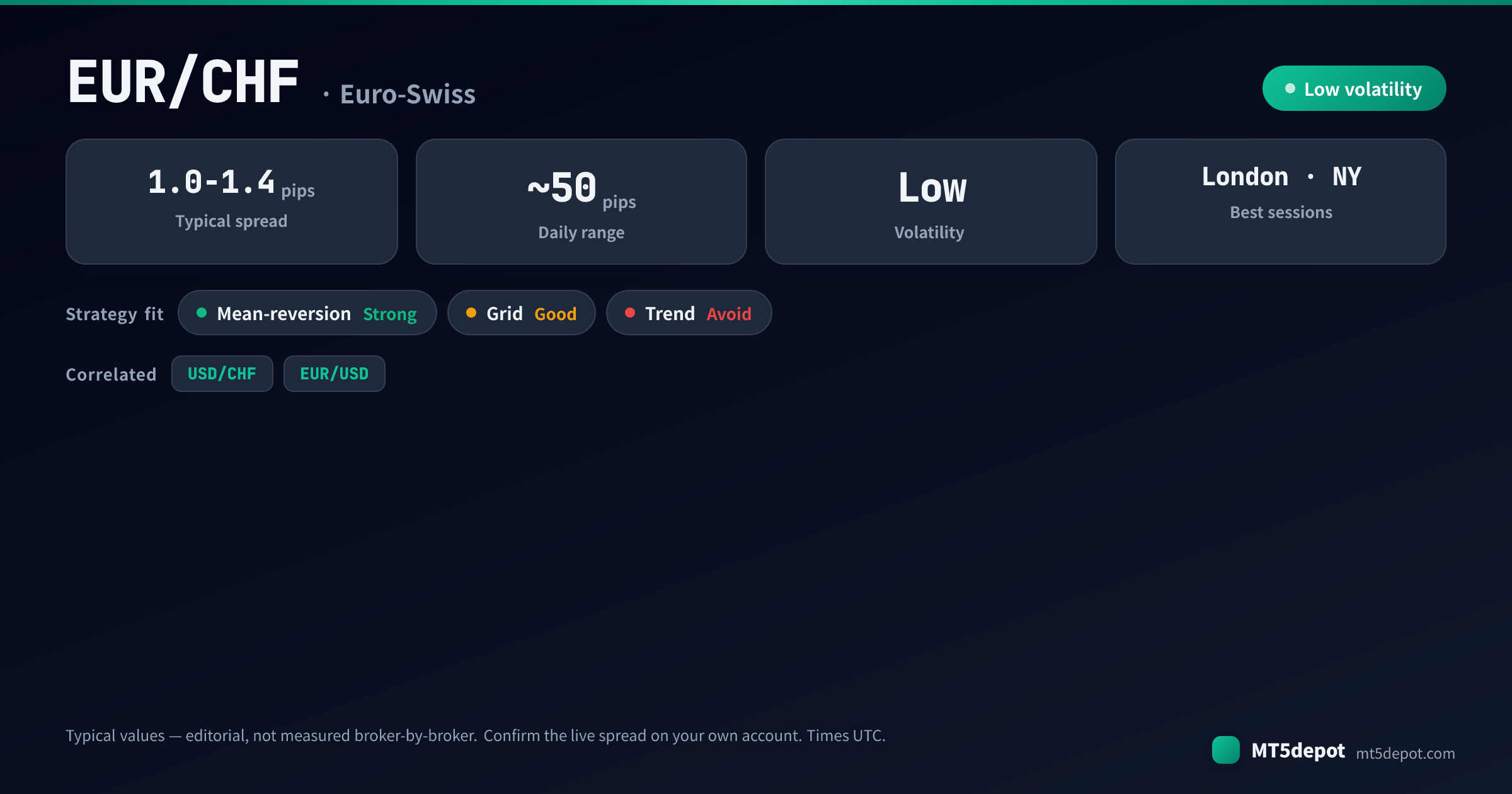
A low-volatility major cross and one of the cleanest mean-reversion surfaces in FX. Tight EU–Swiss economic integration and SNB intervention history create implicit range boundaries — ideal for Bollinger and grid EAs, and a poor fit for anything that needs a large trend. The 2015 peg break is the standing tail-risk warning.
Typical values — EUR/CHF is not yet measured broker-by-broker; confirm the live spread on your own account.
Data
Trading conditions
Session windows, broker spreads, and cost math for this symbol — measured and typical values, not marketing.
Trading sessions
FX market closed (weekend)
Sydney—22:00–07:00 UTC
Tokyo—00:00–09:00 UTC
LondonBest sessions—07:00–16:00 UTC
New YorkBest sessions—12:00–21:00 UTC
0006121824
Times are UTC and adjust automatically for daylight saving (Tokyo has no DST). The timeline shows the current UTC day; the vertical marker is the time right now.
Position planning
Pip value · Spread cost
Lots
Pip value
Cost at 1.1 pips
0.01
0.1 CHF
0.11 CHF
0.10
1 CHF
1.1 CHF
1.00
10 CHF
11 CHF
Values in CHF, the quote currency.
Required margin
Enter a price to calculate
Planning estimates from the typical values on this page — not live quotes. Actual pip value, margin and spread depend on your broker's contract specification and account currency.
Every catalogued EA on this symbol is re-verified by a rolling backtest as new price data arrives, using the settings locked at listing. Figures update daily from the verified data chain.
EUR/CHF — “Euro-Swiss” in the dealing room — is the mirror image of the volatile majors: a low-volatility cross that trades a narrow band rather than a trend, held there by the deep economic integration between the Eurozone and Switzerland. That makes it one of the cleanest mean-reversion surfaces in FX, and the first thing to decide is whether your strategy wants that character or merely tolerates it. A Bollinger reversion or a grid EA feeds on Euro-Swiss’s tendency to snap back toward equilibrium. A breakout or trend system sized for EUR/USD finds almost no room to run here. Pick the pair to the strategy, not the other way round.
This page covers what EUR/CHF gives an automated strategy that EUR/USD does not, the sessions that shape its results, what it costs, the failure modes that catch systems moved over from trending majors, and how to build and test a EUR/CHF EA when there is no off-the-shelf one to copy.
How EUR/CHF Behaves: What Euro-Swiss Gives an EA
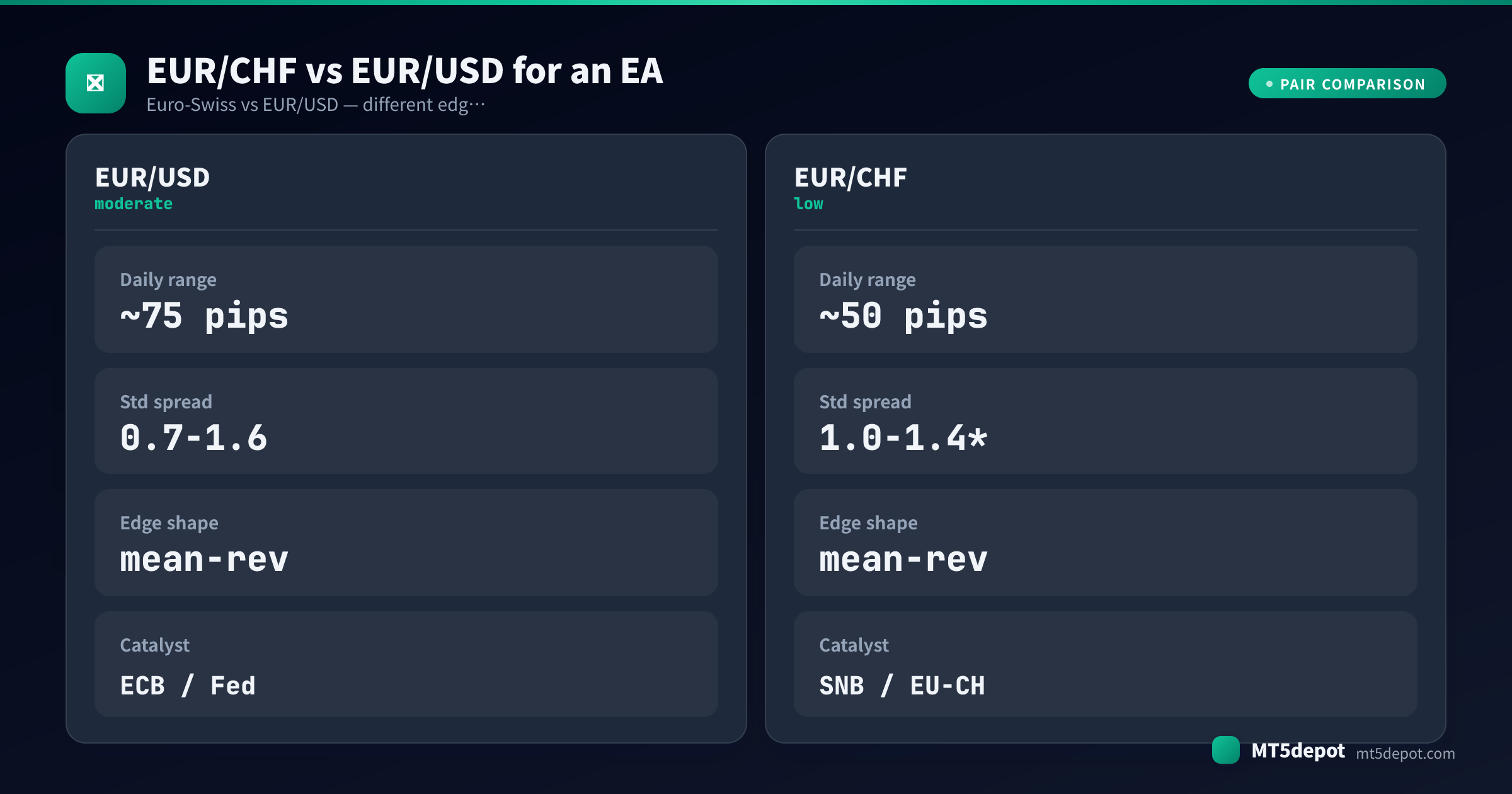
EUR/CHF is defined by what it does not do: it does not trend far. Tight EU–Swiss trade and capital integration, plus the Swiss National Bank’s long record of leaning against a strong or weak franc, keep the pair pinned to a narrow band. Our published typical daily range is near 50 pips — roughly half of a EUR/USD day and a fraction of a Cable day — which is the single fact everything else on this page follows from.
For an EA, that character reduces to three properties:
A reversion surface, not a momentum one. Between shocks, EUR/CHF tends to oscillate around an equilibrium rather than break out. The same integration that suppresses the range also pulls price back toward it. That is why a mean-reversion or grid system reads real signal here, where a trend system reads mostly noise. The edge is the snap-back, not the run.
Implicit range boundaries that are policy, not physics. The band Euro-Swiss trades in is partly a market artefact of expected SNB behaviour. That gives grid EAs an unusually well-defined range to work. It is also precisely the property that turns dangerous: a boundary set by policy can be moved by policy without notice.
A calm that hides an asymmetric tail. For long stretches EUR/CHF is one of the quietest majors on the board, which lulls automated systems into treating the low volatility as permanent. It is not: the pair carries a documented history of a single event erasing years of gentle range in minutes.
The trap for automated strategies is that the very calm that makes the reversion clean is what conceals the tail. A grid or reversion EA can print months of smooth equity on Euro-Swiss and still be one policy headline away from ruin — and the backtest almost never spans that headline. Euro-Swiss rewards systems that respect its one big risk and quietly flatters ones that assume the range is a law of nature.
Which EA Strategies Suit EUR/CHF?
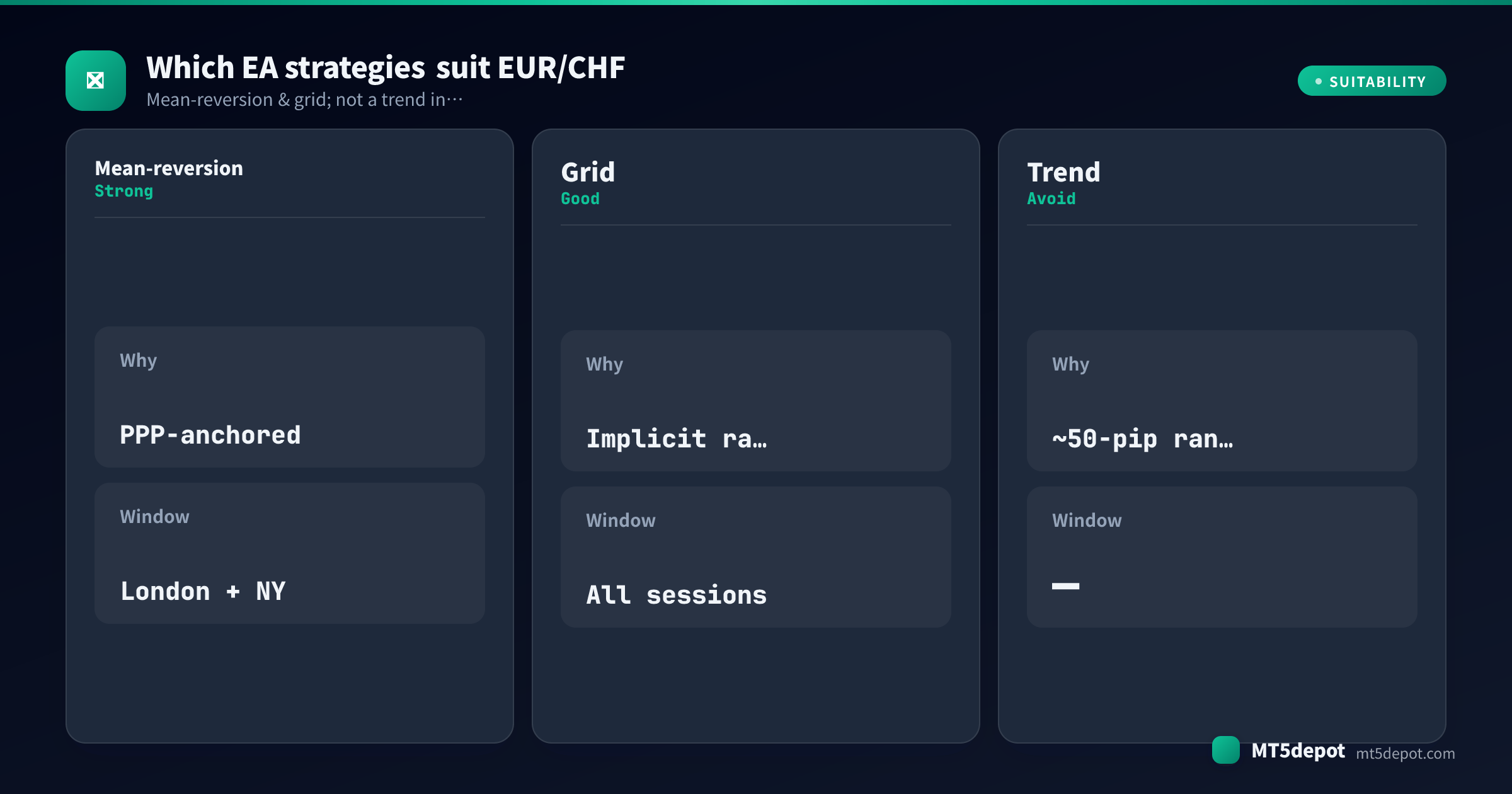
The pair’s profile lists mean-reversion and grid as suitable — but suitability is an editorial assessment, not proof. In a like-for-like template baseline (one year, default inputs, no optimisation), most strategy templates finish below a 1.0 profit factor on the majors. The ones that clear it usually earn it through mechanics — a capped range, an exposure ceiling — not the indicator on the box. What EUR/CHF’s character tends to support:
Strategy
Fit on EUR/CHF
Why
Mean-reversion
Strong
The pair is anchored to an equilibrium by EU–Swiss integration, so systems that fade extremes toward the mean find a cleaner surface here than on any trending major.
Grid
Good
The implicit range gives a grid an objective structure to work — but only with a hard depth limit and a total-exposure cap, because a gap opens every level at once (covered below).
Trend / breakout
Avoid
A ~50-pip typical range leaves little room above the spread for a trend target; systems that need a large directional move mostly starve on Euro-Swiss.
Mean-reversion and grid are the shapes that turn EUR/CHF’s narrow range into an asset; a trend system mostly fights it. Because there is no EUR/CHF-specific catalogue EA yet, the practical route is to build one of these shapes yourself — the Builder ships templates that accept EUR/CHF and exposes every parameter — and then test it (below) before you trust a single number.
Best Trading Hours for EUR/CHF EAs
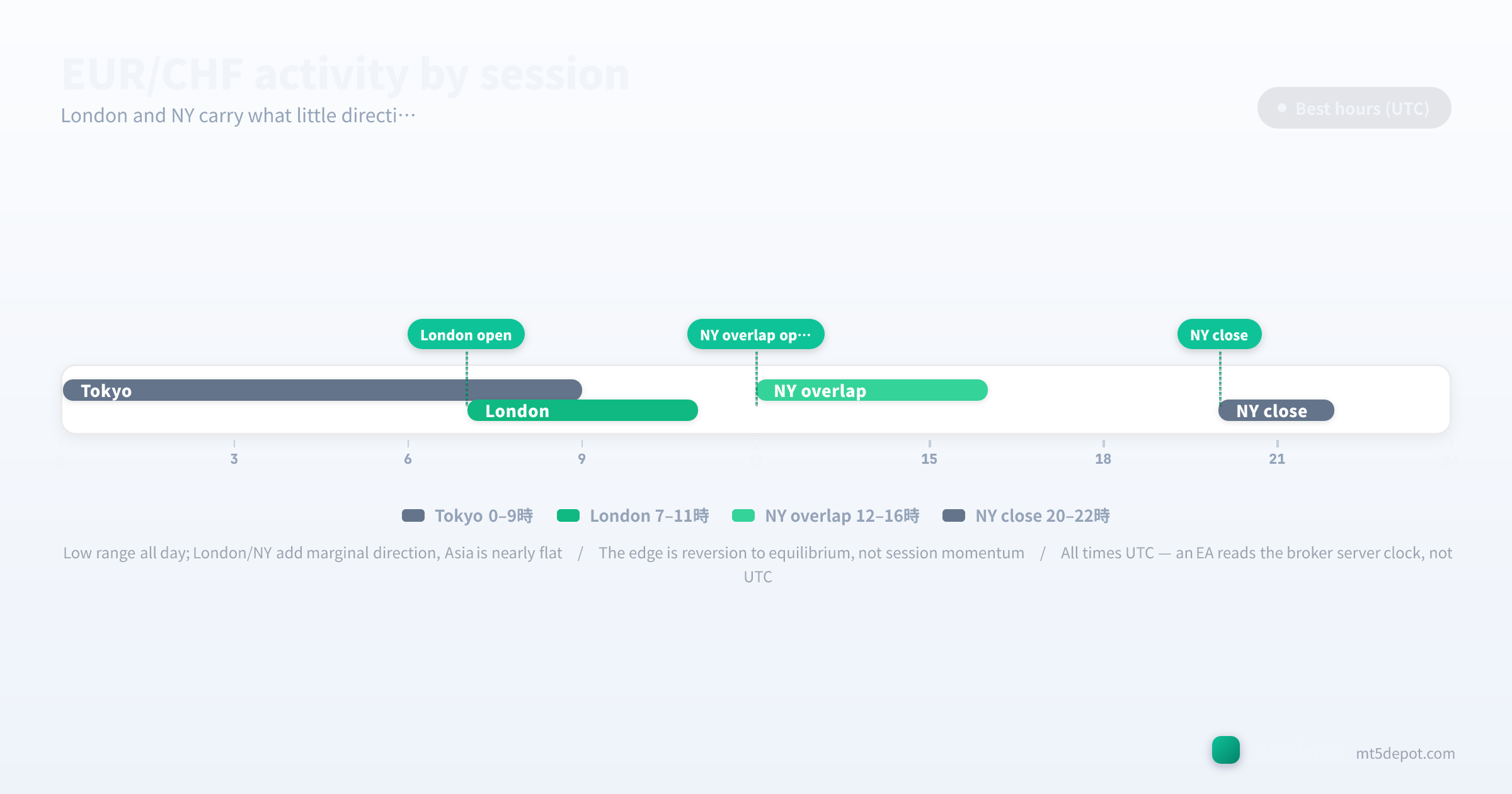
Session structure matters less on Euro-Swiss than on most pairs, because its edge is reversion to equilibrium rather than session momentum — but the little directional flow there is still clusters predictably:
Asian session (00:00–07:00 UTC): nearly flat. EUR/CHF prints very little range here, and a reversion system often has too little movement to work with.
London hours (07:00–12:00 UTC): the pair’s most active window, where European flow gives the range enough width for a reversion or grid entry to fill and mean-revert.
NY overlap (12:00–16:00 UTC): a second, milder window as US data nudges the euro and dollar legs; still calm by major-pair standards.
Late NY / pre-Asia (16:00–24:00 UTC): liquidity thins and the range contracts further; most systems find little worth trading here.
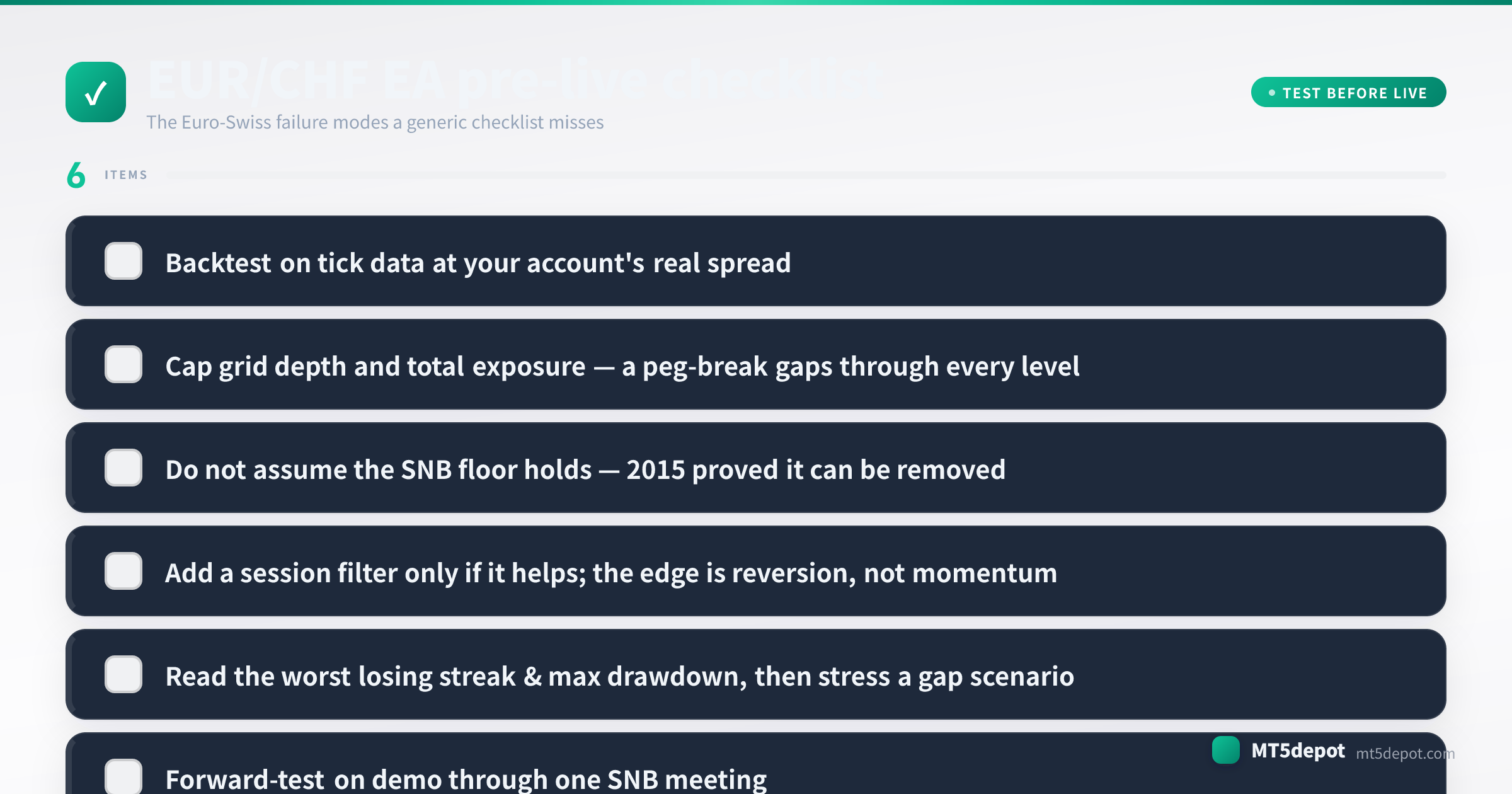
A session filter on EUR/CHF is worth adding only if your own test shows it helps, in our editorial assessment — unlike the trending majors, restricting hours is not a near-automatic improvement, because the reversion can set up at any time the range is wide enough. One caution applies whatever window you pick. Every clock time above is UTC, and an EA reads your broker’s server clock, which is usually not UTC — so a “07:00” London filter shifts silently when you move the EA between brokers on different server timezones. This is the one clock rule for the whole page; verify it once, in MT5’s Market Watch, and every session boundary lines up.
Spreads, Costs, and Execution
EUR/CHF is wider and thinner than EUR/USD, and on a ~50-pip-range pair that matters more than the raw pip figures suggest. The figures below are editorial reference ranges compiled from broker-published standard and raw conditions (updated July 2026), not broker-by-broker measured numbers. Our live spread sampling currently covers EUR/USD and a few reference symbols, so confirm the live spread on your own account before you size a fast strategy:
Account type
Typical EUR/CHF spread
Commission
Who it suits
Standard
1.0 – 1.4 pips
none
mean-reversion / grid EAs
Raw / ECN
sub-pip (≈0.3 – 0.6)
$3 – 7 / lot
tighter-grid / higher-frequency EAs
Two cost rules specific to this pair:
On a narrow-range pair, spread is a larger share of the target. A 1.0–1.4 pip spread is modest against a Cable-sized 100-pip day. But on a ~50-pip Euro-Swiss day it consumes a meaningful slice of every reversion move — and a grid that trades many small legs pays it repeatedly. That is why tighter-frequency EUR/CHF systems belong on a raw-type account where the spread compresses to a known sub-pip number, while a slower reversion EA can live on standard.
The commission is an account property, not a pair property. The same $3–7/lot raw commission applies whether you trade EUR/USD or EUR/CHF; what changes between pairs is the spread on top of it. A grid validated at 0.4 pips all-in and deployed at 1.4 is running a different strategy from the one you tested — and on Euro-Swiss’s thin range, that difference is proportionally larger than on a trending major.
Risks to Test Before Going Live
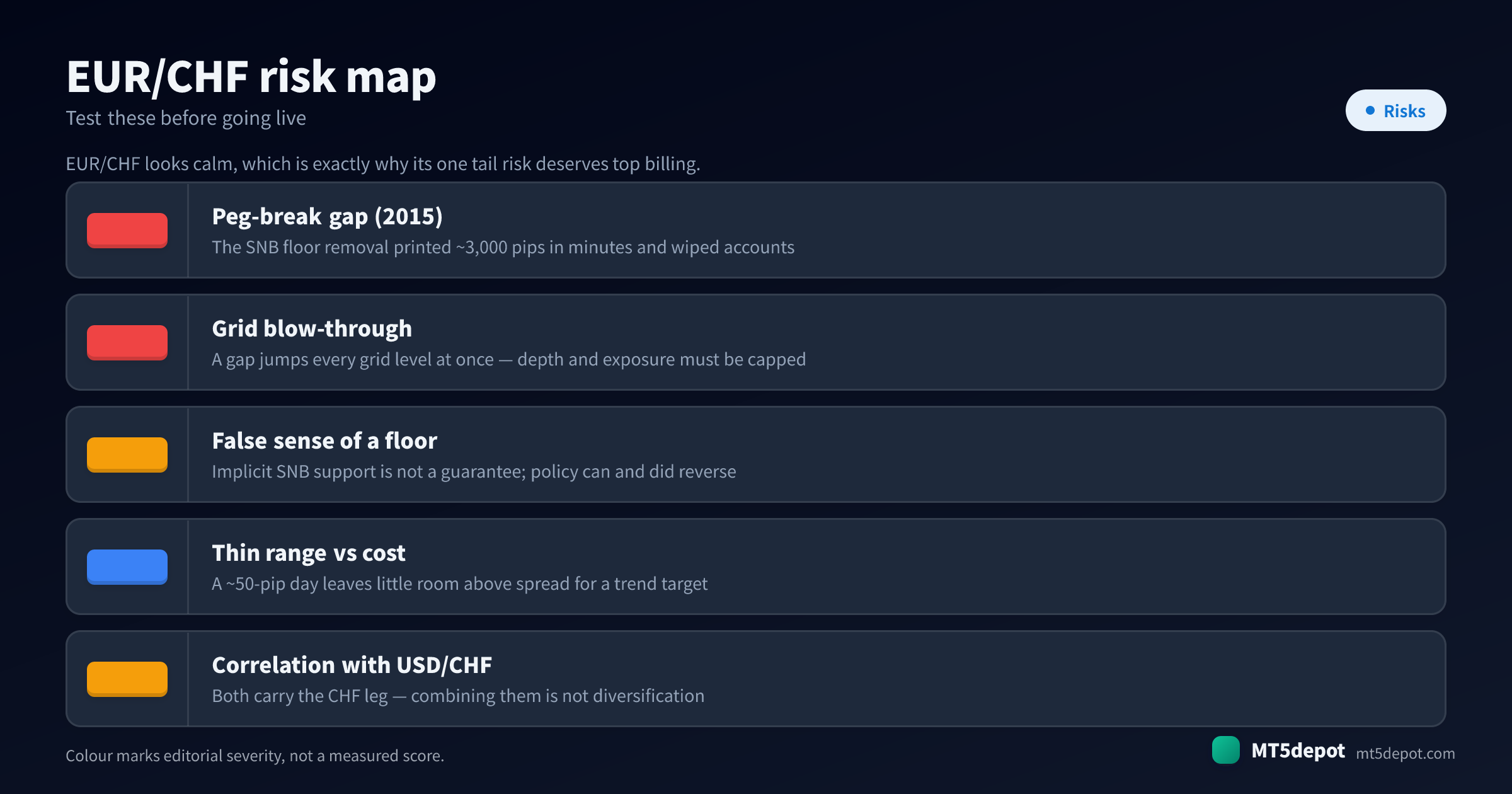
EUR/CHF looks calm, which is exactly why its one tail risk deserves top billing. Its failure modes are specific enough that a generic risk checklist misses them:
The 2015 peg-break gap is the standing tail. On 15 January 2015 the SNB removed its 1.20 floor and EUR/CHF fell roughly 3,000 pips in minutes. That is documented history, not a modelled scenario — it wiped out margined accounts and some brokers. No stop protects against a gap of that size, so the only defence is exposure that survives one. Test every system against a large adverse gap, not just a smooth range.
A gap blows through the entire grid at once. A grid assumes price walks its levels one at a time. A peg-break-style gap jumps every level simultaneously, opening the full ladder of losing positions in one print. Cap grid depth and total exposure so the worst-case simultaneous fill is survivable — this is the single setting that most often decides whether a Euro-Swiss grid lives or dies.
The SNB “floor” is a false sense of a floor. Implicit central-bank support is a market expectation, not a guarantee: 2015 is the proof that policy can and did reverse. An EA that sizes up near a perceived boundary because “the SNB won’t let it break” is pricing a floor that has already been removed once.
A thin range leaves no room for a trend target. On a ~50-pip typical day, a trend or breakout system has little space above the spread to reach a 2:1 target before the range reverts — the same narrowness that helps reversion starves momentum. This is a pair-fit failure, not a parameter one: no amount of tuning turns Euro-Swiss into a trend instrument.
USD/CHF correlation is hidden leverage, not diversification. EUR/CHF and USD/CHF share the CHF leg, so running an EA on each is closer to one concentrated Swiss-franc bet than a hedge — and any Swiss shock hits both at once. The correlation stacks your exposure without appearing in either EA’s risk settings.
How to Test a EUR/CHF EA
Because there is no catalogue EA to lean on for this pair, the test is the whole edge. Hold anything you build to the same bar our catalogue EAs publish under the site’s methodology:
Backtest on tick data at your account’s real spread. Use an every-tick model with the standard-or-raw spread you will actually trade, not the platform default. On a narrow-range pair the typical-vs-measured spread gap above becomes real money faster than on any major. A reversion strategy validated at a spread it will never see is a fiction.
Read the worst losing streak, not the headline profit factor. The max drawdown and the longest run of losing trades tell you the capital and the patience the strategy demands. For a grid, add a manual stress test that gaps the price through every open level at once. Budget for that worst case before you fund it.
Forward-test on demo through at least one SNB meeting. Euro-Swiss’s defining risk only shows up around Swiss policy, so a demo window that never spans an SNB decision has not tested the thing that matters most. The calm months are not the test; the shock is.
Confirm the server clock before the first live trade. Re-check MT5’s Market Watch time against the UTC session hours above, and re-check it again after any broker migration — a step that is easy to skip and expensive to miss.
Every backtest number this produces is a historical measurement, not a forecast — say so in your own notes, and size for the drawdown you measured rather than the return you hope for.
EUR/CHF EAs and Builder Templates
No dedicated EUR/CHF EA is currently listed in our catalogue. Rather than point you at a generic recommendation, the honest route to a Euro-Swiss EA is to build and verify one:
The Builder (open it here) accepts EUR/CHF in its mean-reversion and grid templates, so the EA you deploy is built on your own numbers — the CTA below covers exactly what it produces.
Broker fit matters more here. Because the edge is thin and the spread eats a large share of it, the account you run on decides the result. The broker catalogue is where to compare the standard and raw conditions that make or break a Euro-Swiss grid.
The concept canonicals. If a term above is unfamiliar, the spread, volatility and swap entries define the mechanics a EUR/CHF EA depends on.
Frequently asked questions
What is the best EA for EUR/CHF?
There is no EUR/CHF-specific EA with a five-year backtest in our catalogue yet — our full backtests currently sit on EUR/USD and GBP/JPY. Because Euro-Swiss is one of the cleanest mean-reversion surfaces in FX, the practical route is to build a Bollinger or grid EA in the Builder and judge it the way you would any pair: read the worst losing streak and max drawdown first, then validate on tick data at your own broker's spread. On this pair add one check the marketing never mentions — how the strategy behaves if a Swiss National Bank shock gaps the price through every level at once, the way January 2015 did.
Is EUR/CHF good for grid and mean-reversion EAs?
It is arguably the natural home for both. Tight EU–Swiss economic integration keeps EUR/CHF pinned to a narrow band — our published typical daily range is near 50 pips — so price tends to revert toward an equilibrium rather than trend, which is exactly the surface a Bollinger reversion or a grid system is built for. The catch is that the same implicit boundaries that make the reversion clean can be removed by policy: a grid without a capped depth and a hard exposure ceiling is one gap away from opening every level simultaneously.
What happened to EUR/CHF in 2015, and why does it still matter?
On 15 January 2015 the Swiss National Bank abandoned its 1.20 floor under EUR/CHF without warning, and the pair fell roughly 3,000 pips in minutes — a documented event, not a modelled scenario, that wiped out heavily-margined accounts and some brokers. It matters because the market structure that produced it has not gone away: EUR/CHF still trades near implicit policy boundaries, and any EA that treats those boundaries as a guaranteed floor is pricing a tail that has already detonated once. Test every EUR/CHF system against a large gap, not just a smooth range.
Which sessions should a EUR/CHF EA trade?
London and NY carry what little directional flow there is (roughly 07:00–16:00 UTC across the two), while the Asian hours are nearly flat. But the honest answer is that session timing matters less here than on most pairs, because the edge is reversion to equilibrium rather than session momentum — a filter is worth adding only if your own test shows it helps. Whatever window you choose, check it against your broker's server clock, which is usually not UTC.
How does EUR/CHF spread compare to EUR/USD?
EUR/CHF is wider and thinner: budget roughly 1.0–1.4 pips on a standard account against EUR/USD's ~0.7–1.6, and sub-pip (≈0.3–0.6) on raw plus the account's per-lot commission. On a ~50-pip-range pair that extra width matters more than it sounds, because it eats a larger share of every reversion target. These are typical reference ranges compiled from broker-published conditions, not broker-by-broker measured figures, so confirm the live spread on your own account before you size a fast strategy.