EUR/GBP (Chunnel) — MT5 symbol overview

At a glance

EUR/GBP · Chunnel

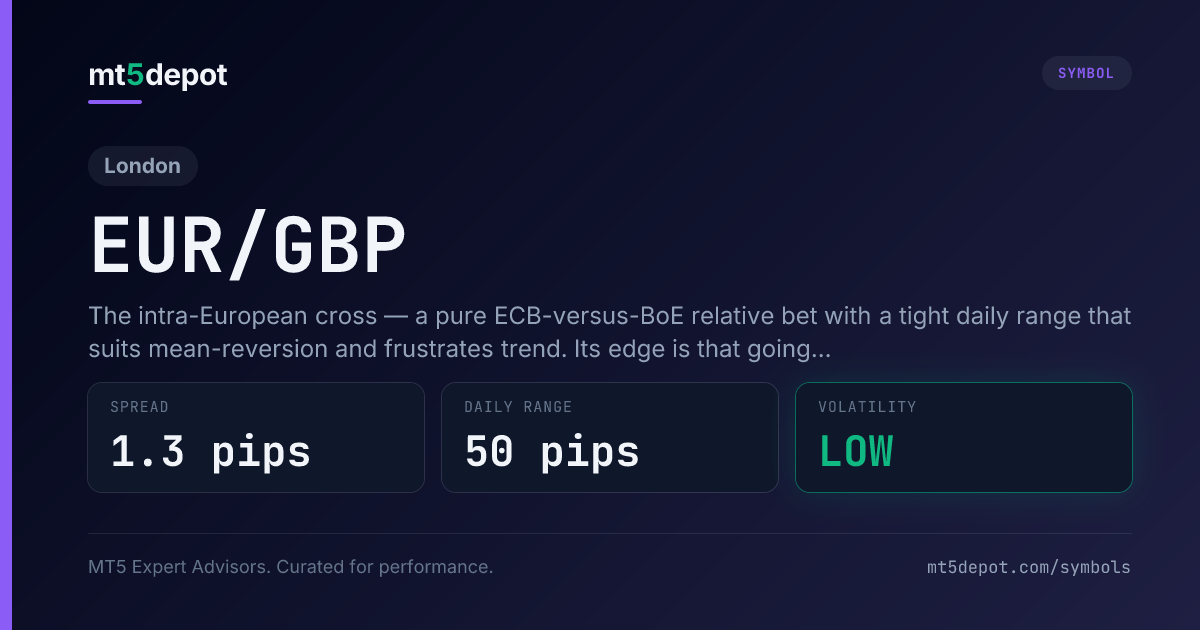
The intra-European cross — a pure ECB-versus-BoE relative bet with a tight daily range that suits mean-reversion and frustrates trend. Its edge is that going long EUR/GBP is close to long EUR/USD and short GBP/USD at once, so it is both a clean single-trade expression of divergence and a hidden correlation trap.

low 1.3 pips spread ~50 pips/day
Best sessions
London
Suitable strategies

Typical values — EUR/GBP is not yet measured broker-by-broker; confirm the live spread on your own account.

Data

Trading conditions

Session windows, broker spreads, and cost math for this symbol — measured and typical values, not marketing.

Trading sessions

Sydney 22:00–07:00 UTC
Tokyo 00:00–09:00 UTC
London Best sessions 07:00–16:00 UTC
New York 12:00–21:00 UTC

Times are UTC and adjust automatically for daylight saving (Tokyo has no DST). The timeline shows the current UTC day; the vertical marker is the time right now.

Position planning

Pip value · Spread cost

LotsPip valueCost at 1.3 pips
0.010.1 GBP0.13 GBP
0.101 GBP1.3 GBP
1.0010 GBP13 GBP

Values in GBP, the quote currency.

Required margin

Enter a price to calculate

Planning estimates from the typical values on this page — not live quotes. Actual pip value, margin and spread depend on your broker's contract specification and account currency.

EA catalogue

2 EAs traded on EUR/GBP

All EAs →

Out-of-sample tracking

Verification history

EATracked sinceData throughClosed tradesReturnMax drawdownVerified re-runs
Ballast2026-04-012026-08-129+1.7%-0.5%0
Thunderhead2025-12-012026-07-3134+3.0%-4.8%0

Every catalogued EA on this symbol is re-verified by a rolling backtest as new price data arrives, using the settings locked at listing. Figures update daily from the verified data chain.

Analysis

EUR/GBP: the full analysis

EUR/GBP — the “Chunnel,” named for the tunnel that links the two economies it prices — is not a directional currency bet at all. It is a relative bet on whether the European Central Bank or the Bank of England is the more hawkish of the two. That character produces a tight daily range and a strong pull back toward the middle of it. The first question is whether your strategy wants a quiet mean-reverting surface or merely tolerates it. Port a trend system built for a wide-range major here and you will spend the whole session paying spread while waiting for a move that rarely arrives.

This page covers what EUR/GBP gives an automated strategy that a dollar-based major does not, the single session that decides its results, and what it costs. It then covers the failure modes that catch systems ported over from trending pairs, and how to build and test a Chunnel EA when there is no off-the-shelf one to copy.
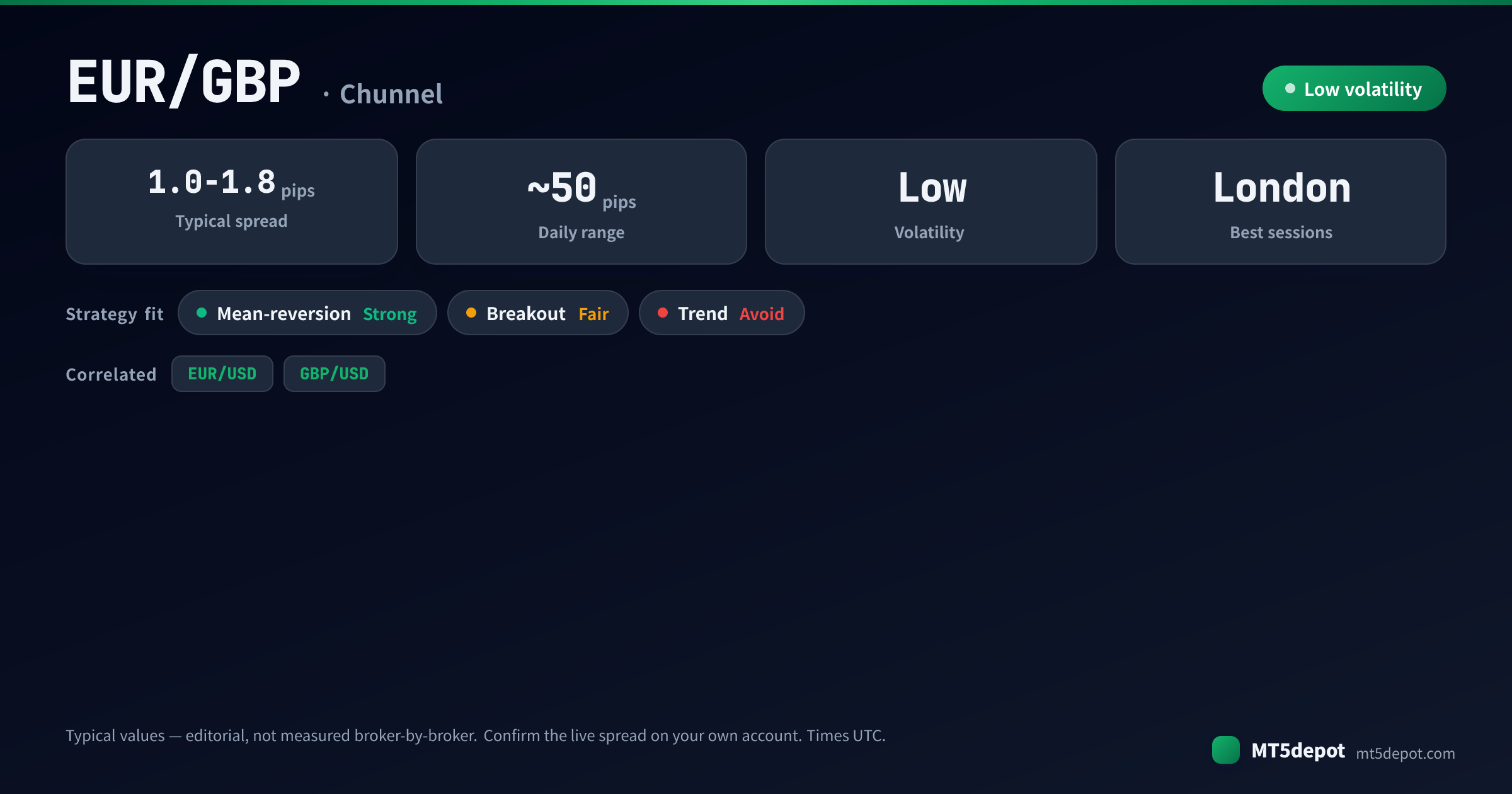
EUR/GBP at-a-glance: typical spread 1.0-1.8 pips, ~50-pip daily range, low volatility, best in the London sessions

How EUR/GBP Behaves: What Chunnel Gives an EA

EUR/GBP prices the difference between two neighbouring, tightly-linked economies. Because the eurozone and the UK share trade, geography, and most of the same global shocks, the euro and the pound tend to move together against the rest of the world. What is left to trade is only the gap between them, and that gap is small.
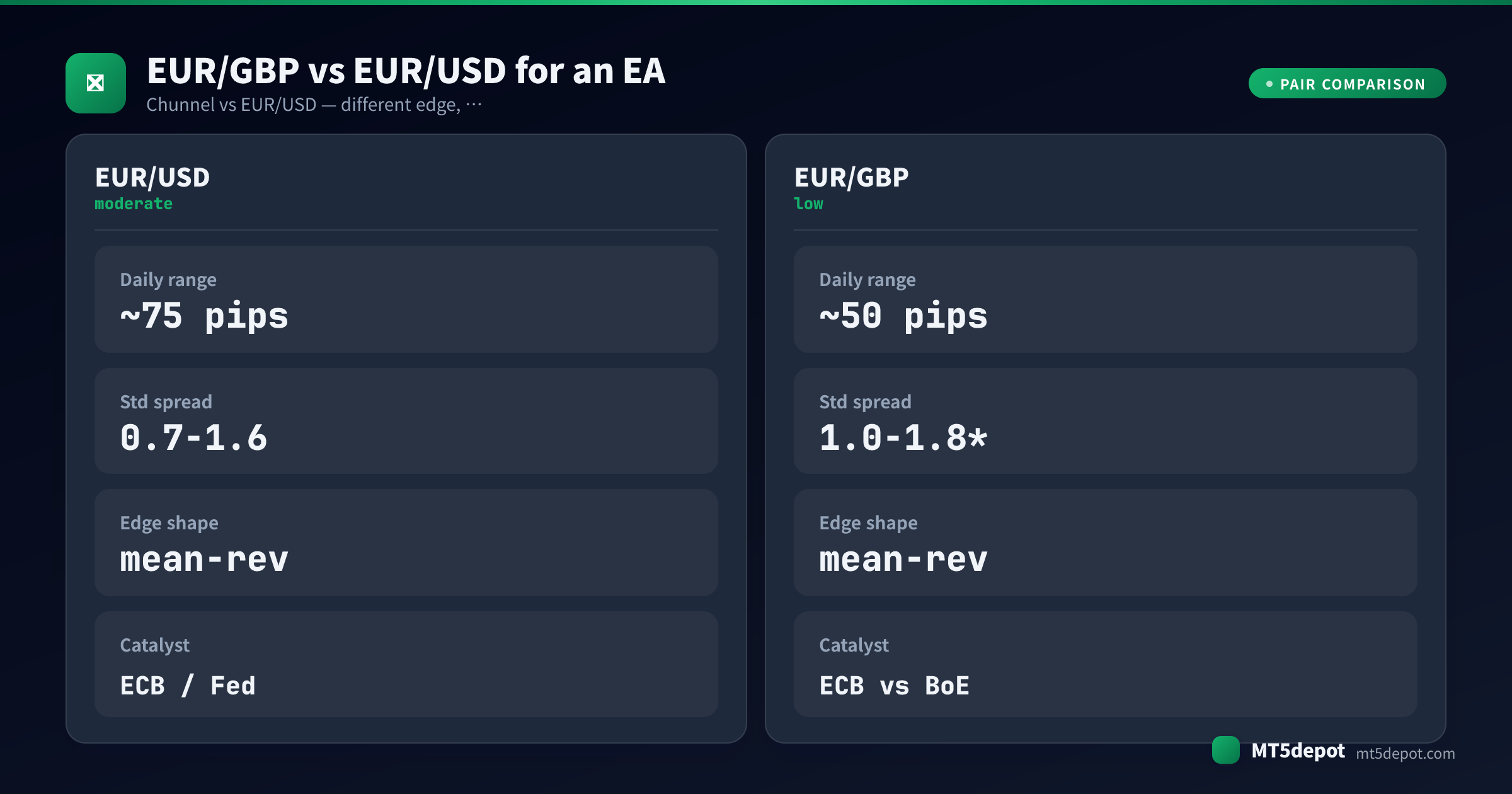
Comparison card contrasting EUR/GBP and EUR/USD daily range, spread, edge shape and catalyst for an EA

For an EA, that character reduces to three properties:

  • A pure ECB-versus-BoE relative bet. There is no third currency doing the work here the way the dollar drives EUR/USD. The pair moves on the relative stance of two central banks. That is why its published typical daily range is near 50 pips — labelled typical, not measured broker-by-broker — a fraction of what a dollar major covers in a session. Everything else on this page follows from that narrow range.
  • Mean-reversion by default, breakout only on divergence. Inside its range the pair tends to revert, so range and reversion logic has a natural home here. The range only breaks hard when the ECB and the BoE genuinely diverge — a policy surprise, a rate decision that lands against expectations. Those are the rare occasions a breakout entry is justified.
  • A concentrated, single-window life. Both legs are European, so the pair does almost all of its living in the London hours and drifts on thin flow the rest of the day. There is no NY-overlap second wind of the kind a dollar pair enjoys.

The trap for automated strategies is treating that calm as if it were either a trend surface or a diversifier. A ~50-pip range rarely pays a 2:1 trend target, so a ported trend system bleeds on the spread while it waits. And because long EUR/GBP is close to long EUR/USD and short GBP/USD at once, a “diversified” book that already holds those pairs is quietly doubling one bet. Chunnel rewards systems that respect its low volatility and punishes ones that mistake it for something it is not.

Which EA Strategies Suit EUR/GBP?

The pair’s profile lists mean-reversion and breakout as suitable — but suitability is not proof. In a like-for-like template baseline (one year, default inputs, no optimisation), most strategy templates finish below a 1.0 profit factor on any pair. On a narrow-range cross the spread eats the margin faster still. What EUR/GBP’s character supports specifically:

StrategyFit on EUR/GBPWhy
Mean-reversionStrongThe tight, reverting range is the pair’s defining trait. Fading extremes back toward the middle during the London session is the shape that fits Chunnel’s character rather than fighting it.
Breakout (policy events)FairThe range only breaks on genuine ECB-vs-BoE divergence. A breakout EA earns its keep at rate decisions and inflation prints and idles the rest of the time. Treat it as an event strategy, not a daily one.
Trend-followingAvoidA ~50-pip range rarely produces the sustained moves a trend target needs. A trend template ported from a dollar major mostly pays spread waiting for a move that does not come.

Mean-reversion is the shape that turns EUR/GBP’s range into an asset; breakout is a narrow event play; trend is the one to leave at home. Because there is no EUR/GBP-specific catalogue EA yet, the practical route is to build a reversion or event shape yourself. The Builder exposes every parameter, so you set the range and the filters on your own numbers. Test it (below) before you trust a single result.
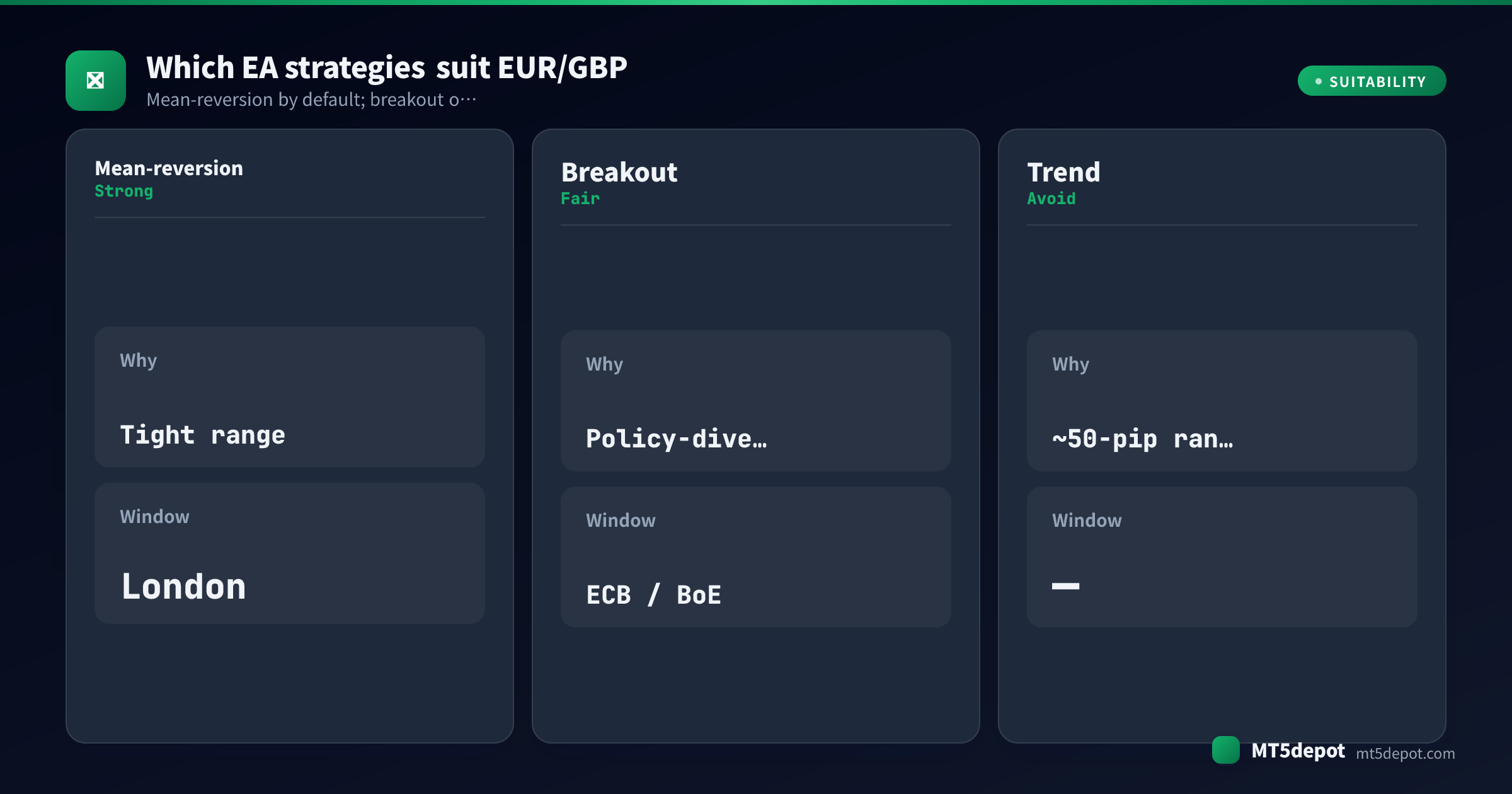
Card rating how mean-reversion, breakout, trend EA strategies fit EUR/GBP

Best Trading Hours for EUR/GBP EAs

Session structure decides more of a EUR/GBP result than indicator choice does, and here the structure is unusually simple because both legs are European:

  1. Asian session (00:00–07:00 UTC): nearly flat. With neither Europe nor London active, the pair drifts on thin flow that frequently reverses at the London open. An EA trading here is trading noise, not signal.
  2. London session (07:00–16:00 UTC): the one window that matters. This is where EUR/GBP does almost all of its meaningful movement, where reversion setups form and complete, and where an ECB or BoE surprise resolves into a genuine break. A EUR/GBP EA that is not London-focused is fighting its own pair.
  3. After London (16:00 UTC onward): liquidity thins again as European desks close, and moves become the kind of low-conviction drift that traps late entries.

In our editorial assessment, a session filter that trades London and stands aside otherwise is best treated as part of the strategy definition rather than an optimisation flourish. It is a hypothesis worth testing on your own data. Two cautions come with it. Scheduled ECB and BoE events sit inside the London window and widen the spread exactly then. A reversion strategy needs to know when a range break is a real divergence rather than a level to fade. And every clock time above is UTC. An EA reads your broker’s server clock, which is usually not UTC, so a “07:00” filter shifts silently when you move the EA between brokers on different server timezones. This is the one clock rule for the whole page. Verify it once in MT5’s Market Watch, and every session boundary lines up.
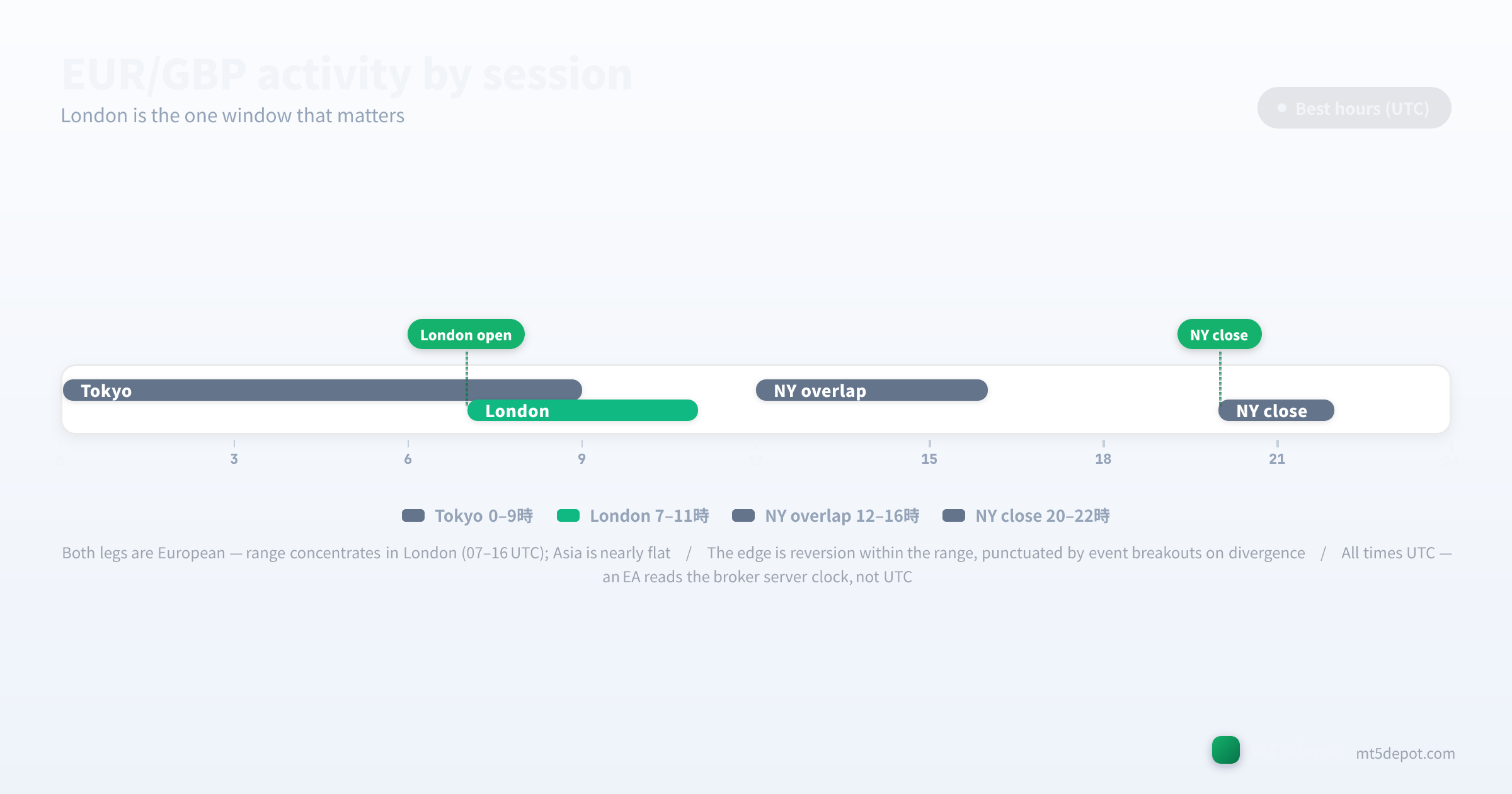
EUR/GBP activity timeline showing the London session hours in UTC

Spreads, Costs, and Execution

On a narrow-range pair, the spread matters more per pip than it does on a wide major, because it is a larger fraction of the day’s whole opportunity. The figures below are editorial reference ranges compiled from broker-published standard and raw conditions (updated July 2026), not broker-by-broker measured numbers; our live spread sampling does not yet cover EUR/GBP. Confirm the live spread on your own account before you size a strategy that targets small moves:

Account typeTypical EUR/GBP spreadCommissionWho it suits
Standard1.0 – 1.8 pipsnonelow-frequency mean-reversion / event EAs
Raw / ECN≈0.4 – 0.8 pips$3 – 7 / lothigher-frequency reversion EAs

Two cost rules specific to this pair:

  1. A pip of spread is a bigger bite on a 50-pip day. On a wide major a 1.5-pip spread is a rounding error against a 100-pip range. On EUR/GBP the same spread is a meaningful slice of a typical ~50-pip day, so a reversion EA aiming at small moves has to clear it on every single trade. That is the arithmetic that decides whether a EUR/GBP strategy is viable at all.
  2. The commission is an account property, not a pair property. The same $3–7/lot raw commission applies whether you trade EUR/USD or Chunnel; what changes between pairs is the spread on top of it. A EUR/GBP reversion EA validated at 0.5 pips all-in and deployed at 1.8 is running a different strategy from the one you tested.

Risks to Test Before Going Live

EUR/GBP looks calm. Its failure modes nearly all come from mistaking that calm for either a trend surface or a diversifier — so a generic risk checklist misses them:
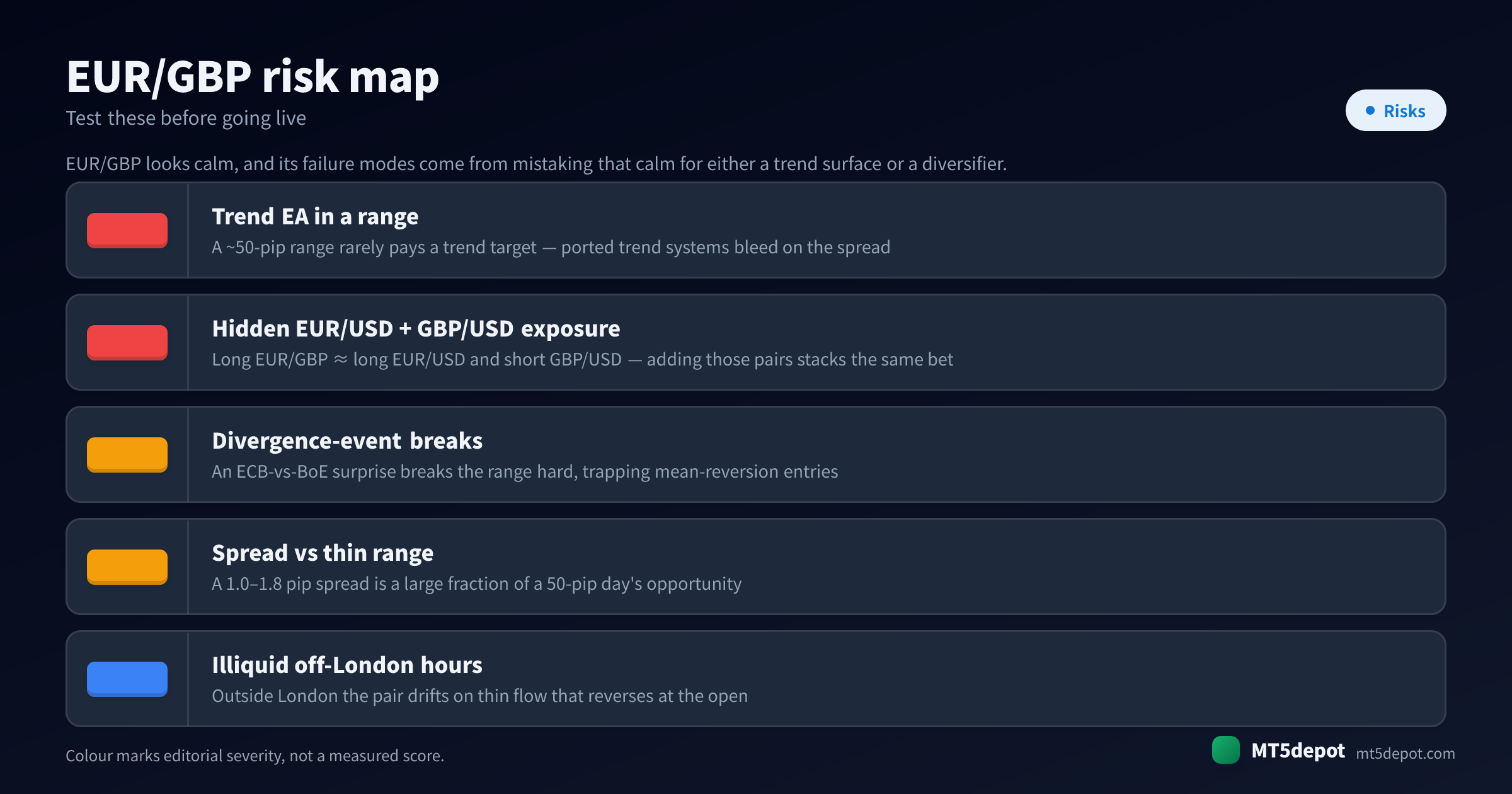
  1. A trend EA in a range bleeds. The most common porting error is dropping a trend system built for a wide-range major onto Chunnel’s ~50-pip range. There it rarely reaches a trend target, and instead pays the spread again and again while it waits. Match the strategy shape to the pair before anything else — mean-reversion, not trend, is what this range supports.
  2. Hidden EUR/USD and GBP/USD exposure. Long EUR/GBP is close to long EUR/USD and short GBP/USD at the same time. Adding EUR/GBP to a book that already holds either of those pairs stacks the same underlying bet rather than hedging it. The correlation doubles your exposure without appearing anywhere in any single EA’s risk settings — always net out your euro, pound, and dollar legs across the whole book.
  3. Divergence events break the range. The range that a mean-reversion EA relies on breaks hard when the ECB and the BoE actually diverge, and a fade entry placed just before an unexpected rate decision can be run over. Slower strategies need stops that survive a policy-driven break; faster ones need an event pause.
  4. The spread is a large tax on thin range. Because a 1.0–1.8 pip spread is a large fraction of a 50-pip day, a strategy that looked profitable on a platform-default spread can turn negative at your real one. This is not a tail risk; it is a recurring cost on every trade.

Colour-coded EUR/GBP risk map covering its main pre-live failure modes

How to Test a EUR/GBP EA

Because there is no catalogue EA to lean on for this pair, the test is the whole edge. Hold anything you build to the same bar our catalogue EAs publish under the site’s methodology:

  1. Backtest on tick data at your account’s real spread. Use an every-tick model with the standard-or-raw spread you will actually trade, not the platform default. On a narrow-range pair this matters more than anywhere else. A EUR/GBP strategy validated at a spread it will never see is a fiction, because the spread is such a large fraction of the move it is trying to capture.
  2. Read the worst losing streak, not the headline profit factor. The max drawdown and the longest run of losing trades tell you the capital and the patience the strategy demands. A mean-reversion system that fades a range can string together a painful run when a divergence event breaks that range, so budget for the worst streak before you fund it.
  3. Forward-test on demo through one ECB and one BoE decision. EUR/GBP’s defining risk only shows up when the two central banks diverge. A demo window that never spans both a eurozone and a UK rate decision has not tested the thing most likely to break it.
  4. Confirm the server clock before the first live trade. Re-check MT5’s Market Watch time against the UTC London hours above, and re-check it again after any broker migration. That step is easy to skip and expensive to miss on a pair whose entire edge lives in one session.

Every backtest number this produces is a historical measurement, not a forecast — say so in your own notes, and size for the drawdown you measured rather than the return you hope for.
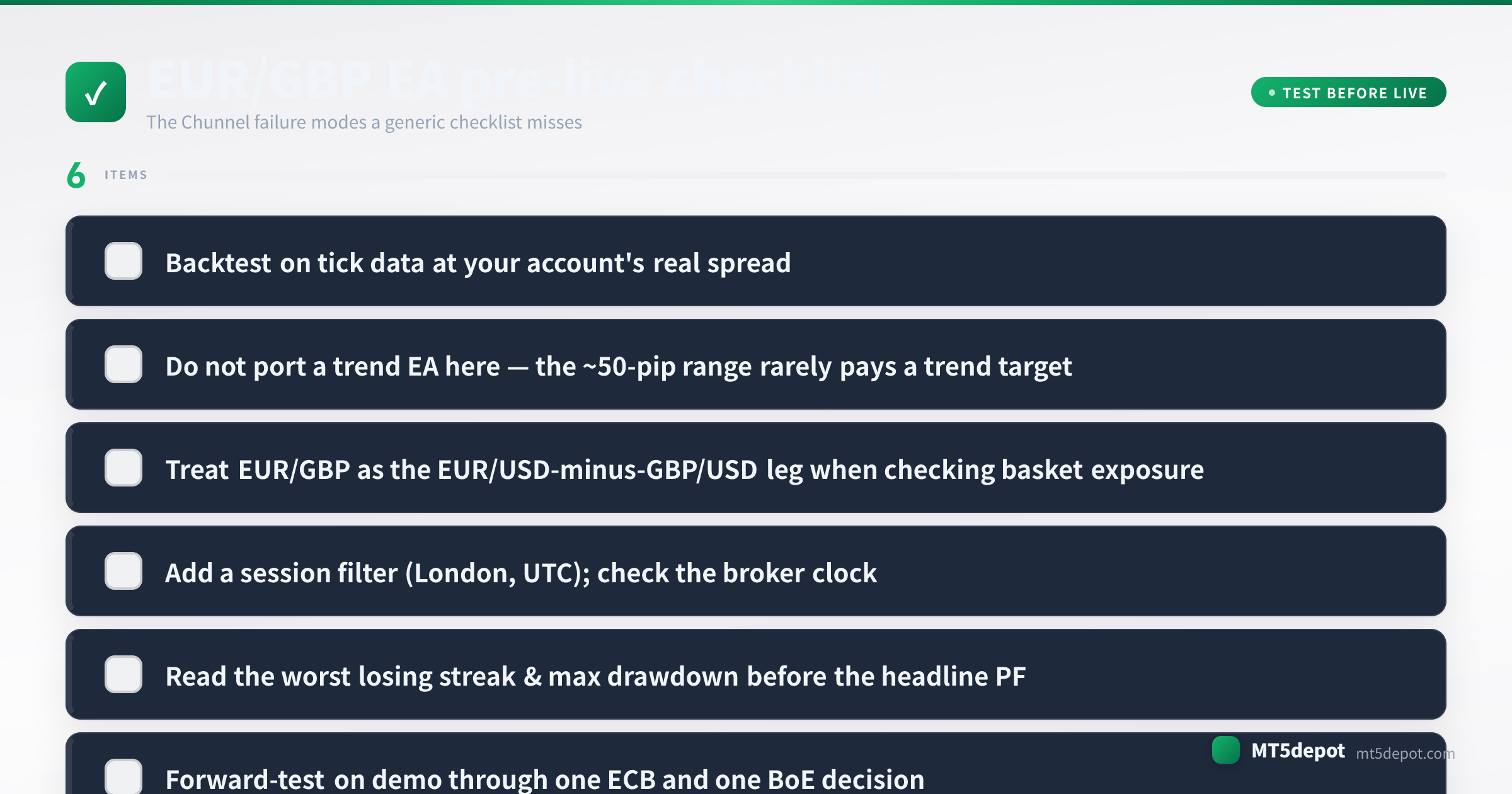
Pre-live checklist for a EUR/GBP EA covering tick-data backtest, sizing, session filter and drawdown

EUR/GBP EAs and Builder Templates

No dedicated EUR/GBP EA is currently listed in our catalogue. Rather than point you at a generic recommendation, the honest route to a Chunnel EA is to build and verify one.

  • The Builder (open it here) exposes every parameter, so you can set the range bounds, the London session filter, and the event handling on your own numbers. That generates an EA built to EUR/GBP’s character rather than ported from a trending pair.
  • Related-pair reference. There is no EUR/GBP-specific example in the catalogue. But the fully-backtested Tidewell Slack is a useful shape to study for how a published EA reports its worst losing streak and drawdown. Read it for the discipline of the presentation, not because its pair or its style transfers to Chunnel.
  • The concept canonicals. If a term above is unfamiliar, the spread, volatility and swap entries define the mechanics a EUR/GBP EA depends on. Swap matters especially here, since a slow reversion strategy can hold positions across the rollover more often than a fast dollar-pair system does.

Frequently asked questions

What is the best EA for EUR/GBP?
No EUR/GBP-specific EA with a five-year backtest is in our catalogue yet — our full backtests currently sit on other pairs. Because Chunnel is a tight-range mean-reversion pair rather than a trend surface, the sensible route is to build a range or reversion EA in the Builder and validate it on tick data at your own broker's spread. Judge it by its worst losing streak and max drawdown before any headline profit factor, and never assume a trend template will transfer here.
Is EUR/GBP good for scalping or mean-reversion EAs?
Mean-reversion inside its narrow range is the natural fit; scalping is harder than it looks because a 1.0–1.8 pip typical spread is a large fraction of a roughly 50-pip day. Any strategy that targets small moves has to clear that spread on every trade, so raw-type accounts help but do not create an edge on their own. Treat any EUR/GBP scalper as unproven until your own tick-data test with a realistic spread says otherwise.
Why does EUR/GBP have such a small daily range?
EUR/GBP is a relative bet between two economies that move together — the eurozone and the UK share trade links, geography, and often the same global shocks — so the euro and the pound tend to rise and fall in tandem against the rest of the world, leaving only their difference to price. Our published typical daily range is near 50 pips, labelled typical rather than measured broker-by-broker. The range widens sharply only when the ECB and the Bank of England actually diverge.
Which sessions should a EUR/GBP EA trade?
London, essentially alone. Both legs are European, so almost all of the pair's meaningful movement concentrates in the London session (roughly 07:00–16:00 UTC), and Asian hours are nearly flat. A session filter that trades London and stands aside otherwise is best treated as part of the strategy rather than an optional tweak, and the filter's clock times must be checked against your broker's server time, not your local time.
Does buying EUR/GBP double my EUR/USD and GBP/USD exposure?
It can, and this is the single most overlooked risk on the pair. Going long EUR/GBP is close to going long EUR/USD and short GBP/USD at the same time, so if you already hold either of those positions, adding EUR/GBP stacks the same underlying bet rather than diversifying it. Always check a basket's net euro, pound, and dollar exposure before assuming three tickets mean three independent risks.

Related symbols

Symbols →

Related articles

Glossary

Key terms

All terms →
SpreadVolatilitySwap