The Nikkei 225 CFD — Japan's blue-chip index and, in practice, a leveraged bet on a weak yen: it rises when the yen falls, so a JP225 EA that ignores USD/JPY is missing its main driver. Price-weighted like the Dow, it gaps on the Tokyo open after overnight US-tech moves.
Typical values — JP225 is not yet measured broker-by-broker; confirm the live spread and point value on your own account.
Data
Trading conditions
Session windows, broker spreads, and cost math for this symbol — measured and typical values, not marketing.
Trading sessions
FX market closed (weekend)
Sydney—22:00–07:00 UTC
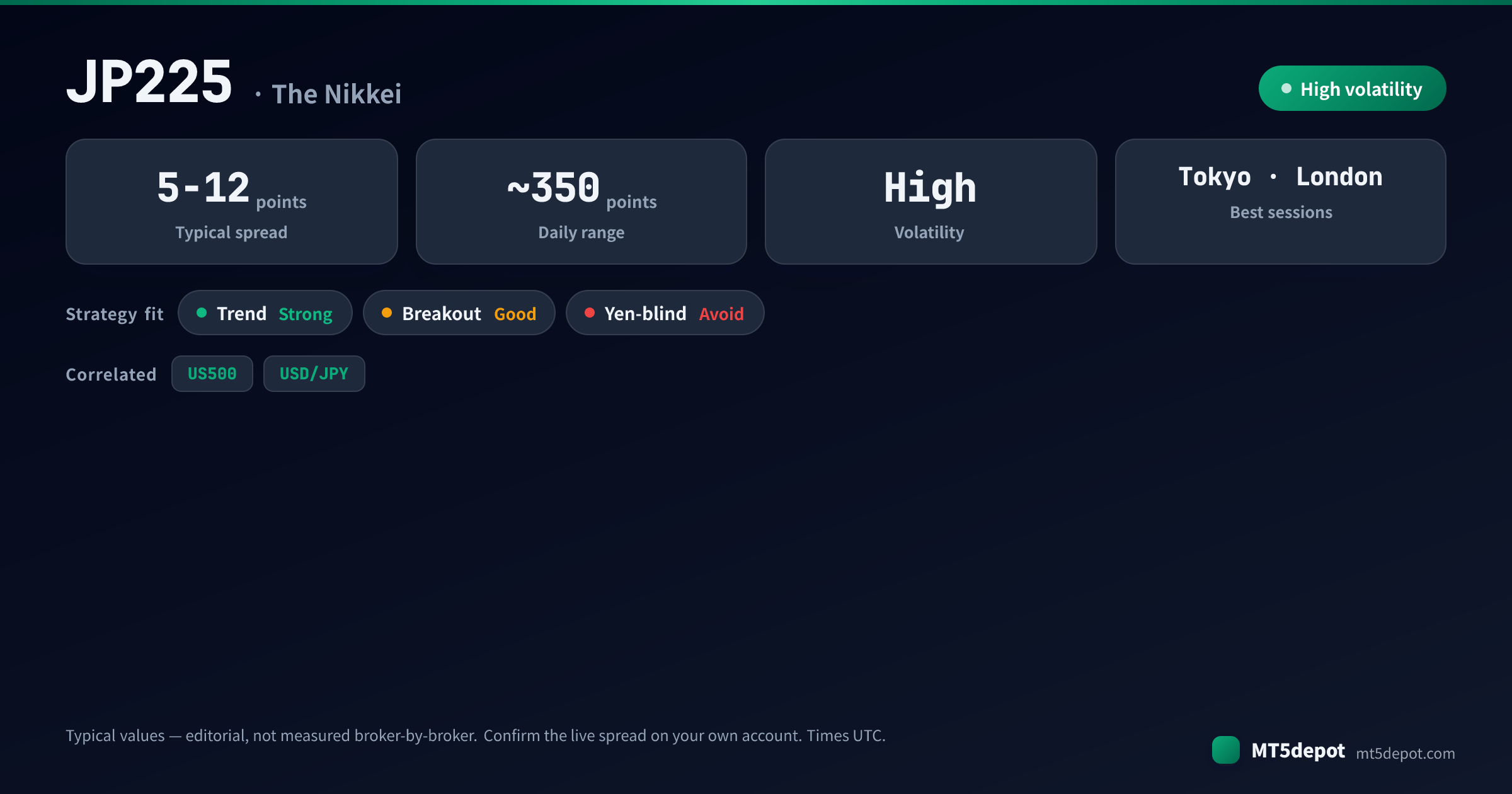
TokyoBest sessions—00:00–09:00 UTC
LondonBest sessions—07:00–16:00 UTC
New York—12:00–21:00 UTC
0006121824
Times are UTC and adjust automatically for daylight saving (Tokyo has no DST). The timeline shows the current UTC day; the vertical marker is the time right now.
Position planning
Contract size for this instrument varies by broker, so pip value and margin cannot be quoted generically — check your broker's contract specification.
Planning estimates from the typical values on this page — not live quotes. Actual pip value, margin and spread depend on your broker's contract specification and account currency.
Every catalogued EA on this symbol is re-verified by a rolling backtest as new price data arrives, using the settings locked at listing. Figures update daily from the verified data chain.
The Nikkei 225 is Japan’s headline stock-index CFD, and it is not a currency pair. It is a leveraged claim on 225 of Japan’s largest listed companies, quoted and traded in index points. The single fact that changes everything for an automated strategy is that the Nikkei is, in practice, a leveraged bet on a weak yen. It tends to rise when the yen falls, so a JP225 EA that watches only the index chart is blind to USD/JPY — frequently its real driver. The first thing to decide is whether your strategy wants that character: a yen-aware trend or breakout system feeds on the Tokyo-open expansion, while a system that merely tolerates it is trading an instrument it does not understand.
This page covers what the Nikkei gives an automated strategy that an FX pair or even the S&P 500 does not, the sessions that decide its results, and what it costs including overnight financing. It then covers the failure modes that catch systems ported over from forex, and how to test a JP225 EA when there is no off-the-shelf one to copy.
How JP225 Behaves: What The Nikkei Gives an EA
The Nikkei 225 is structurally different from both a forex major and a US index in ways that matter more for automation than any indicator choice. Its catalysts sit outside the FX world an EA was probably designed for, and its construction distorts what the index actually measures.
For an EA, that character reduces to three properties:
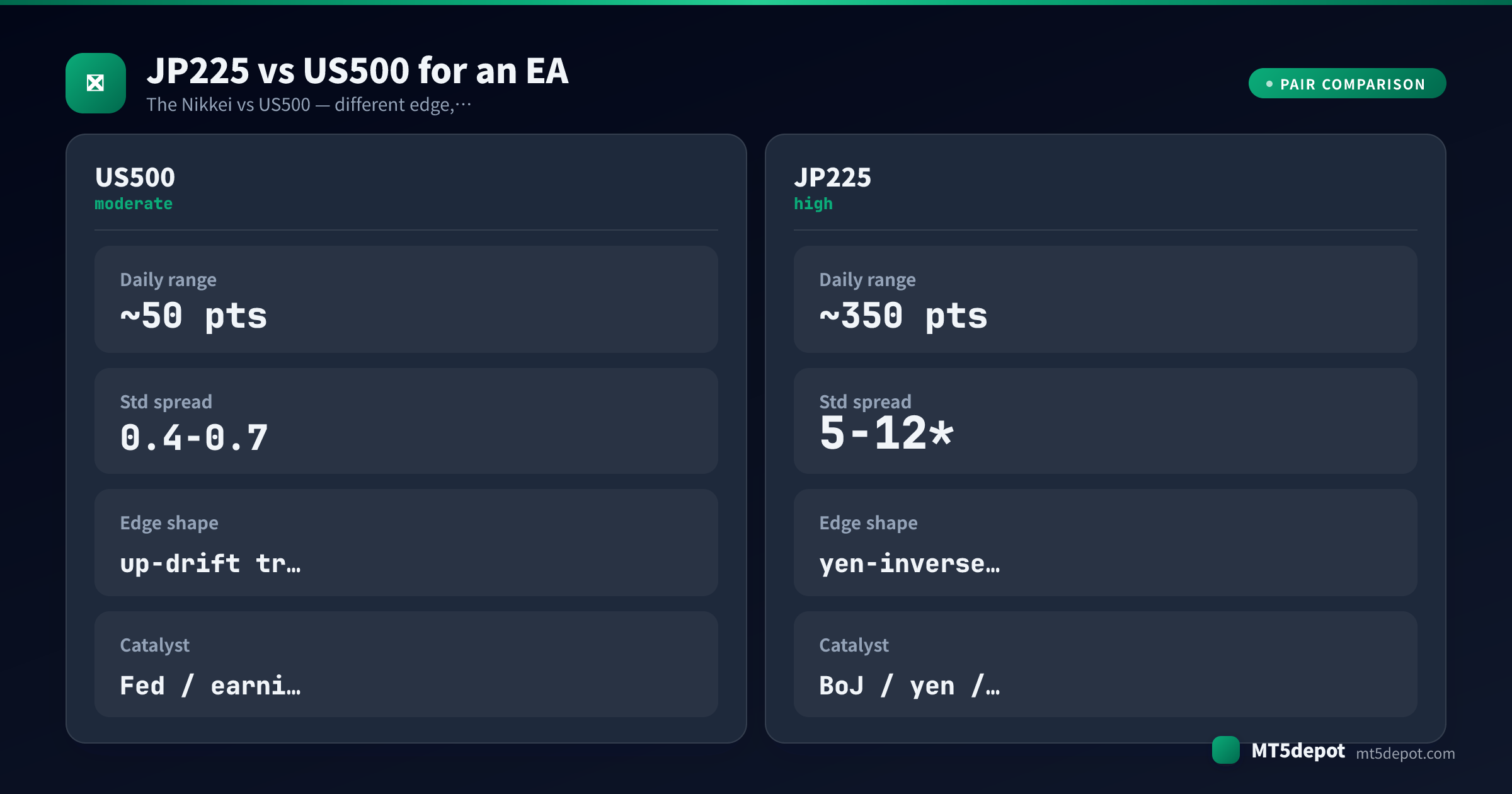
Inverse-yen correlation is the main driver. The index is dominated by large exporters whose overseas earnings are worth more in yen when the yen weakens, so JP225 tends to rise as the yen falls and USD/JPY rises. This is the single most important fact on the page. A JP225 EA that ignores USD/JPY is blind to the force behind most of its moves, and a “diversified” pair of EAs on JP225 and USD/JPY is closer to one leveraged position than a hedge.
Price-weighted construction distorts the index. Like the Dow and unlike the market-cap-weighted US500, the Nikkei is price-weighted. A handful of high-priced members move the index far more than their actual size in the Japanese economy warrants. A single expensive stock’s gap can swing the whole index on a day the broader market is flat, so a JP225 EA is effectively trading a small basket of high-priced shares, not a broad read on Japan.
It follows Wall Street, so it is not an independent bet. The Nikkei carries a high correlation with the US500 and takes its risk tone from the overnight US session. When Wall Street sells off, the Nikkei usually opens weak regardless of Japanese fundamentals. A JP225 position is partly a delayed echo of a market that has already closed for the day.
The trap for automated strategies is that a clean-looking Nikkei chart hides two off-screen forces: the yen move that is often the true cause of the trend, and the overnight US session that has already set the day’s tone. An EA reading price alone can be right about the index and wrong about why. It finds out at the Tokyo open, when both forces gap the price at once.
Which EA Strategies Suit JP225?
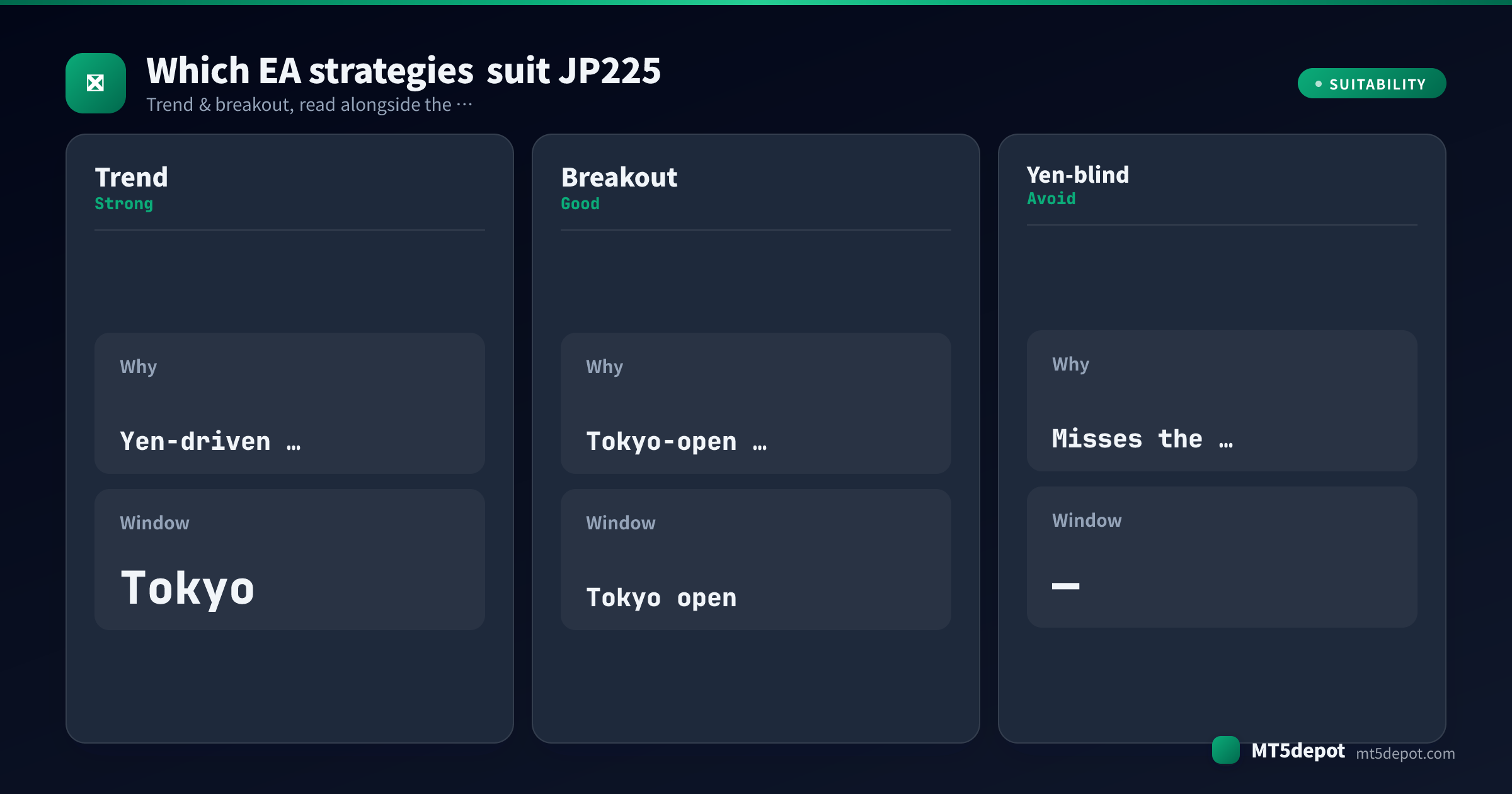
The instrument’s profile lists trend and breakout as suitable — but suitability is an editorial assessment, not proof. In a like-for-like template baseline (default inputs, no optimisation), most strategy templates finish below a 1.0 profit factor on any instrument. The ones that clear it usually earn it through mechanics — session windows, gap handling, a yen filter — not the indicator on the box. What the Nikkei’s character tends to support:
Strategy
Fit on JP225
Why
Trend
Strong
The yen-driven runs that lift the Nikkei can extend for days; a momentum system on M15/H1 that reads the trend alongside USD/JPY often has its cleanest edge here.
Breakout
Good
The Tokyo-open gap gives an objective level to break, and the index’s ~350-point range gives a 2:1 target room to fill. Pending-order entries reduce the spread cost a market fill pays at the volatile open.
Yen-blind (any shape)
Avoid
A JP225 EA that never references USD/JPY is trading without its main driver — it can hold straight into a yen reversal with no idea the force behind its position has flipped.
Trend and breakout that read the yen alongside the index are the shapes that turn the Nikkei’s character into an asset. A yen-blind system, whatever its indicator, is fighting the instrument it is on. There is no JP225-specific catalogue EA yet, so the practical route is to build one of these shapes yourself. The Builder ships templates that accept JP225 and exposes every parameter — then test it (below) before you trust a single number.
Best Trading Hours for JP225 EAs
Session structure decides more of a Nikkei result than indicator choice does:
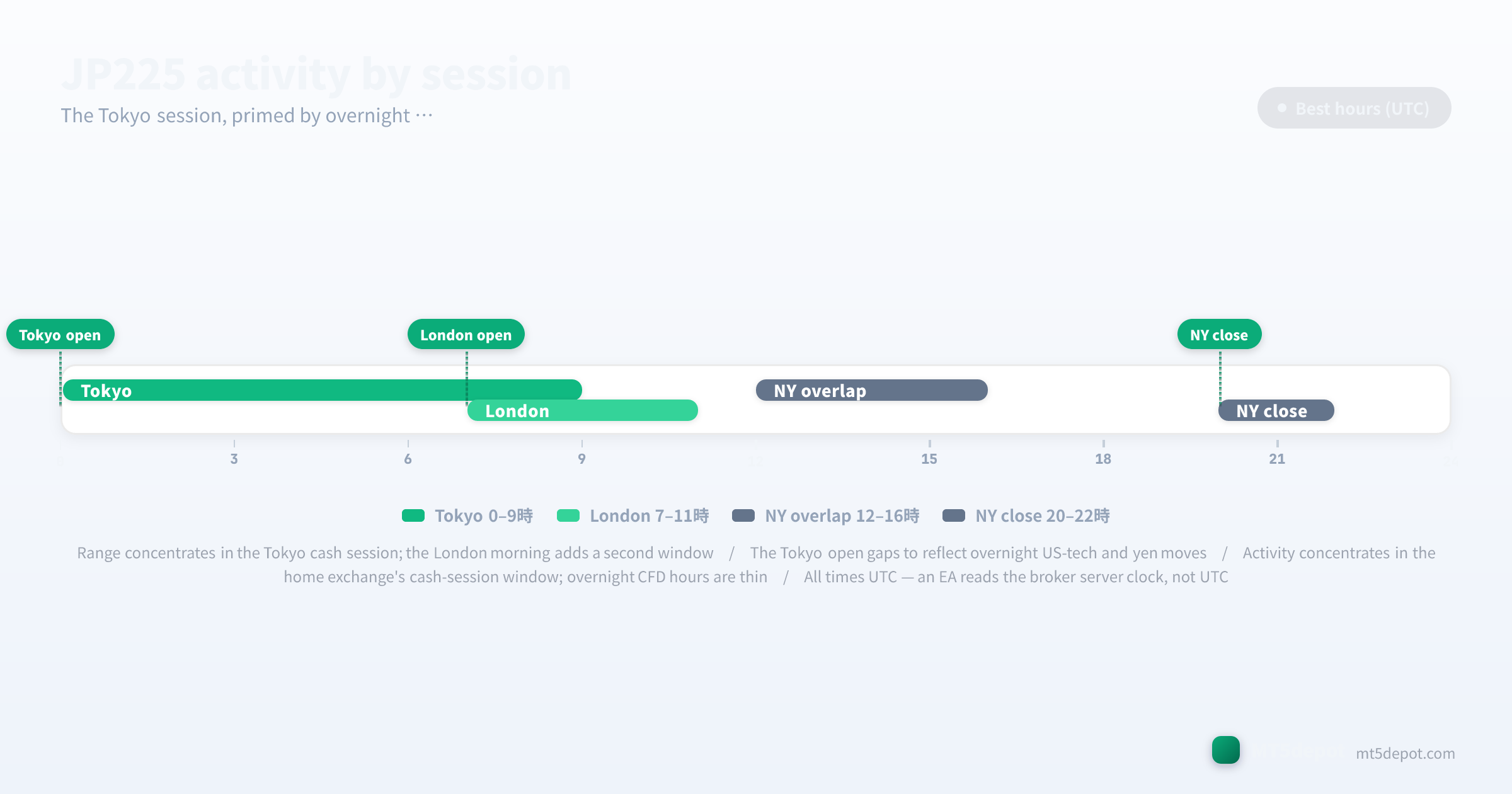
Tokyo open (roughly 00:00 UTC): the most violent minutes of the day. The index gaps to reflect the overnight US-tech and yen moves that accumulated while Japan was closed. This is where breakout EAs find their objective level — and where stops from the previous session can be jumped straight over.
Tokyo cash session (00:00–06:00 UTC): the primary window. Volume and conviction are highest here, and trend EAs tend to earn most of their result while the underlying shares are actually trading.
London morning (07:00–11:00 UTC): the secondary window. European flow adds a second stretch of activity and often revisits or extends the Tokyo range, useful for continuation setups.
Late US / overnight (after London): thin liquidity and low conviction on the CFD, prone to false breakouts that fail once Tokyo reopens. A session filter should treat these hours with caution.
In our editorial assessment, EAs that concentrate on the Tokyo cash session and the London morning often out-perform 24-hour variants. Treat a session filter as part of the strategy definition rather than an optimisation flourish. And every clock time above is UTC. An EA reads your broker’s server clock, which is usually not UTC, so a “00:00” Tokyo-open filter shifts silently when you move the EA between brokers on different server timezones. Verify it once in MT5’s Market Watch, and every session boundary lines up.
Spreads, Costs, and Execution
The Nikkei is priced in index points, not pips, and its costs come in three parts an FX cost model tends to miss. The figures below are editorial reference ranges compiled from broker-published index-CFD conditions (updated July 2026), not broker-by-broker measured numbers; our live sampling currently covers a few FX reference symbols. Confirm the live spread and the point value on your own account before you size a fast strategy:
Cost component
Typical JP225 figure
Notes
Spread
5 – 12 points
Widens sharply at the Tokyo open and in thin overnight hours
Commission
account property
Some index CFDs are spread-only; others add a small per-contract fee
Overnight financing (swap)
daily charge
Applied at rollover for positions held overnight; usually a cost on longs
Two cost rules specific to this instrument:
Overnight financing is a real drag on anything that holds. A JP225 CFD is a leveraged, financed position, so a swing or trend EA that holds for days pays a financing charge every night — a cost a forex-shaped backtest often omits entirely. A strategy that looks profitable before financing can be a loser after it. The swap has to be inside the test, not bolted on afterwards.
The point value is a broker property, not a fixed number. How much one index point is worth per contract varies far more between brokers on an index CFD than a forex lot does, and it decides the real money behind that 5–12 point spread. The commission, where it exists, is an account property layered on top. A JP225 EA validated at one broker’s point value and spread is running a different strategy at another’s until you re-confirm both.
Risks to Test Before Going Live
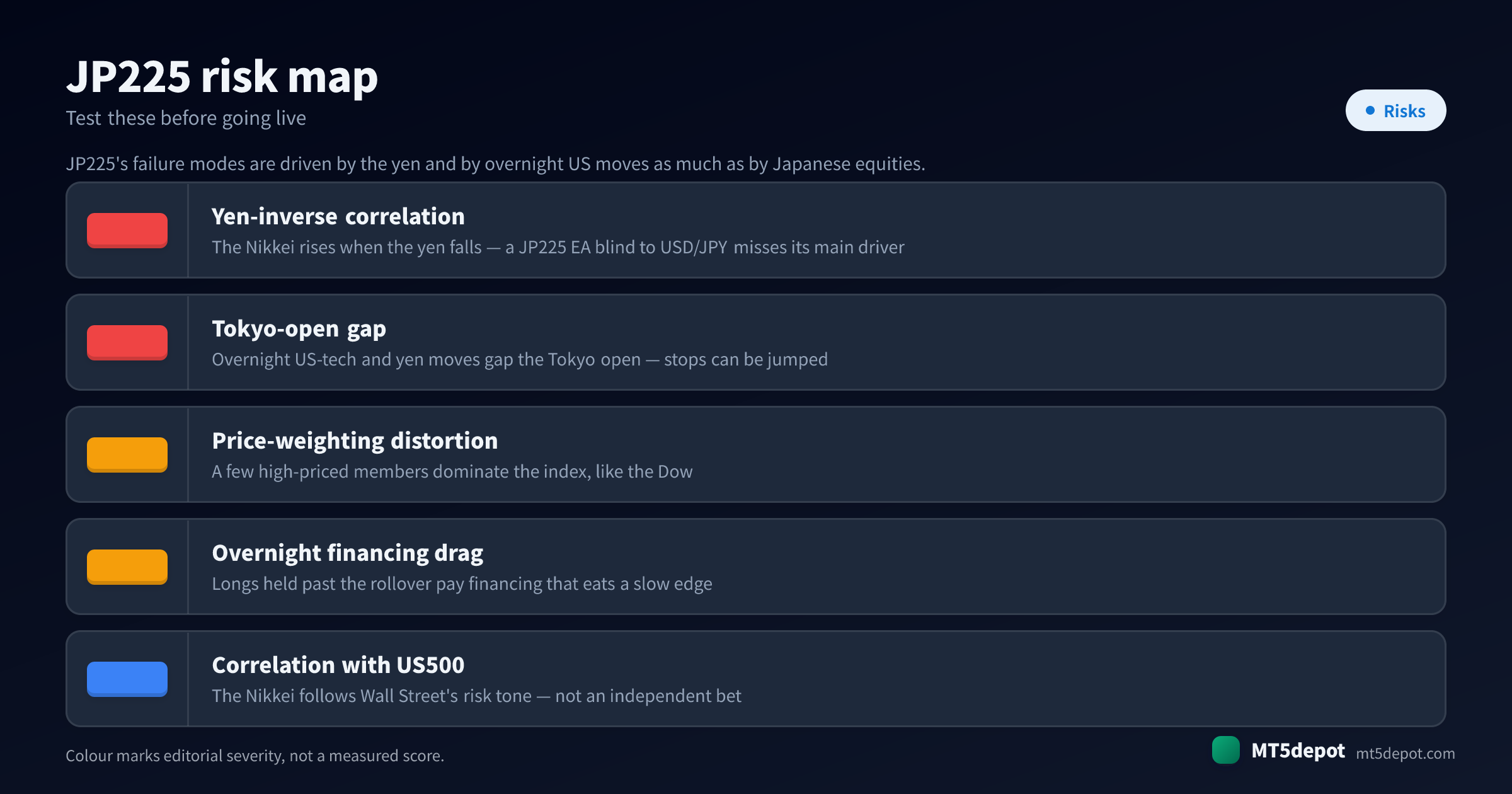
The Nikkei’s failure modes are instrument-and-context errors first, strategy errors second. A generic risk checklist misses most of them:
The yen-blind EA misses its own driver. The single most common Nikkei error is running a JP225 EA that never references USD/JPY. Because the index rises when the yen falls, a price-only system can hold straight into a yen reversal with no signal that the force behind its position has flipped. The strategy can be right about the chart and wrong about the market.
The Tokyo-open gap jumps stops. Overnight US-tech and yen moves accumulate while Tokyo is closed and gap the price at the open. A stop placed the previous session can be leapt over entirely rather than filled at its level. Gap risk has to be modelled with realistic slippage, not assumed away.
Price-weighting hides concentration risk. A few high-priced members dominate the index, so a single expensive stock’s move can swing the whole Nikkei on a day the broader market is flat. An EA that treats JP225 as a broad Japan read is really trading a small, concentrated basket, and a mean-reversion system can be blindsided by one member’s gap.
Overnight financing quietly erodes held positions. A trend or swing EA that holds through the daily rollover accrues a financing charge every night. A backtest that ignores it overstates the edge, sometimes enough to turn a winner into a loser once the swap is applied.
It follows Wall Street, so it is not an independent bet. The Nikkei’s high correlation with the US500 means a JP225 position added to a US-index EA doubles exposure to the same risk tone rather than diversifying it. The correlation is hidden leverage that appears nowhere in either EA’s settings.
How to Test a JP225 EA
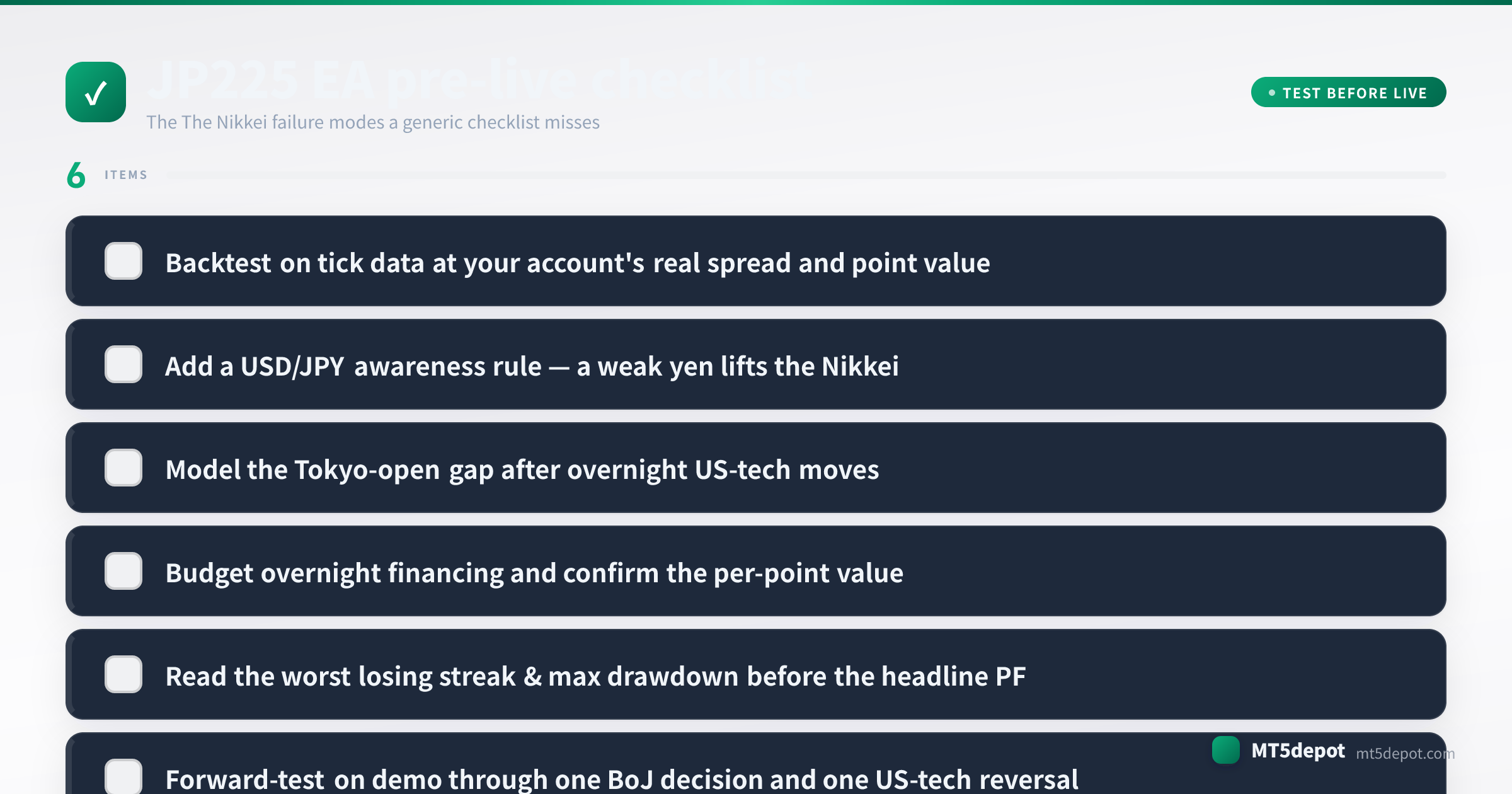
Because there is no catalogue Nikkei EA to lean on, the test is the whole edge. Hold anything you build to the same bar our catalogue EAs publish under the site’s methodology:
Backtest on tick data at your account’s real spread and point value. Use an every-tick model with the 5–12 point spread and the overnight financing you will actually pay, not the platform default. On an index CFD the point-value gap is real money, because it varies so much between brokers.
Model the Tokyo-open gap, then read the worst losing streak. Confirm the strategy survives a realistic open gap with slippage rather than a clean fill. Then read the max drawdown and the longest run of losing trades in account-currency terms. Budget for the worst streak — including a gapped stop — before you fund it.
Forward-test on demo through at least one BoJ or yen catalyst. The Nikkei’s defining risk shows up around a yen move. A demo window that never spans a Bank of Japan decision or a sharp USD/JPY swing has not tested the thing that matters most — the volatility the yen drives into the index.
Confirm the server clock before the first live trade. Re-check MT5’s Market Watch time against the UTC session hours above, especially the Tokyo open, and re-check it after any broker migration. Easy to skip, expensive to miss on an instrument whose whole edge sits at one clock time.
Every backtest number this produces is a historical measurement, not a forecast — size for the drawdown you measured, not the return you hope for.
JP225 EAs and Builder Templates
No dedicated JP225 EA is currently listed in our catalogue. Our full five-year backtests sit on FX majors, and we will not pass off a forex EA as a tested index one. The honest route to a Nikkei EA is to build and verify one:
The Builder (open it here) accepts JP225 in its trend and breakout templates and exposes every parameter. The EA you deploy is built on your own numbers, including the point value and financing your broker actually charges.
Broker and account fit. An index CFD’s spread, point value and overnight financing depend on the account. Check those conditions on your own broker before you size anything — our broker catalogue compares them.
The concept canonicals. If a term above is unfamiliar, the volatility, ATR and leverage entries define the mechanics a JP225 EA depends on most. Leverage especially: a financed index position amplifies both the yen move and the cost of holding it.
Frequently asked questions
What is the best EA for JP225 (Nikkei 225)?
No JP225-specific EA with a five-year backtest is in our catalogue yet — our full backtests currently sit on FX majors, not index CFDs. You can build a Nikkei trend or breakout EA in the Builder instead, then judge it the way you would any strategy: read the worst losing streak and max drawdown before the marketing, and validate on tick data at your own broker's index spread. Add one check FX rarely needs — confirm the point value your broker uses per contract, because index-CFD sizing varies far more between brokers than a forex lot does.
Why does the Nikkei rise when the yen falls?
The index is dominated by large exporters — carmakers, electronics and industrial names — whose overseas earnings are worth more in yen terms when the yen weakens, so a falling yen lifts their expected profits and the index with them. That is why USD/JPY strength and JP225 strength usually move together, and why traders often treat the Nikkei as a leveraged expression of a weak-yen view. An EA that reads only the index chart is blind to the currency move that is frequently the real driver.
Why does JP225 gap at the Tokyo open?
The Tokyo cash market is closed while Wall Street and the US-tech session trade, so any overnight move in US equities or in the yen accumulates with no Japanese price to absorb it. When Tokyo reopens the index gaps to catch up, which is why the first minutes of the Tokyo session are the most violent of the day. Stops placed the previous session can be jumped straight over, so gap risk has to be modelled, not assumed away.
Is JP225 good for scalping EAs?
It is a difficult instrument for it. A 5–12 point typical spread is a meaningful share of a small index scalp, and the Tokyo-open gap plus thin overnight liquidity punish the tight stops a scalper relies on. Most Nikkei strategies work better on M15 or H1, where the larger index swings make the spread and the overnight financing a small fraction of the trade rather than the whole margin.
Does holding a JP225 CFD overnight cost money?
Usually yes. An index CFD is a leveraged, financed position, so a broker applies a daily swap or financing charge for holding it past the daily rollover, and for a long position that charge is typically a cost rather than a credit. A scalper who closes intraday never sees it, but a swing or trend EA that holds for days accrues it every night, so the financing has to be inside the backtest before the strategy looks profitable.