The Dow Jones 30 CFD — a price-weighted blue-chip index where the highest-priced stocks, not the biggest companies, move the tape. That quirk plus a large per-point value makes it behave differently from the cap-weighted S&P, and rewards trend EAs that understand what is actually driving it.
Typical values — US30 is not yet measured broker-by-broker; confirm the live spread and point value on your own account.
Data
Trading conditions
Session windows, broker spreads, and cost math for this symbol — measured and typical values, not marketing.
Trading sessions
FX market closed (weekend)
Sydney—22:00–07:00 UTC
Tokyo—00:00–09:00 UTC
LondonBest sessions—07:00–16:00 UTC
New YorkBest sessions—12:00–21:00 UTC
0006121824
Times are UTC and adjust automatically for daylight saving (Tokyo has no DST). The timeline shows the current UTC day; the vertical marker is the time right now.
Position planning
Contract size for this instrument varies by broker, so pip value and margin cannot be quoted generically — check your broker's contract specification.
Planning estimates from the typical values on this page — not live quotes. Actual pip value, margin and spread depend on your broker's contract specification and account currency.
Every catalogued EA on this symbol is re-verified by a rolling backtest as new price data arrives, using the settings locked at listing. Figures update daily from the verified data chain.
US30 is the CFD on the Dow Jones Industrial Average — “The Dow” — a basket of 30 US blue-chip stocks. It is not a currency pair but a stock-index CFD, so it inherits two things no forex pair has. The first is a price-weighted construction, in which the highest-priced members move the tape most regardless of company size. The second is an underlying cash market that closes overnight. The first thing to decide is whether your strategy wants that character or merely tolerates it. A trend EA can feed on the Dow’s blue-chip drift and its US-open ranges. A system designed for a 24-hour forex pair instead meets an instrument that gaps at the open, charges financing to hold, and moves in hundreds of points where a major moves in fractions of one. Pick the instrument to the strategy, not the other way round.
This page covers what The Dow gives an automated strategy that a forex pair does not, the session that decides its results, and what it costs in index points. It then covers the failure modes that catch FX-built systems, and how to test a US30 EA when there is no off-the-shelf one to copy.
How US30 Behaves: What The Dow Gives an EA
For an automated strategy, the Dow’s most important feature is structural rather than reputational: it is built and priced in ways a forex EA was never designed for. Three properties define its behaviour.
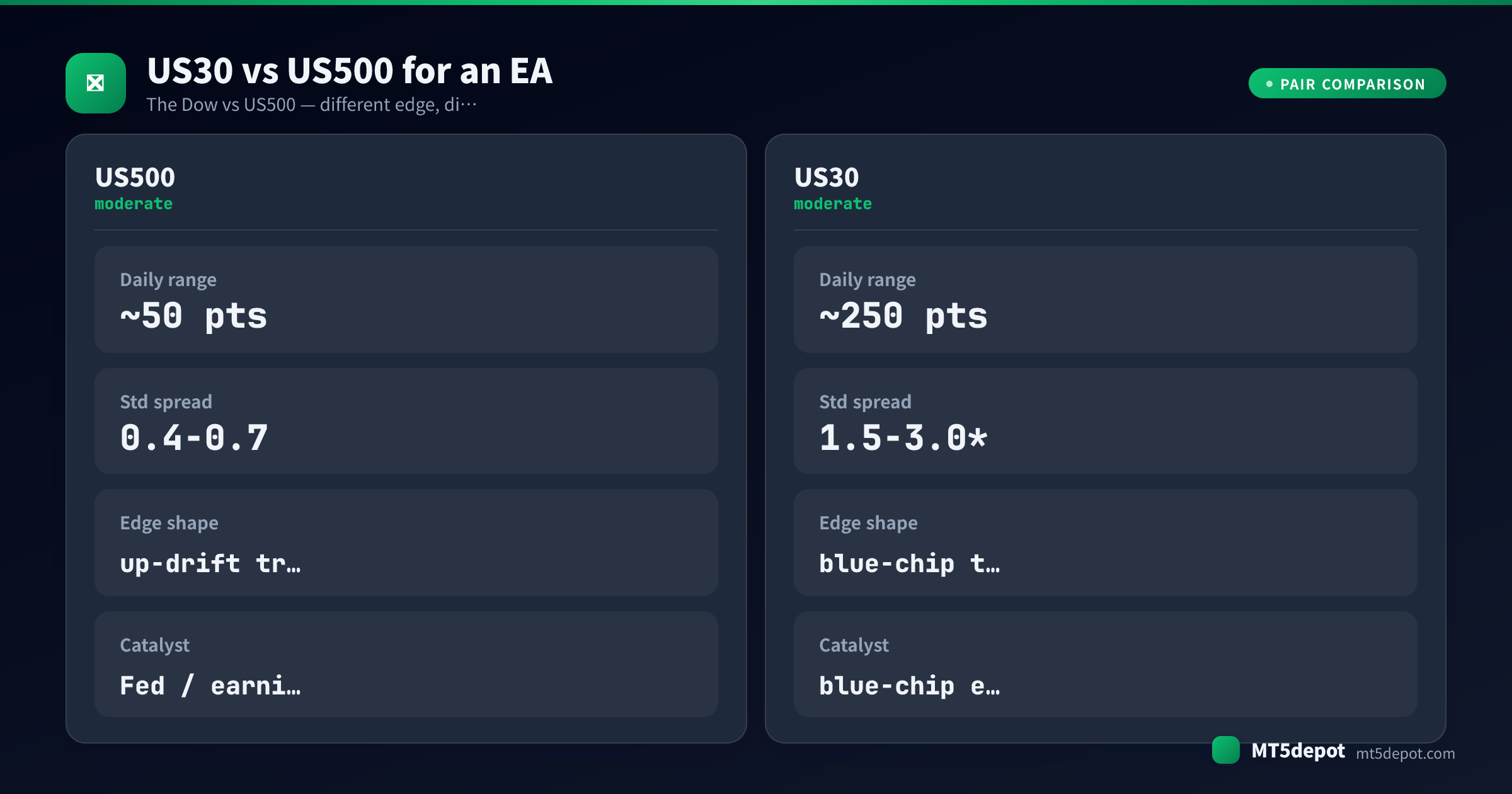
Price-weighted, not cap-weighted. This is the defining quirk, and the one most traders get wrong. A member’s influence is proportional to its share price, not its market capitalisation. A high-priced constituent therefore moves the index far more than a much larger company with a low share price. That is the opposite of the S&P 500 (US500), which is capitalisation-weighted. An EA that reasons about “the largest US firms” is reasoning about US500; on US30 it tracks whichever handful of high-priced names dominate the arithmetic.
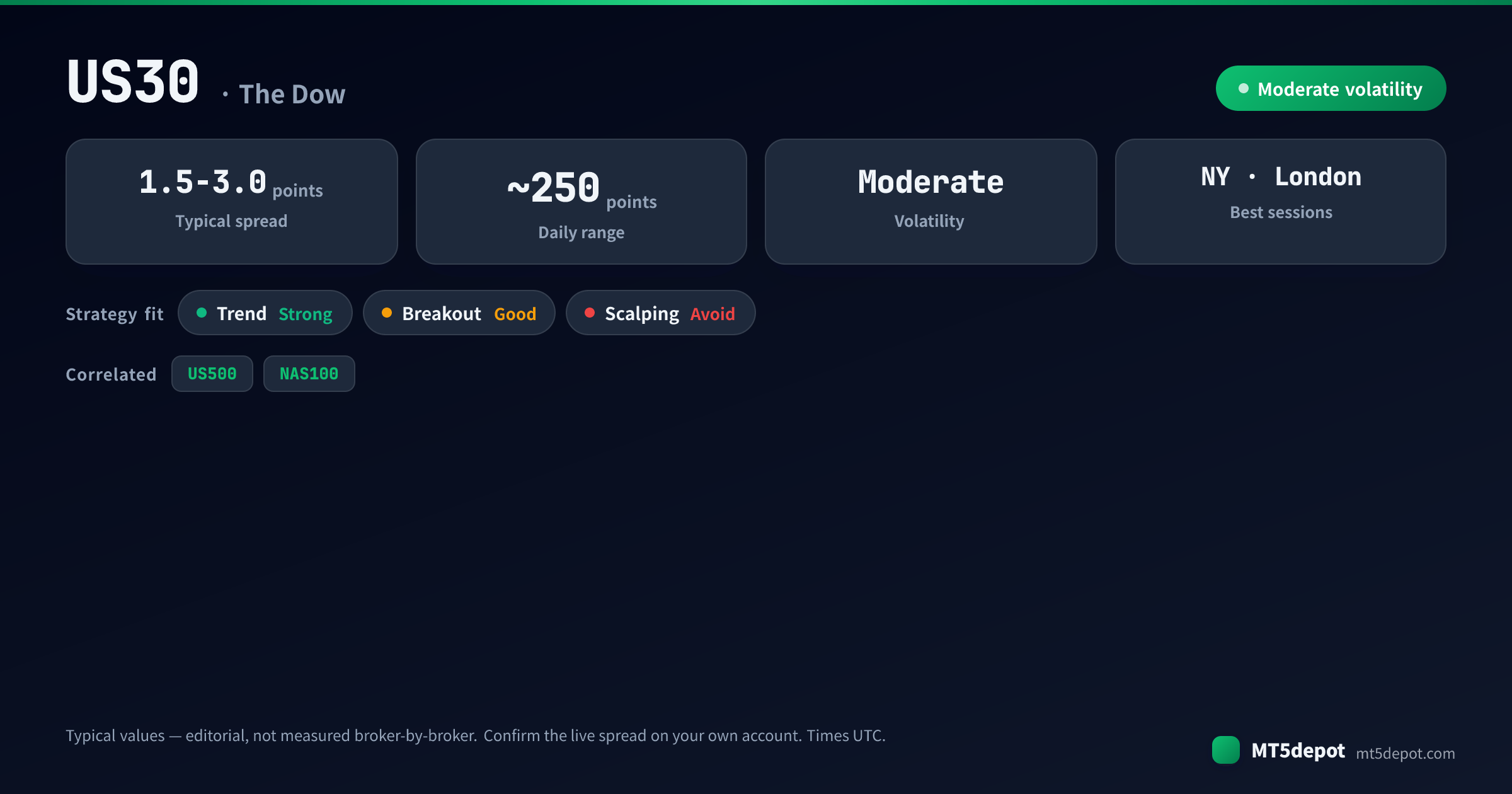
A large per-point value and hundreds of points of range. The index trades in the tens of thousands, and its typical daily range is around 250 points — a reference figure, not a broker-by-broker measurement. Each point carries a value set by the contract, far larger in account-currency terms than a forex pip. The same lot size that is prudent on EUR/USD can put a multiple of your intended risk on one US30 position. Position sizing — not the entry signal — decides whether the strategy survives its first ordinary move.
A closing cash market and financing. US30 tracks an underlying that shuts overnight and at weekends, so it opens with gaps rather than moving continuously. Holding past the broker’s rollover time incurs a daily financing charge, because you hold a leveraged derivative rather than the stocks themselves. Neither behaviour has any analogue in a 24-hour forex pair.
The trap for automated strategies is that a smooth blue-chip trend looks like an easy edge on a backtest. The same instrument, with its large per-point value, overnight gaps and financing drag, turns one ordinary session into an account event if the EA was sized and modelled like forex. The Dow rewards strategies that respect its volatility regime and its sizing arithmetic, and quietly ruins ones that treat it as “a pair that goes up.”
Which EA Strategies Suit US30?
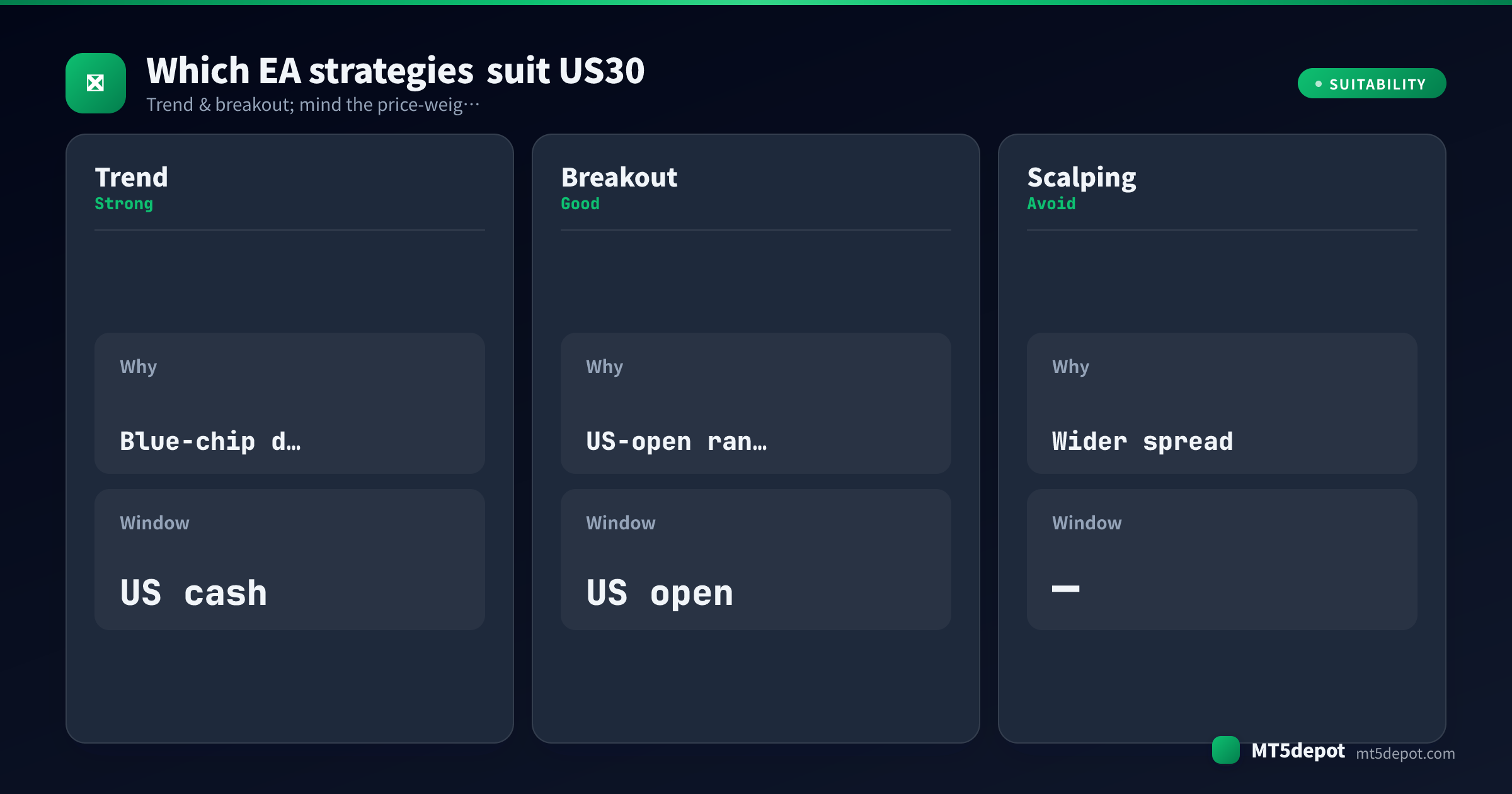
The instrument’s profile lists trend and breakout as suitable — but suitability is an editorial assessment, not proof. In a like-for-like template baseline (default inputs, no optimisation), most strategy templates finish below a 1.0 profit factor on any instrument. The ones that clear it usually earn it through mechanics — timeframe, session windows, sizing discipline — not the indicator on the box. What the Dow’s character tends to support:
Strategy
Fit on US30
Why
Trend-following
Strong
The Dow’s blue-chip drift produces sustained directional moves through the US cash session that momentum systems on M15/H1 can ride — the large point range gives a 2:1 or 3:1 target room to fill.
Breakout (pending orders)
Good
The US-open range and reaction to US data give an objective level to break; pending-order entries at the range edge reduce the spread cost a market fill pays on a wider-spread index.
Scalping
Avoid
A 1.5–3.0 point spread plus the large per-point value make the cost a meaningful share of a small target, and the Dow’s fast excursions punish tight stops. The cost math rarely clears.
Multi-index basket
Handle with care
US30 is correlated with US500 and NAS100; a basket across all three is closer to one leveraged bet than a hedge — see the risks below.
Trend and breakout in the US cash session are the shapes that turn the Dow’s range into an asset. There is no US30-specific catalogue EA yet, so the practical route is to build one of these shapes yourself. The Builder ships templates that accept index symbols and exposes every parameter, including lot size — then test it (below) before you trust a single number.
Best Trading Hours for US30 EAs
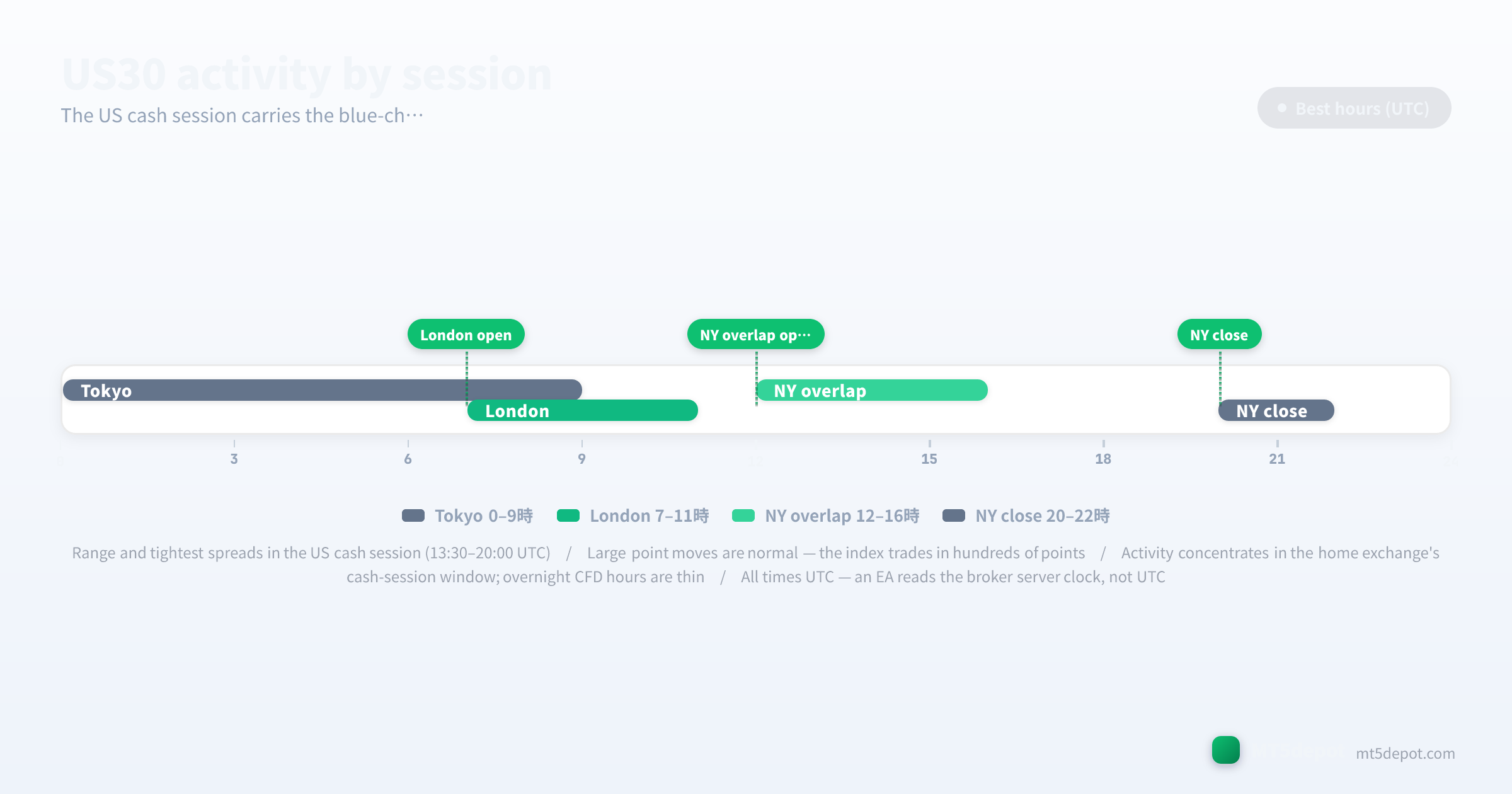
Session structure decides more of a US30 result than indicator choice does. The decisive window is narrower than a forex trader expects, because the Dow’s real liquidity lives in the US cash session:
Pre-US hours (before 13:30 UTC): the London morning and Asian hours trade the index thinly against the closed US cash market. Ranges are quiet, spreads are wider, and breakouts here often fail once real US depth arrives.
US cash open (≈13:30 UTC): the primary event of the day. The cash market opens, the overnight gap resolves, and the index expands sharply. This is where breakout and trend EAs on the Dow tend to earn most of their result — and where the overnight gap can skip a stop.
US cash session (13:30–20:00 UTC): the core window. Volume is highest and spreads are tightest here, and the sustained directional moves that suit a trend EA form in these hours.
After the US close (after 20:00 UTC): liquidity drains, conviction drops, and false signals return until the next cash open — hours a session filter should generally exclude.
In our editorial assessment, EAs that restrict trading to the US cash session often out-perform 24-hour variants on the Dow. Treat a session filter as part of the strategy definition rather than an optimisation flourish, and test that on your own data. Two cautions come with it. Scheduled US events — CPI, FOMC, non-farm payrolls, plus blue-chip earnings — sit inside that good window and widen the index spread exactly then. A fast strategy needs a news pause, or it pays several times the normal spread at the worst moment. And every clock time above is UTC. An EA reads your broker’s server clock, which is usually not UTC, so a “13:30” US-open filter shifts silently when you move the EA between brokers on different server timezones. Verify it once in MT5’s Market Watch, and every session boundary lines up.
Spreads, Costs, and Execution
US30 is priced and costed in index points, not pips, and its cost has a third component a forex pair does not: overnight financing. The figures below are editorial reference ranges compiled from broker-published index-CFD conditions (updated July 2026), not broker-by-broker measured numbers; our live spread sampling currently covers a few FX reference symbols. Confirm the live spread and the value per point on your own account before you size a fast strategy:
Cost component
Typical US30 level
Notes
Spread
1.5 – 3.0 points
Tightest in the US cash session; wider pre-open and around US data
Commission
none – small per-lot
An account property, not an instrument property
Overnight financing
daily charge on held positions
Applies past the broker’s rollover time; negligible for intraday, real for swing
Three cost rules specific to this instrument:
The spread is measured in points, and the point is expensive. A 1.5–3.0 point spread sounds small. But each index point carries a large account-currency value, so the dollar cost of a round-trip is far higher than a forex pair’s. That is why small-target and scalping systems rarely clear it, and why the table above rates scalping avoid.
The commission is an account property, not an instrument one. Whether a broker charges a per-lot commission or folds the cost into the spread depends on the account type, not on the Dow. What changes between symbols is the spread and the point value on top of it. A US30 system validated on one account’s cost structure is a different strategy on another’s.
Financing is a real, recurring cost a forex-style backtest often ignores. A swing EA that holds US30 for days pays the daily charge each time. A backtest that models the index as a 24-hour instrument with no rollover cost overstates that strategy’s profit. Include financing in the test, or keep the EA intraday.
Risks to Test Before Going Live
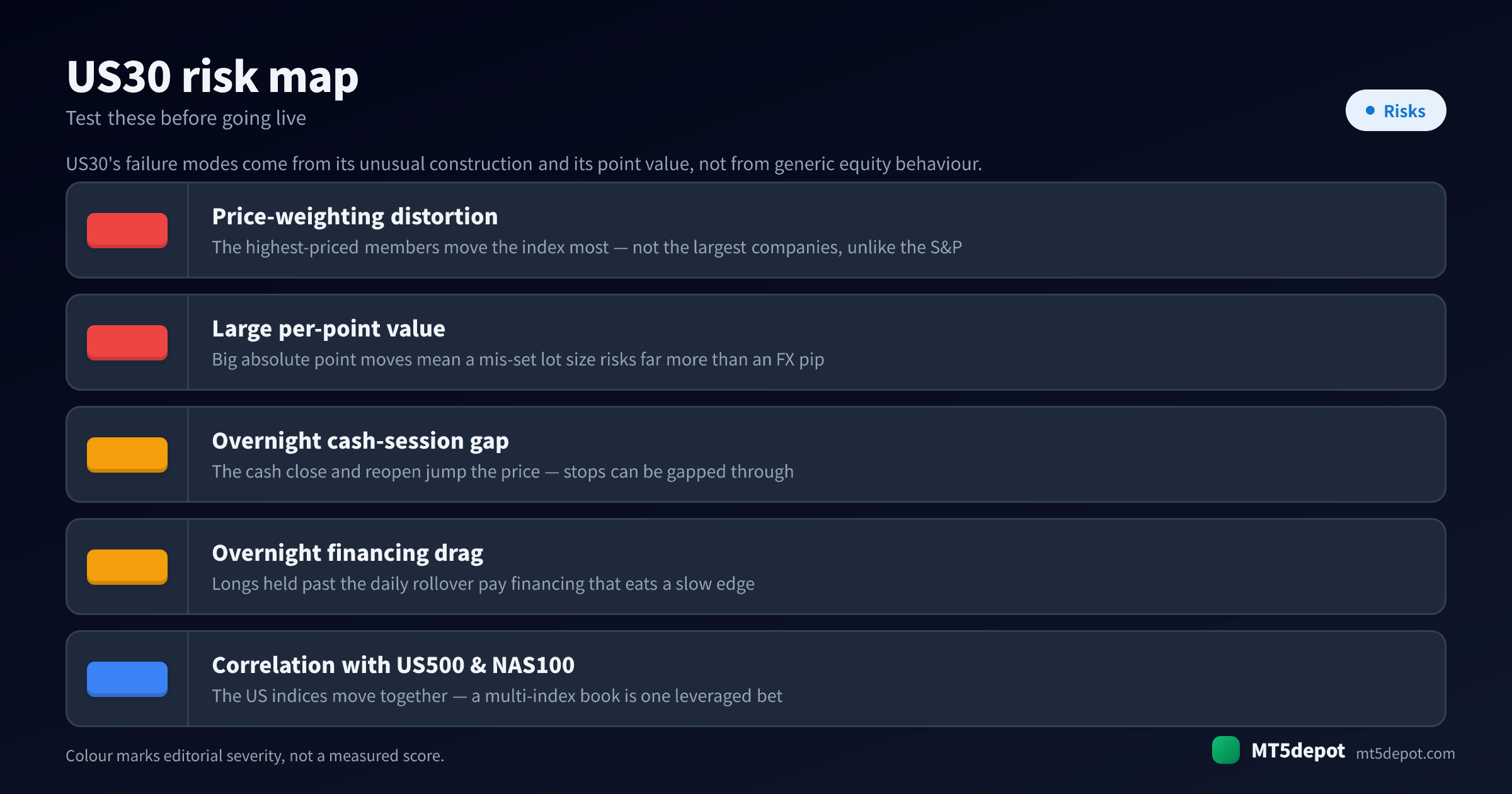
The Dow’s failure modes are capital-and-structure errors first, strategy errors second, and a generic risk checklist misses most of them:
The per-point sizing shock. Because each US30 point carries a large account-currency value, running the index at a forex-style lot size can put a multiple of your intended risk on one position. One ordinary Dow move at the wrong lot size can be an account-ending event before the strategy has done anything wrong. Re-size lots to the value per point before anything else.
The overnight cash gap skips your stop. US30 tracks a market that closes overnight and at weekends, so it opens with gaps that a 24-hour forex EA never produces. A stop placed inside that gap is not filled at your price — it is skipped and filled at the next available one. A swing EA must model gap risk explicitly rather than assume a continuous market.
Financing drag quietly erodes swing results. A position held past rollover pays a daily financing charge, and a backtest that ignores it flatters any multi-day strategy.
Price-weighting distorts what “the market” is doing. Because the Dow is price-weighted, a single high-priced constituent’s earnings can swing the index while the broad US equity market barely moves. That is the opposite of the cap-weighted US500. An EA that assumes US30 reflects “big US companies” is mis-reading its own signal.
Correlation across indices is hidden leverage. US30, US500 and NAS100 move together most of the time. Two “diversified” EAs on US30 and US500 are closer to one leveraged position than a hedge. The correlation doubles your exposure to US equities without appearing anywhere in either EA’s risk settings.
How to Test a US30 EA
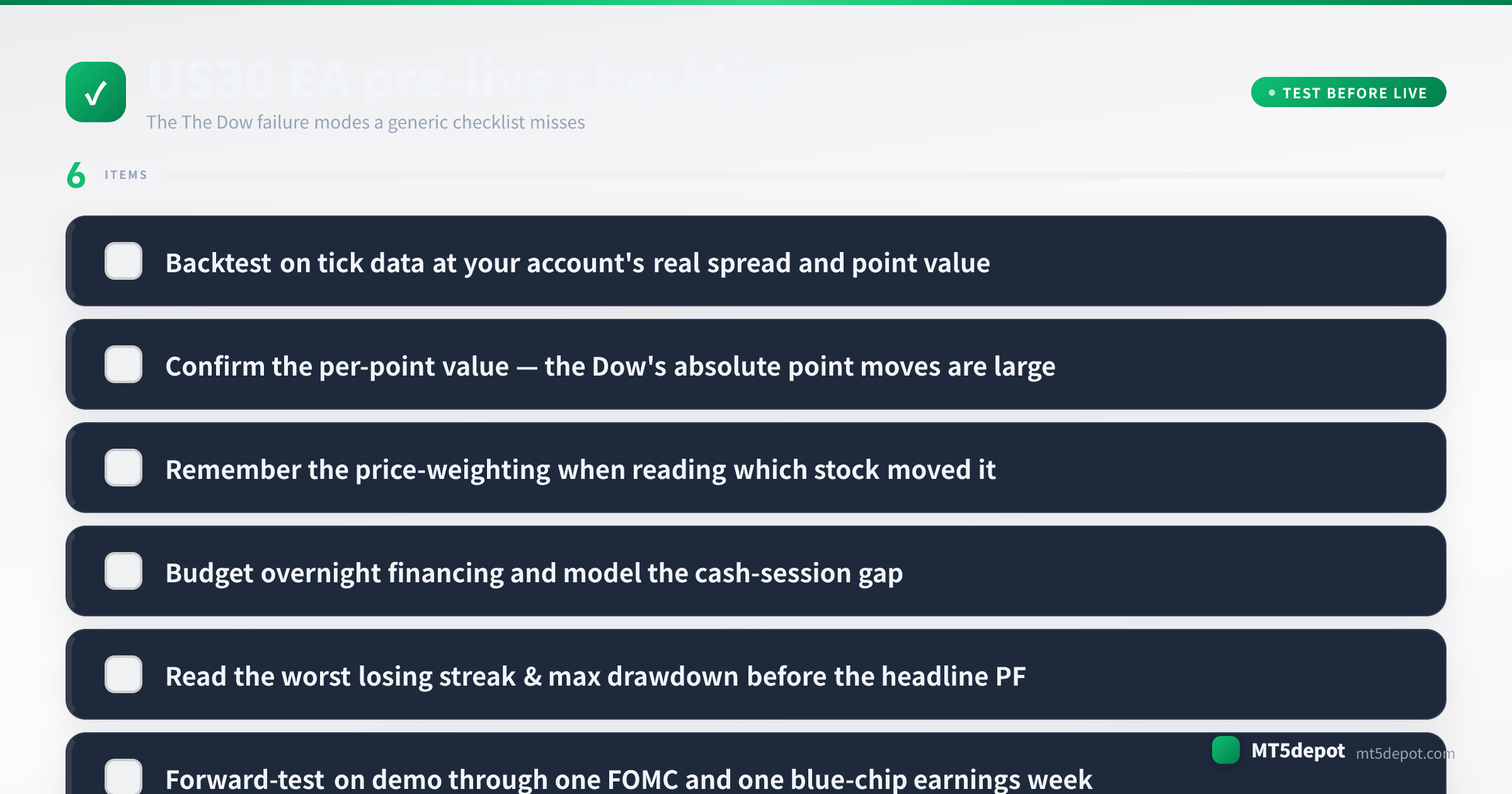
Because there is no catalogue Dow EA to lean on, the test is the whole edge. Hold anything you build to the same bar our catalogue EAs publish under the site’s methodology:
Backtest on tick data at your account’s real index spread — and include financing. Use an every-tick model with the 1.5–3.0 point spread you will actually trade, not the platform default. Switch on the broker’s swap/financing so a swing strategy is judged on its true cost, not one it will never trade at.
Right-size the lots, then read the worst losing streak in account currency. Confirm the value per point your lot size implies is one you can survive. Then read the max drawdown and the longest run of losing trades in money terms, not points — the Dow’s large per-point value turns a modest point drawdown into a large capital one. Budget for the worst streak before you fund it.
Forward-test on demo through at least one overnight gap and one US print. The Dow’s defining risks — the cash gap and the reaction to CPI, FOMC or blue-chip earnings — only show up around those events. A demo window that never spans a weekend gap or a scheduled US release has not tested the thing that matters most.
Confirm the server clock before the first live trade. Re-check MT5’s Market Watch time against the UTC session hours above, and re-check it after any broker migration. Easy to skip, expensive to miss: the US-open filter is what keeps the EA out of the thin, wide-spread hours.
Every backtest number this produces is a historical measurement, not a forecast — size for the drawdown you measured, not the return you hope for.
US30 EAs and Builder Templates
No dedicated US30 EA is currently listed in our catalogue. Our full five-year backtests sit on FX majors, and we will not pass off a forex EA as a tested index one. The honest route to a Dow EA is to build and verify one:
The Builder (open it here) accepts index symbols in its trend and breakout templates and exposes every parameter — crucially the lot size that decides an index strategy’s survival. The EA you deploy is built on your own numbers and your own per-point sizing arithmetic.
Broker and account fit. The Dow’s cost, point value and financing all depend on the account. Check the spread, the value per point and the swap conditions on your own broker before you size anything — our broker catalogue compares them.
The concept canonicals. If a term above is unfamiliar, the volatility, ATR and leverage entries define the mechanics a US30 EA depends on most.
Frequently asked questions
What is the best EA for US30?
No US30-specific EA with a five-year backtest is in our catalogue yet — our full backtests currently sit on FX majors, not stock-index CFDs. You can build a Dow trend or breakout EA in the Builder instead, then judge it the way you would any strategy: read the worst losing streak and max drawdown first, and validate on tick data at your own broker's index spread. On an index, add one check FX rarely needs — confirm the value per point, because a wrong lot size can risk far more than a mis-set forex position.
How is US30 different from the S&P 500 (US500)?
US30 tracks only 30 blue-chip stocks and is price-weighted, so the highest-priced members move it most regardless of company size; US500 tracks 500 names and is capitalisation-weighted, so the largest companies dominate. That means a single high-priced Dow constituent can swing the index while a mega-cap with a low share price barely registers. The two indices usually move together but not identically, which is why treating them as one basket understates your real exposure.
Why does US30 gap at the open?
A stock-index CFD tracks a cash market that is closed overnight and on weekends, so news that lands while it is shut is priced in as a jump when it reopens rather than as a continuous move. The result is an overnight cash gap that a 24-hour forex pair never produces. A stop placed inside that gap is skipped and filled at the next available price, so gap risk has to be modelled explicitly, not assumed away.
Does holding a US30 CFD cost money overnight?
Usually yes. Index CFDs carry a daily financing charge for positions held past the broker's rollover time, because you are trading a leveraged derivative rather than owning the underlying stocks. For a fast intraday EA that flattens before rollover the drag is negligible, but for a swing system that holds for days it is a recurring cost that a backtest ignoring financing will quietly overstate the profit of.
Can you scalp US30 profitably?
It is the harder path. The typical index spread of 1.5–3.0 points plus the large per-point value make the cost of each round-trip a meaningful share of a small target, and the Dow's fast excursions punish the tight stops a scalper relies on. Most index strategies work better as trend or breakout systems in the US cash session, where the larger moves make the spread a small fraction of the trade rather than the whole margin.