At a glance
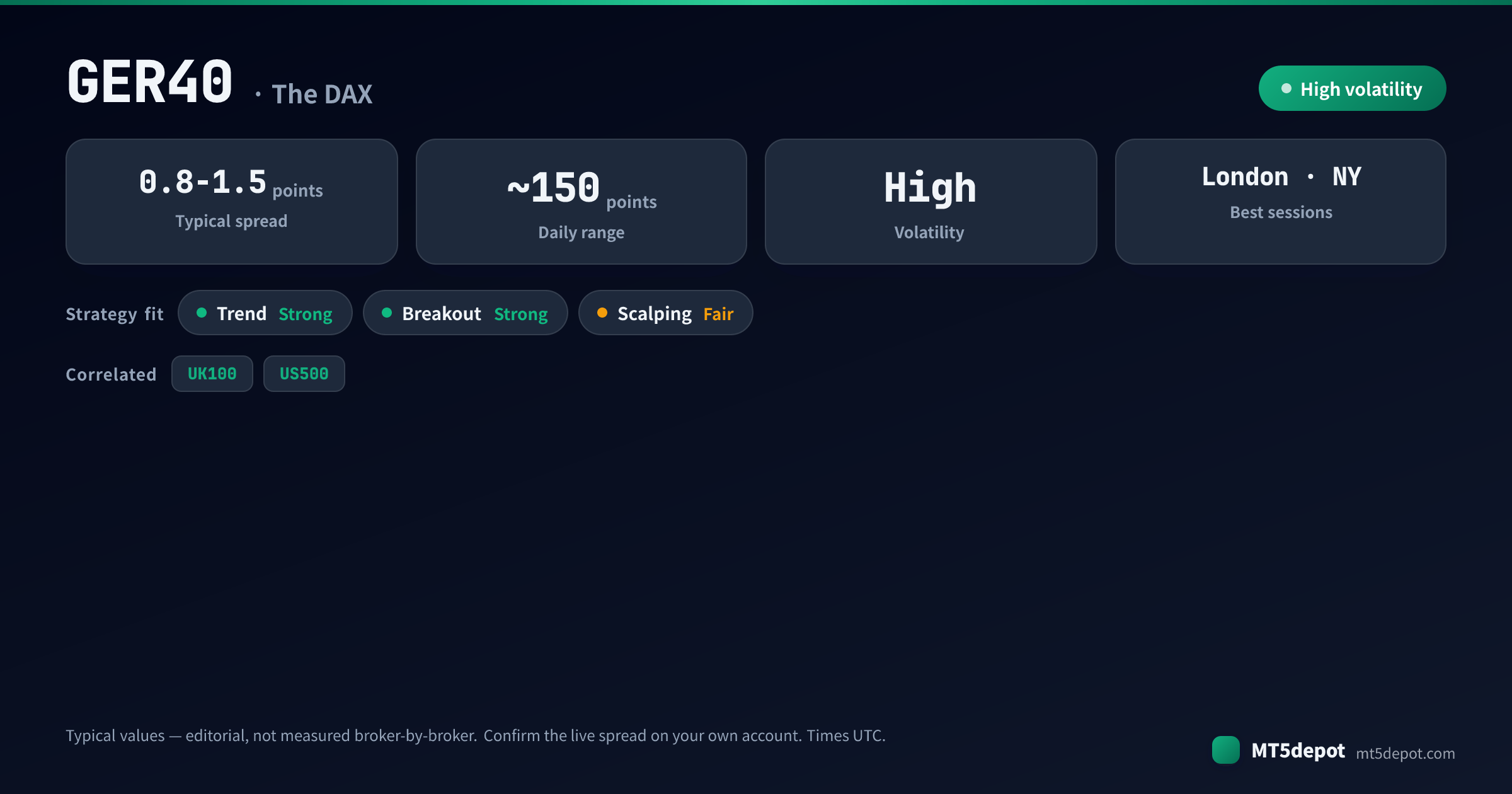
GER40 · The DAX
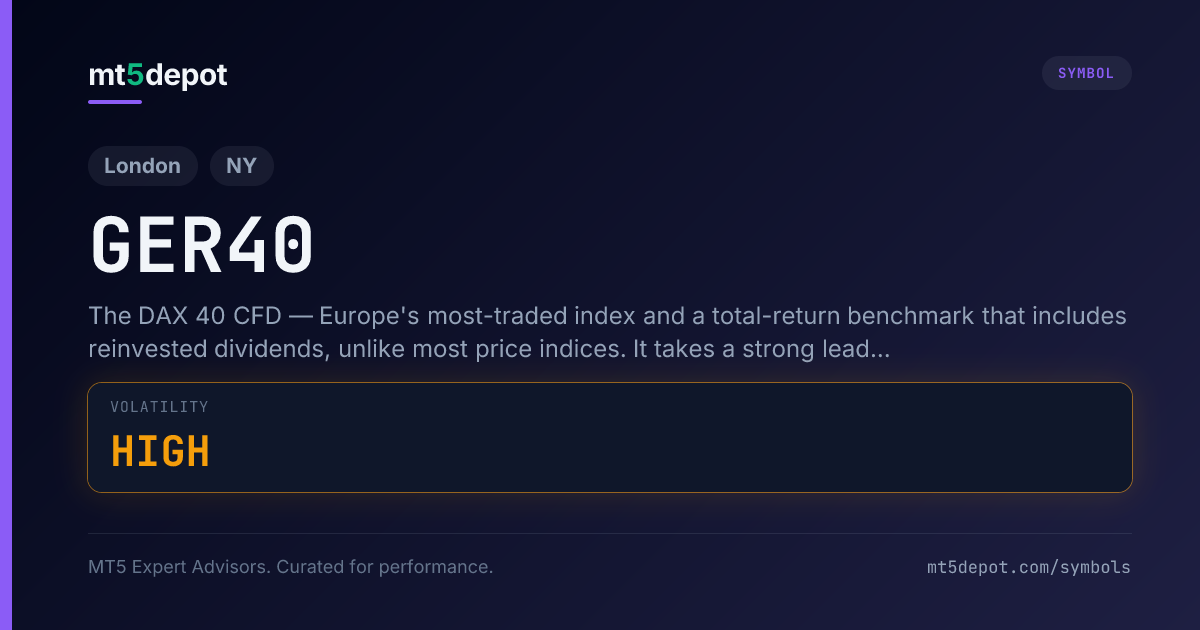
The DAX 40 CFD — Europe's most-traded index and a total-return benchmark that includes reinvested dividends, unlike most price indices. It takes a strong lead from the US open, so a DAX EA that ignores Wall Street is trading half the picture. Clean European-session ranges reward trend and breakout systems.
Typical values — GER40 is not yet measured broker-by-broker; confirm the live spread and point value on your own account.
Data
Trading conditions
Session windows, broker spreads, and cost math for this symbol — measured and typical values, not marketing.
EA catalogue
EAs for GER40
Why this list is empty
Our catalogue lists no GER40 EA right now. An EA is listed only after it passes our tick-data backtest gate — and the numbers are published either way. Until then, build and test your own below.
- Listing is gated, not editorial — an EA reaches this page only after it passes our tick-data backtest gate.
- The numbers are published either way, including the EAs that failed the gate and were delisted.
- You can build your own GER40 EA and backtest it on this symbol before anything goes live.
Analysis
GER40: the full analysis
GER40 is the DAX 40 as a contract-for-difference: not a currency pair, but a stock-index CFD tracking Germany’s 40 largest listed companies. The first thing to decide is whether your strategy wants this instrument’s character or merely tolerates it. The DAX is a total-return index that bakes in reinvested dividends, and it takes a strong lead from the US open, so it behaves differently from a price index like the UK100 (FTSE 100) that a strategy might have been designed on. A trend or breakout EA feeds on the DAX’s clean European-session ranges. A system that assumes a self-contained, dividend-free instrument meets structural quirks that FX and price-index assumptions both miss.
This page covers what the DAX gives an automated strategy that a currency pair does not, the sessions that decide its results, and what it costs. It then covers the failure modes that catch systems moved over from FX or from price indices, and how to test a DAX EA when there is no off-the-shelf one to copy.
How GER40 Behaves: What The DAX Gives an EA
The DAX is Europe’s most-traded index and one of the busiest index CFDs on any retail platform. It differs from a forex pair — and even from other indices — in ways that matter more for automation than any indicator choice. Its construction and its drivers sit outside the assumptions a typical FX or price-index EA carries.
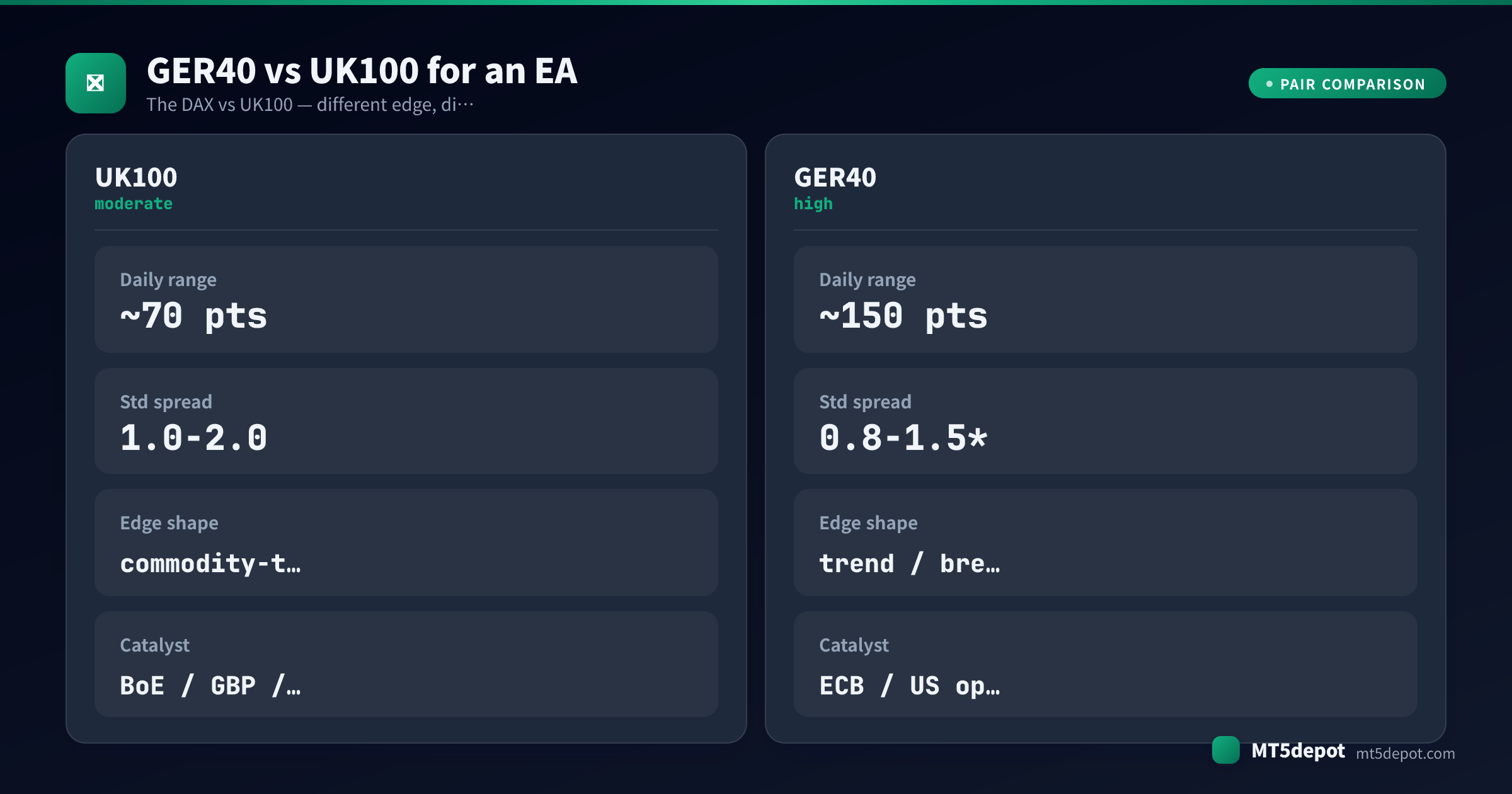
For an EA, that character reduces to three properties:
- A total-return construction, not a price index. The DAX is a performance index: ordinary dividends are treated as reinvested and baked into the level. That is why its raw number sits structurally higher over time than a price index like the UK100 or the US500, which strip dividends out. This is a documented methodology fact, not a live measurement. The DAX’s level is therefore not directly comparable to those benchmarks, and any cross-index logic — ratios, spreads, “cheap versus expensive” filters — that treats them on the same footing is comparing two different things.
- A strong lead from the US open. The DAX is dominated by large, export-heavy multinationals whose fortunes track global and especially US demand, so German equities follow Wall Street closely. The index frequently accelerates or reverses its morning European move when the US cash session opens at 13:30 UTC. A DAX EA that reads only European price action is trading half the picture.
- A ~150-point typical daily range with an index CFD’s mechanics. Our published typical daily range for the DAX is near 150 index points — labelled typical, not measured broker-by-broker — which gives trend and breakout systems room to run. But as an index CFD it also carries an overnight cash-session gap and a financing charge on carried positions that a spot-FX EA never models. Re-size stops to the DAX’s own volatility in points, and account for the gap and the financing, before anything else.
The trap for automated strategies is that the DAX’s clean range looks like an easy edge on a backtest. Its US-open dependence, dividend-inclusive level and overnight mechanics quietly change the result in ways the price series alone does not reveal. The DAX rewards strategies built for an index CFD linked to Wall Street, and drains ones that treat it as a self-contained European market that behaves like a currency.
Which EA Strategies Suit GER40?
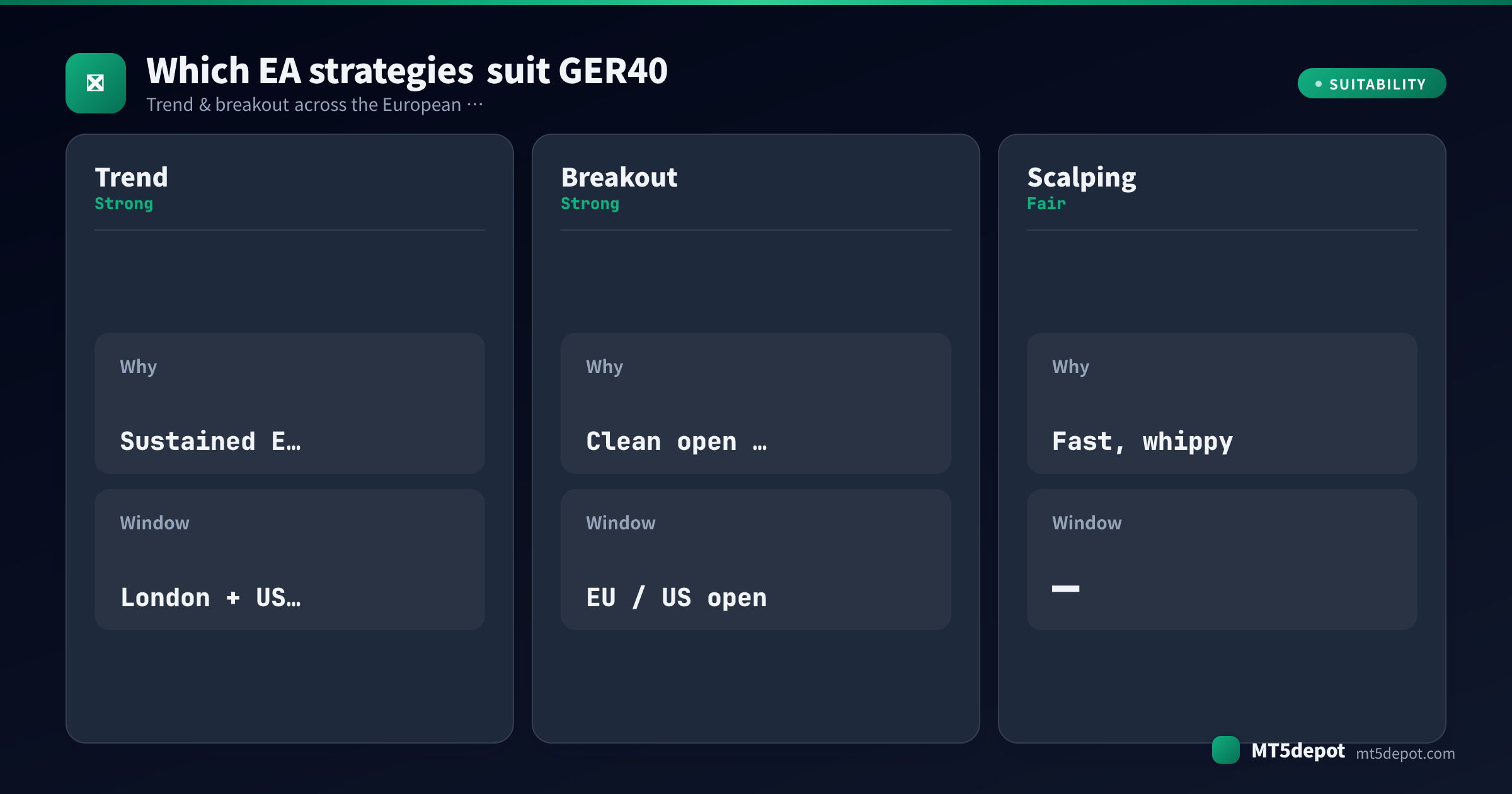
The instrument’s profile lists trend and breakout as suitable — but suitability is an editorial assessment, not proof. In a like-for-like template baseline (default inputs, no optimisation), most templates finish below a 1.0 profit factor on any instrument. The ones that clear it earn it through mechanics — session windows, a US-open rule, pending-order entries — not the indicator on the box. What the DAX’s character tends to support:
| Strategy | Fit on GER40 | Why |
|---|---|---|
| Trend-following | Strong | The DAX produces sustained directional moves across the European session, and the 13:30 UTC US open often extends them — momentum systems that stay aware of Wall Street find their cleanest edge here. |
| Breakout (pending orders) | Strong | The European cash open and the US open both print objective ranges to break; pending-order entries at the range edge are less spread-sensitive than market fills into a fast, whippy index. |
| Scalping | Fair | Possible but harder — the DAX is fast and whippy around both opens, and the spread in points is a real cost against small targets. Treat any DAX scalper as unproven until a tick-data test says otherwise. |
| Multi-index basket | Handle with care | GER40’s correlation with UK100 and US500 is a risk covered below — a “diversified” book across European and US indices is closer to one leveraged directional bet than a hedge. |
Trend and breakout are the shapes that turn the DAX’s range into an asset. Scalping has to fight the noise and the spread at once. There is no DAX-specific catalogue EA yet, so the practical route is to build one of these shapes yourself. The Builder ships trend and breakout templates and exposes every parameter — then test it (below) before you trust a single number.
Best Trading Hours for GER40 EAs
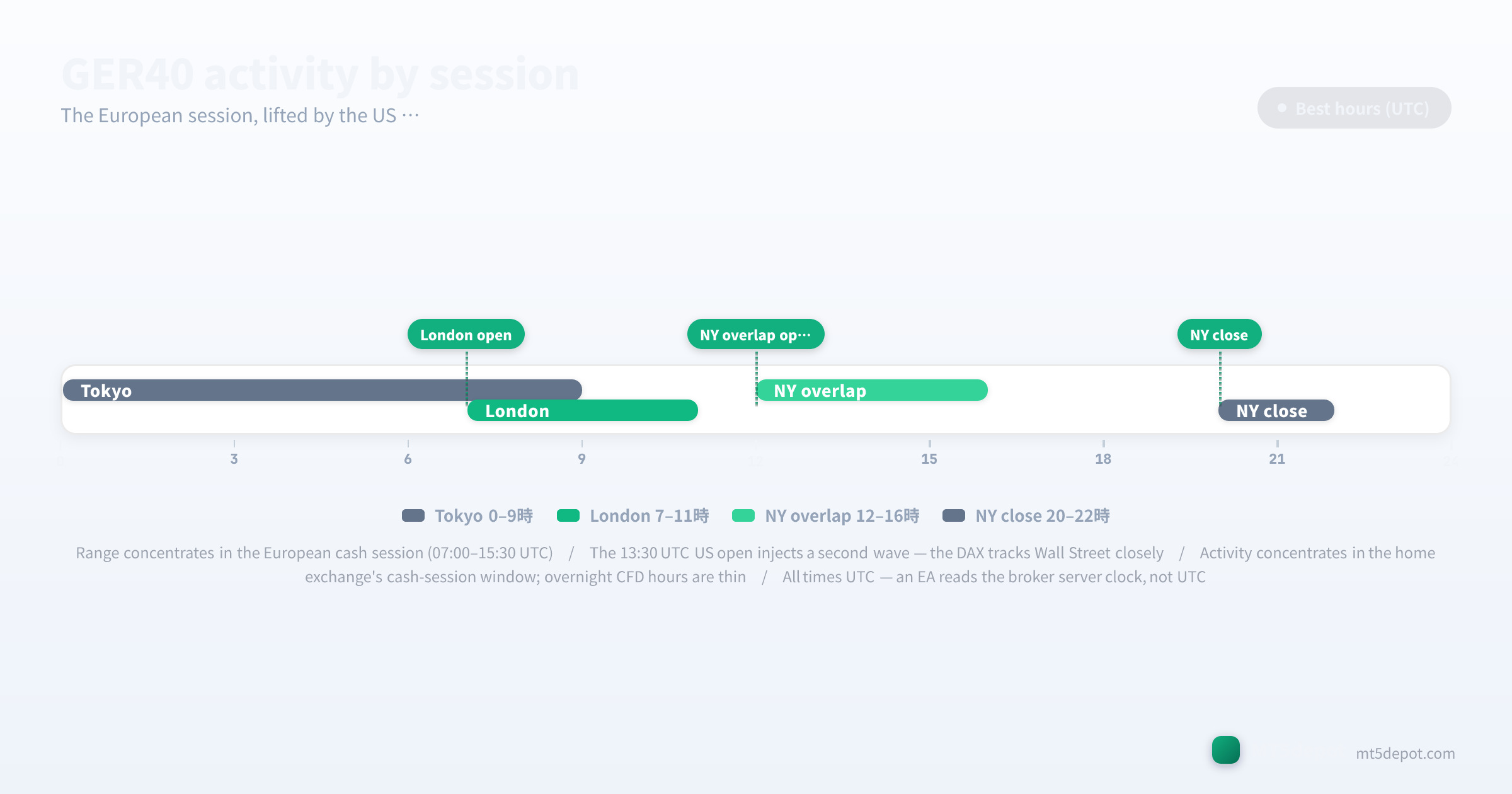
Session structure decides more of a DAX result than indicator choice does:
- Overnight (roughly 21:00–07:00 UTC): thin liquidity and low conviction, and where the overnight cash-session gap forms. Breakouts printed here often fail once the European cash session opens — a window a session filter is right to exclude.
- European cash session (07:00–15:30 UTC): the DAX’s primary window. Volume is highest and ranges cleanest here, and trend and breakout EAs on the DAX tend to earn most of their result in these hours.
- US open (from 13:30 UTC): the second wave. Wall Street’s cash open overlaps the last two hours of the European session, and the DAX frequently accelerates or reverses on the fresh US flow and data. It is often the most decisive stretch of the DAX day, and an EA that ignores it misreads the reversal.
- US afternoon (after 15:30 UTC): the European cash close passes, DAX liquidity thins even while Wall Street trades on, and false signals return.
In our editorial assessment, DAX EAs that restrict trading to the European-cash-plus-US-open window often out-perform 24-hour variants. Treat a session filter as part of the strategy definition rather than an optimisation flourish, and test that on your own data. Two cautions come with it. Scheduled ECB decisions and US data prints sit inside those good windows and widen the DAX spread exactly then. A fast strategy needs a news pause, or it pays several times the normal spread at the worst moment. And every clock time above is UTC. An EA reads your broker’s server clock, which is usually not UTC, so a “13:30” US-open filter shifts silently between brokers on different server timezones. Verify it once in MT5’s Market Watch, and every session boundary lines up.
Spreads, Costs, and Execution
The DAX is priced and traded in index points, not pips, and its cost has a component a spot-FX cost model lacks: overnight financing. The figures below are editorial reference ranges compiled from broker-published index-CFD conditions (updated July 2026), not broker-by-broker measured numbers. Confirm the live spread and the point value on your own account before you size a fast strategy:
| Cost component | Typical GER40 figure | Notes |
|---|---|---|
| Spread | 0.8 – 1.5 points | Widens around the European open, the 13:30 UTC US open and scheduled ECB/US events |
| Commission | account-dependent | Many index CFDs are spread-only; some raw accounts charge a per-lot fee instead |
| Overnight financing | daily charge on carried positions | Applied at the broker’s rollover; a real drag on any position held across days |
Two cost rules specific to this instrument:
- Financing is a cost of the strategy, not a footnote. As a CFD, any GER40 position carried past the broker’s daily rollover pays (or rarely receives) financing. For a slow trend EA that holds for days, that overnight drag compounds and can erode a thin edge that looked profitable on a backtest with no financing model. A DAX strategy validated without financing is a different strategy from the one you will actually run.
- Spread and point value are account properties, not fixed instrument constants. The same DAX quote can carry a different point value and a different all-in cost depending on your account and contract size, and any commission is layered on top of the spread. A DAX EA validated at 0.8 points spread-only and deployed at 1.5 points plus a commission is running different economics. Confirm both the spread and the point value on your own account before you size anything.
Risks to Test Before Going Live
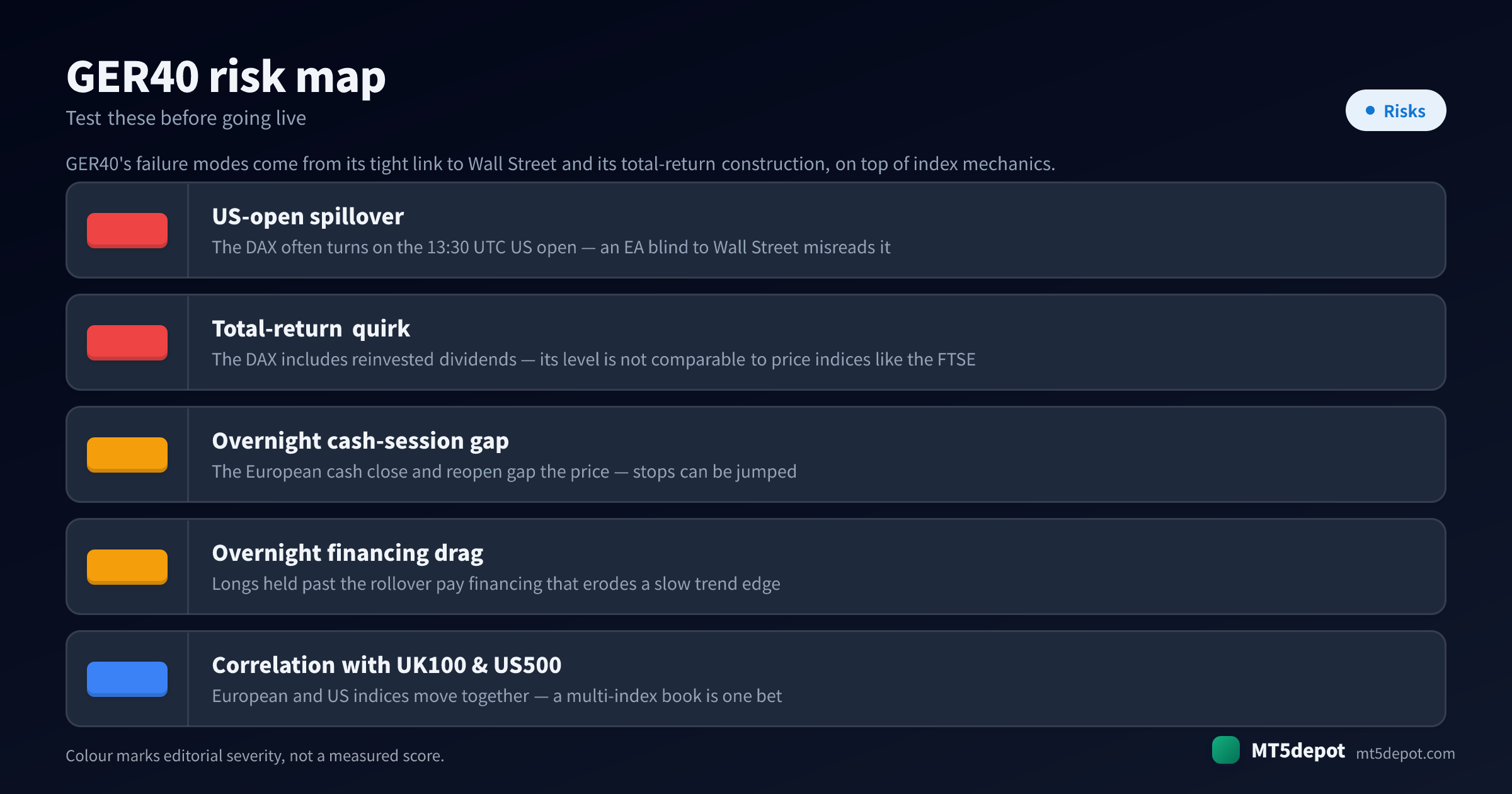
The DAX’s failure modes come from its tight link to Wall Street and its total-return construction, on top of ordinary index mechanics. A generic risk checklist misses most of them:
- US-open spillover blindsides a Europe-only EA. The DAX often turns on the 13:30 UTC US open, so an EA reading only European price action can be long into a move Wall Street is about to reverse. This is the single most DAX-specific risk. Give the strategy an explicit rule for the US open — a pause, a re-evaluation, or a filter — rather than trading through the day’s most decisive hour blind.
- The total-return level is not comparable to price indices. The DAX includes reinvested dividends, so its level sits structurally above a price index like the UK100 or the US500. Any cross-index filter, ratio or “relative value” logic that puts them on the same scale is comparing two differently-constructed numbers and will misfire. Build cross-index logic on returns, not raw levels.
- The overnight cash-session gap can jump a stop. The European cash session closes and reopens, and the DAX can gap across that break on overnight US or Asian news. A stop-loss does not protect against a gap beyond it — the fill is at the gapped price, not the stop. Size for the gap, and do not assume a tight stop caps the worst case.
- Overnight financing drag erodes a slow edge. Longs held past the rollover pay financing that compounds over a multi-day hold, turning a marginal trend edge into a loser once the real carry cost applies. Model the financing before trusting any hold-for-days DAX strategy.
- Correlation with UK100 and US500 is hidden leverage. European and US indices move together, so two “diversified” EAs on GER40 and US500 are closer to one leveraged directional position than a hedge. The correlation doubles your exposure without appearing anywhere in either EA’s risk settings.
How to Test a GER40 EA
Because there is no catalogue DAX EA to lean on, the test is the whole edge. Hold anything you build to the same bar our catalogue EAs publish under the site’s methodology:
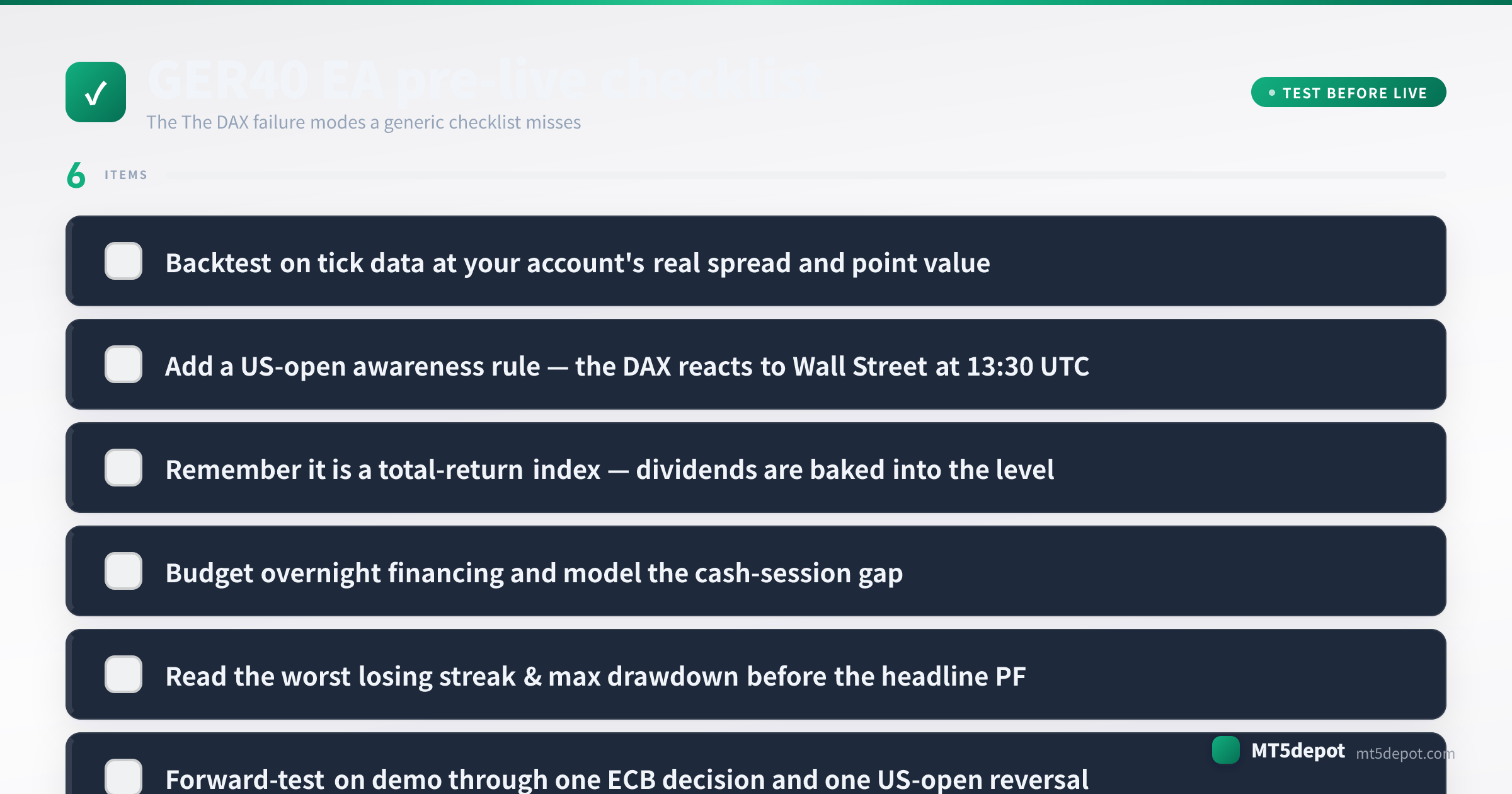
- Backtest on tick data at your account’s real spread and point value. Use an every-tick model with the 0.8–1.5 point spread and the point value you will actually trade, not the platform default. Switch the financing model on, because a DAX backtest that ignores overnight carry flatters a hold-for-days strategy.
- Read the worst losing streak, not the headline profit factor. The max drawdown and the longest losing run tell you the capital and patience the strategy demands, in account-currency terms. Budget for the worst streak before you fund it.
- Forward-test on demo through one ECB decision and one US-open reversal. The DAX’s defining risks show up around a European rate catalyst and, above all, around a 13:30 UTC US open that turns the morning trend. A demo window that never spans one of each has not tested the two things that matter most here.
- Confirm the server clock before the first live trade. Re-check MT5’s Market Watch time against the UTC hours above — especially the 13:30 US-open boundary — and again after any broker migration. Easy to skip, expensive to miss.
Every backtest number this produces is a historical measurement, not a forecast — size for the drawdown you measured, not the return you hope for.
GER40 EAs and Builder Templates
No dedicated GER40 EA is currently listed in our catalogue. Our full five-year backtests sit on FX majors, and we will not pass off a forex EA as a tested DAX one. The honest route to a DAX EA is to build and verify one:
- The Builder (open it here) ships trend and breakout templates and exposes every parameter. The EA you deploy is built on your own numbers, including the session rules that decide a DAX result.
- Broker and account fit. The DAX’s spread, point value and overnight financing depend on the account. Check those conditions on your own broker before you size anything — our broker catalogue compares index-CFD terms.
- The concept canonicals. If a term above is unfamiliar, the volatility, ATR and leverage entries define the mechanics a DAX EA depends on most.
Frequently asked questions
- What is the best EA for GER40?
- There is no GER40-specific EA with a five-year backtest in our catalogue yet — our full backtests currently sit on FX majors, not stock-index CFDs. You can build a DAX trend or breakout EA in the Builder instead, then judge it the way you would any strategy: read the worst losing streak and max drawdown first, and validate on tick data at your own broker's spread and point value. On the DAX, add one check FX never needs — confirm the EA has a rule for the 13:30 UTC US open, because that is where the index most often turns.
- Why does the DAX move when the US market opens?
- The DAX 40 is dominated by large, export-heavy multinationals whose earnings and share prices are tightly linked to global — and especially US — demand, so German equities take a strong lead from Wall Street. When the US cash session opens at 13:30 UTC, the fresh order flow and US data often reverse or accelerate the morning European move. An EA that treats the DAX as a self-contained European instrument is reading only half the picture.
- Is GER40 a total-return index and why does it matter?
- Yes — the DAX is a performance (total-return) index, meaning ordinary dividends are treated as reinvested and are baked into the level, unlike price indices such as the UK100 (FTSE 100) or the US500. That makes its raw level structurally higher over time and not directly comparable to price-index benchmarks. For an EA it mostly matters through the overnight cash-gap and financing that come with holding a dividend-inclusive index CFD across the rollover.
- Can you scalp GER40 with an EA?
- It is possible but harder than the trend and breakout shapes the DAX naturally suits. The index is fast and whippy around the European open and the 13:30 UTC US open, and the spread — though quoted in fractions of a point — is a real cost against small point targets. Most DAX strategies clear the cost more comfortably on the larger intraday swings than on tick-by-tick scalps, so treat any DAX scalper as unproven until your own tick-data test says otherwise.
- What hours should a GER40 EA trade?
- The European cash session (roughly 07:00–15:30 UTC) carries the DAX's core volume and its cleanest ranges, and the 13:30 UTC US open adds a strong second wave. The overnight hours are thin and prone to gaps, so many DAX EAs restrict trading to the European-plus-US-open window. Check the filter against your broker's server clock, which is usually not UTC, before you trust the hours.
Related symbols
Related articles
Glossary