At a glance
ETH/USD · Ether
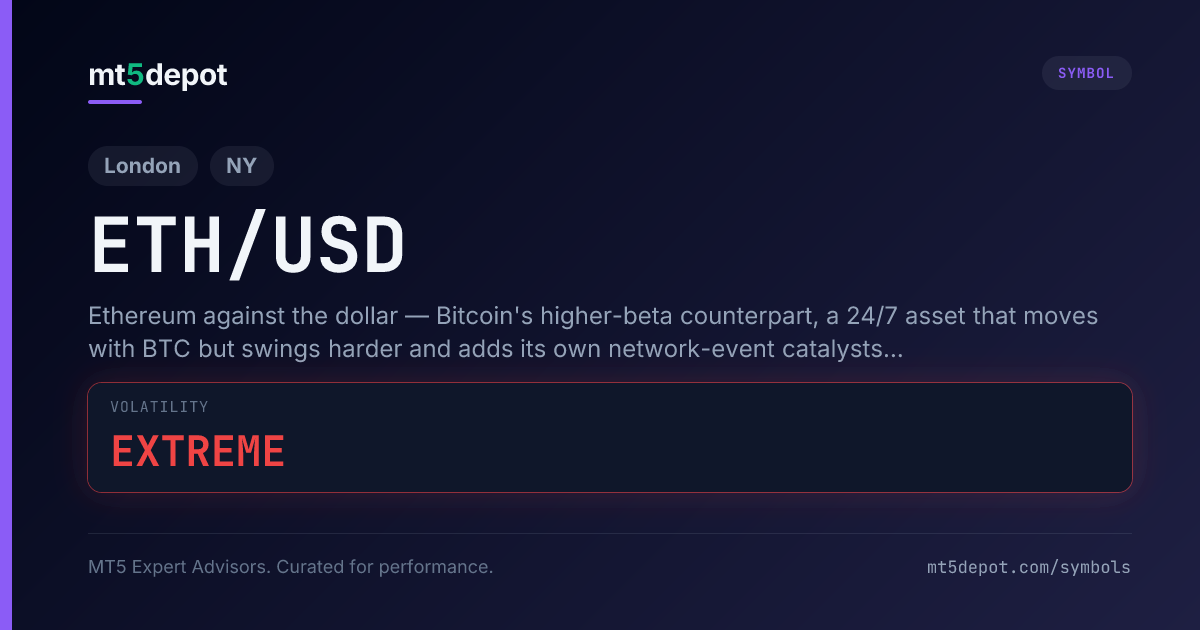
Ethereum against the dollar — Bitcoin's higher-beta counterpart, a 24/7 asset that moves with BTC but swings harder and adds its own network-event catalysts. Running ETH alongside BTC is close to one leveraged crypto bet. Extreme ranges reward trend EAs sized for the volatility and the CFD financing.
Typical values — ETH/USD is not yet measured broker-by-broker; confirm the live spread and financing on your own account.
Data
Trading conditions
Session windows, broker spreads, and cost math for this symbol — measured and typical values, not marketing.
EA catalogue
EAs for ETH/USD
Why this list is empty
Our catalogue lists no ETH/USD EA right now. An EA is listed only after it passes our tick-data backtest gate — and the numbers are published either way. Until then, build and test your own below.
- Listing is gated, not editorial — an EA reaches this page only after it passes our tick-data backtest gate.
- The numbers are published either way, including the EAs that failed the gate and were delisted.
- You can build your own ETH/USD EA and backtest it on this symbol before anything goes live.
Analysis
ETH/USD: the full analysis
Ether is not a currency pair. It is a crypto CFD that happens to be quoted against the US dollar. It behaves as Bitcoin’s higher-beta counterpart — on the days BTC moves, ETH tends to move further in the same direction. It also adds its own network-event catalysts and a 24/7 clock that a forex EA was never designed for. The first thing to decide is whether your strategy wants that character or merely tolerates it. A trend or breakout EA feeds on ETH’s extreme range, while a system sized and stopped for a forex major — or even for Bitcoin — meets swings it was never built to survive. Pick the instrument to the strategy, not the other way round.
This page covers what Ether gives an automated strategy that a forex pair does not, the sessions that concentrate its liquidity, and what it actually costs once daily financing is included. It then covers the failure modes that catch systems moved over from FX or from BTC, and how to test an ETH EA when there is no off-the-shelf one to copy.
How ETH/USD Behaves: What Ether Gives an EA
Ether is structurally different from a forex major — and even from Bitcoin — in ways that matter more for automation than any indicator choice. Its catalysts, its clock and its cost model all sit outside the FX world an EA was probably built for.
For an EA, that character reduces to three properties:
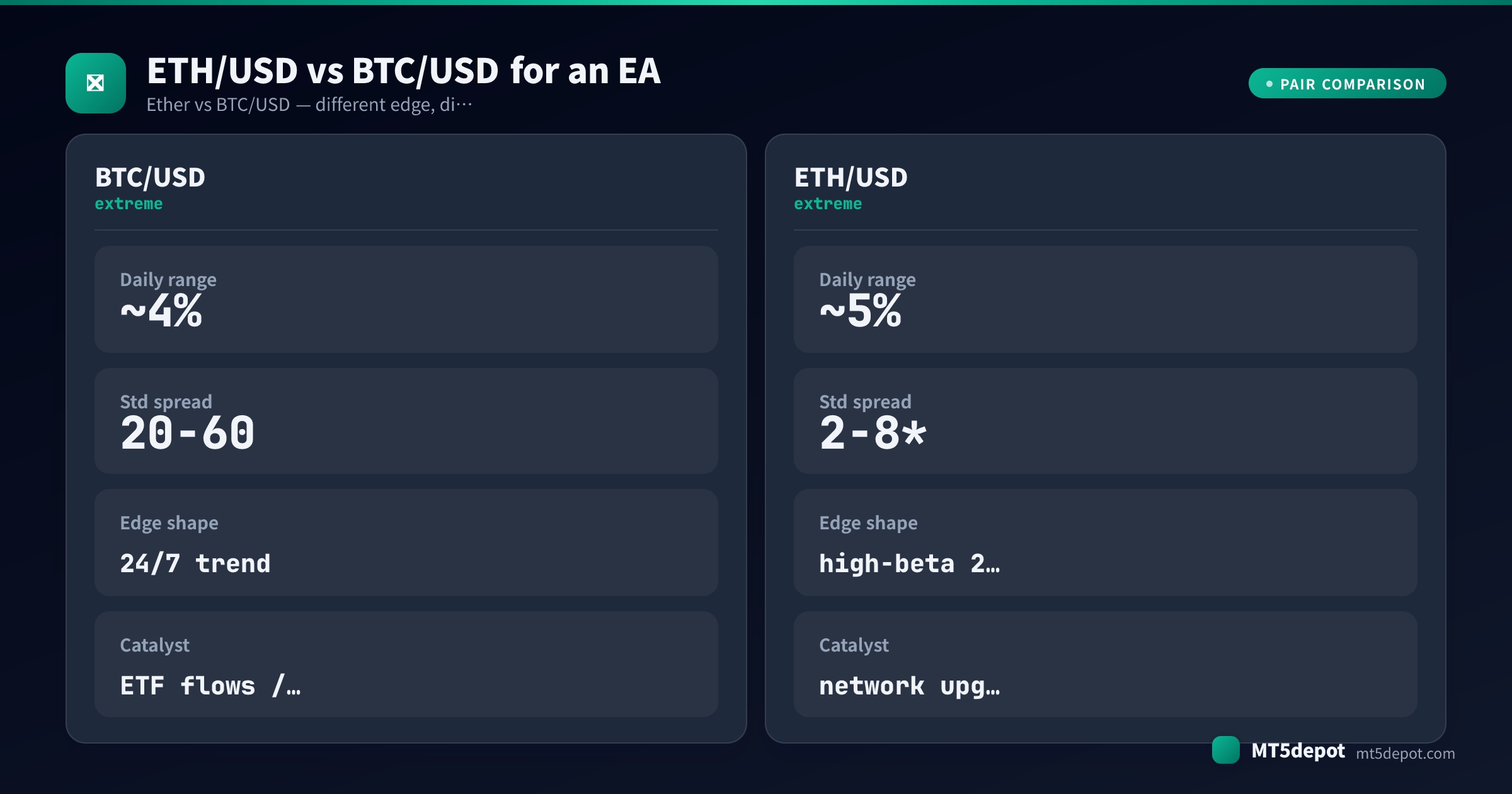
- An extreme range, quoted as a percentage. Our published typical daily range for ETH is around 5% of price — labelled typical, not measured broker-by-broker — many times a forex major’s fractional-percent range. That range gives trend and breakout systems room to run, but a stop distance carried over from FX, or copied from Bitcoin, sits well inside ETH’s ordinary daily noise. Re-sizing stops and targets to ETH’s own range and ATR is the fact everything else here follows from.
- Higher beta than Bitcoin, and near-total correlation with it. ETH tracks BTC closely — when Bitcoin trends, Ether almost always trends with it — but it swings harder for the same BTC move. That is a double edge for automation. A BTC-sized stop is often too tight for ETH and gets clipped by normal movement. And running ETH beside a BTC position is not diversification but one leveraged crypto bet dressed up as two, because the volatility that drives both is the same underlying risk.
- Network catalysts and a 24/7 clock. Protocol upgrades, gas-fee events, staking-yield changes and ETF flow move Ether outside the macro economic calendar an FX EA watches. They arrive with no fixed release time — on a Sunday night as readily as a Tuesday. Because the market never closes, an ETH EA also carries leveraged exposure across every weekend, paying financing the whole time.
The trap for automated strategies is that ETH’s large, clean range looks like an easy edge on a backtest. That same range, plus a 24/7 clock, hidden BTC correlation and a daily financing charge, turns one ordinary move — or one unattended weekend — into an account event if the risk was modelled on forex assumptions. Ether rewards strategies that respect its beta, its correlation and its financing, and quietly ruins ones that treat it as a fast-moving forex pair.
Which EA Strategies Suit ETH/USD?
The instrument’s profile lists trend and breakout as suitable — but suitability is an editorial assessment, not proof. In a like-for-like template baseline (default inputs, no optimisation), most strategy templates finish below a 1.0 profit factor on any instrument. The ones that clear it usually earn it through mechanics — timeframe, session windows, sizing discipline — not the indicator on the box. What ETH’s character tends to support:
| Strategy | Fit on ETH/USD | Why |
|---|---|---|
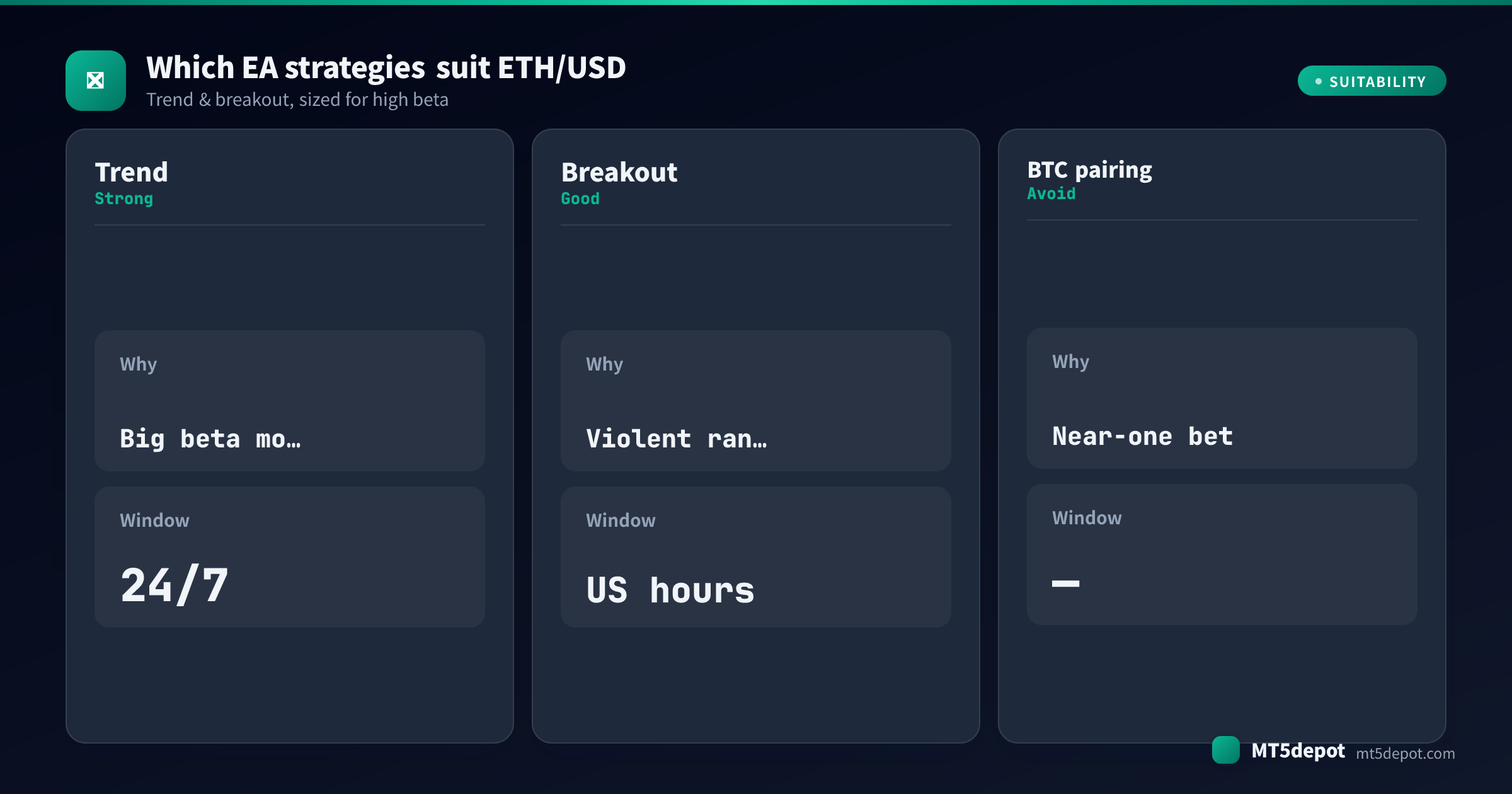
| Trend | Strong | Ether’s high-beta directional moves suit momentum systems — its extreme range gives a 2:1 or 3:1 target ample room to fill, and the trends run 24/7 rather than resetting at a session close. |
| Breakout | Good | The violent ranges around US hours and around network headlines give an objective level to break; pending-order entries reduce the spread cost a market fill pays on a wide-spread crypto CFD. |
| BTC pairing | Avoid | Pairing ETH with BTC as a “hedge” or “basket” is close to one leveraged crypto bet — the correlation is near-total, so it doubles exposure to a single risk instead of spreading it. |
Trend and breakout are the shapes that turn ETH’s range into an asset. There is no ETH-specific catalogue EA yet, so the practical route is to build one of these shapes yourself. The Builder ships templates that accept ETH/USD and exposes every parameter, including the stop distance and lot size — then test it (below) before you trust a single number.
Best Trading Hours for ETH/USD EAs
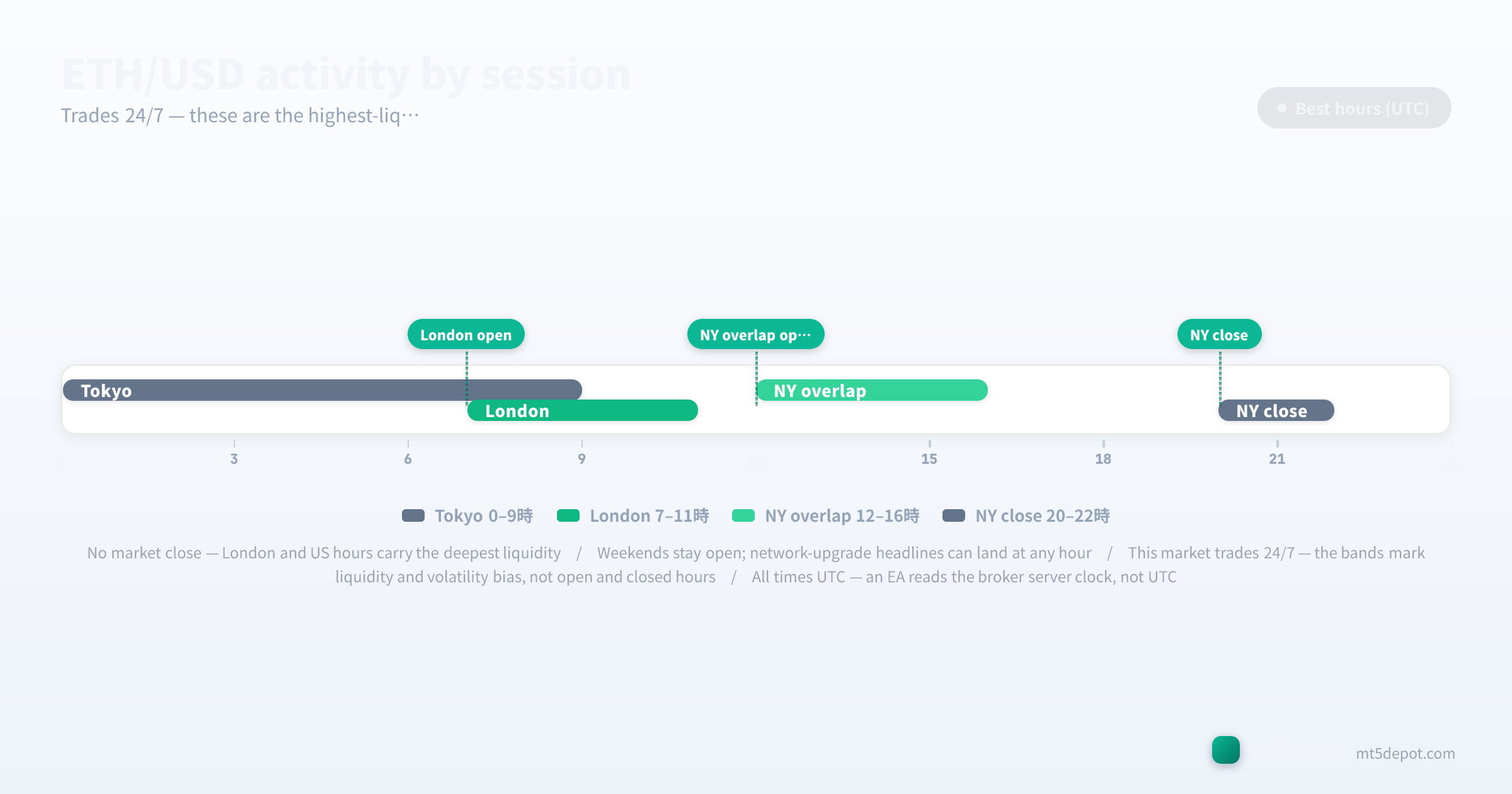
Unlike a forex pair, ETH never closes, but that does not mean every hour is equally worth trading. Liquidity concentrates in the same windows that carry the traditional market, and depth is what keeps the spread and the slippage sane:
- Asia overnight (roughly 21:00–07:00 UTC): thinner participation on the CFD leg and lower conviction. ETH still moves here, but breakouts printed on thin depth often fail once London and US flow arrives. A session filter is right to treat the window cautiously even though the underlying market is open.
- London session (07:00–16:00 UTC): liquidity deepens and spreads tend to tighten as European desks come online, and trend and breakout EAs on ETH tend to see cleaner fills in these hours.
- US hours / overlap (12:00–21:00 UTC): the primary momentum window. US risk sentiment, equity-market direction and crypto-ETF flow drive Ether hardest here, so this stretch is often the most active and the most tradable of the day.
- Weekends: open but thin. Because the market never closes, an ETH EA can trade Saturday and Sunday, but liquidity is low and a network headline can move price with almost nobody on the other side — a window to filter or to trade only with wider stops.
In our editorial assessment, ETH EAs that restrict trading to the deep-liquidity London-and-US windows often out-perform pure 24/7 variants. Treat a session filter as part of the strategy definition rather than an optimisation flourish, and test that on your own data. One clock rule governs the whole page: every time above is UTC. An EA reads your broker’s server clock, which is usually not UTC, so a “07:00” filter shifts silently when you move the EA between brokers on different server timezones. Verify it once in MT5’s Market Watch, and every session boundary lines up.
Spreads, Costs, and Execution
ETH is more expensive to trade than a forex major, and the biggest cost is one FX cost models leave out entirely: daily financing. The figures below are editorial reference ranges compiled from broker-published crypto-CFD conditions (updated July 2026), not broker-by-broker measured numbers; our live spread sampling currently covers a few FX reference symbols. Confirm the live spread and the swap on your own account before you size or hold anything:
| Cost component | Typical ETH/USD figure | Notes |
|---|---|---|
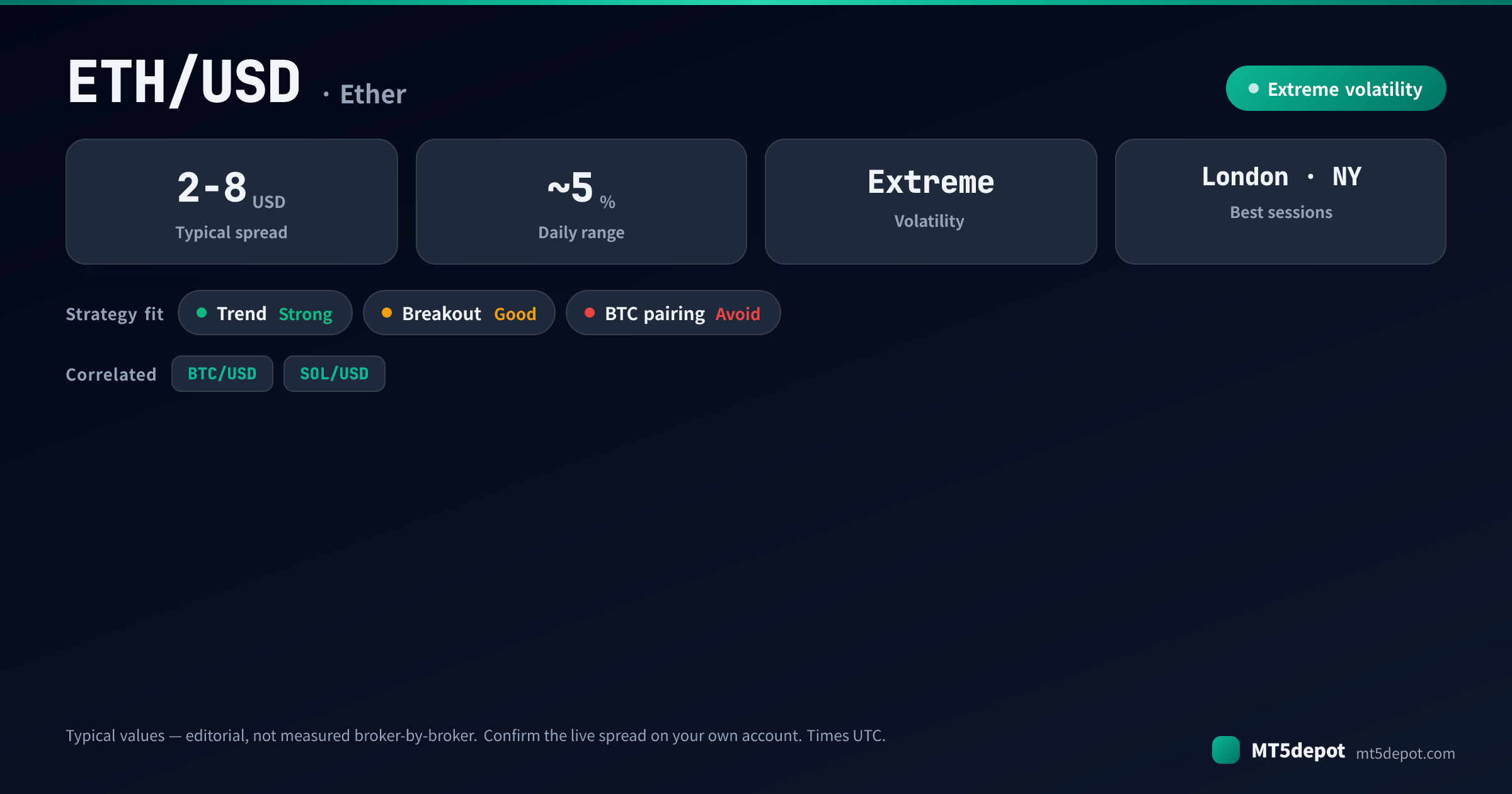
| Spread | 2 – 8 USD | Quoted in US dollars, not pips — ETH is a CFD, not a currency pair. Widens sharply around volatility spikes and thin weekend hours. |
| Commission | account-dependent | A property of your account type, not of ETH — the same schedule applies across a broker’s crypto CFDs. |
| Overnight financing (swap) | charged every calendar day | The dominant cost for any leveraged hold; accrues on weekends too because the market never closes. |
Two cost rules specific to this instrument:
- The spread is in dollars, and it is not the main cost. Budget the 2–8 USD spread as typical, then confirm it live, because it widens hard exactly when ETH moves fastest. But the recurring drain on a leveraged strategy is the daily financing charge, not the spread. A trend EA that holds ETH for a week pays swap seven times, weekends included, and a backtest that ignores it overstates the edge on every multi-day trade.
- Commission is an account property, not an instrument property. What changes between ETH and BTC on the same broker is the spread and the swap rate, not the commission schedule. A strategy validated with no financing line is measuring a different, cheaper instrument than the one you will actually hold.
Risks to Test Before Going Live
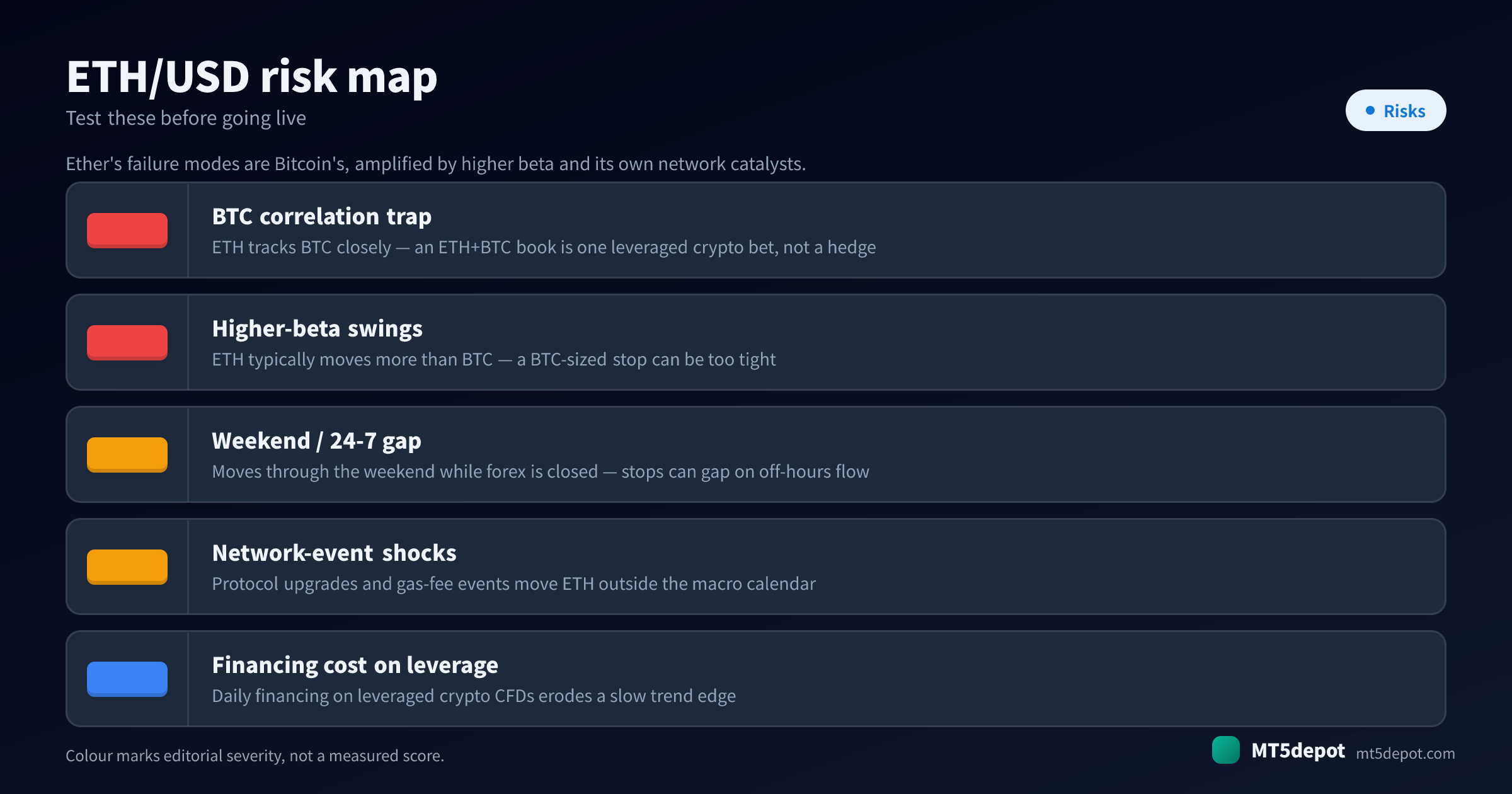
ETH’s failure modes are correlation-and-cost errors first, strategy errors second. A generic crypto checklist misses most of them:
- The BTC correlation trap. ETH tracks Bitcoin so closely that a long-ETH, long-BTC book — or a “hedge” that shorts one against the other — is close to a single leveraged bet on crypto direction, not the diversification it looks like. The correlation doubles your exposure to one risk without appearing anywhere in either EA’s settings. Treat any ETH+BTC combination as one position and size it that way.
- BTC-sized stops are too tight for ETH. Because Ether is the higher-beta asset, a stop distance that survives Bitcoin’s daily range often sits inside ETH’s ordinary noise and gets clipped before the thesis has room to play out. The most common porting error is copying a Bitcoin EA’s stop onto ETH. Re-size stops and targets to Ether’s own range and ATR before anything else.
- The 24/7 weekend gap. A forex EA is built to stand flat over the weekend and dodge the Monday-open gap. ETH removes that gap but replaces it with continuous unattended risk — a large liquidation or a headline can move price at 03:00 on a Sunday with nobody watching. An ETH EA needs stops that work around the clock, not a Friday-flat routine ported from FX.
- Network-event shocks outside the macro calendar. Protocol upgrades, gas-fee spikes, staking changes and ETF news move Ether with no fixed schedule and no entry on the economic calendar an FX EA watches. A price-only trend system can hold straight into an upgrade it had no way to anticipate.
- Financing drag on leverage. Every calendar day a leveraged ETH position is open, it pays a swap charge, weekends included. A long-hold strategy that looked profitable on a spread-only backtest can turn negative once the daily financing is subtracted — the cost most likely to stay invisible until it is real money.
How to Test a ETH/USD EA
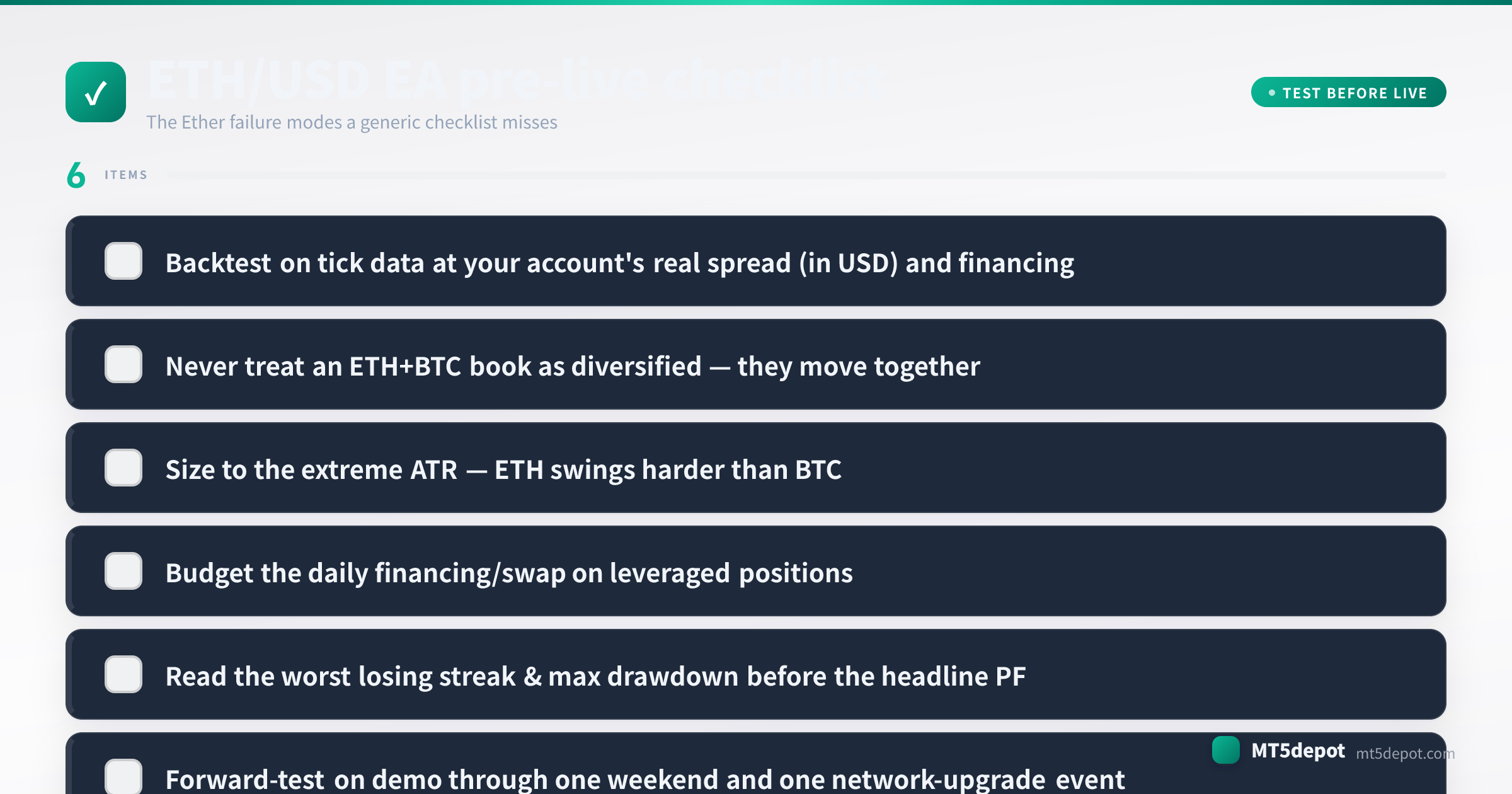
Because there is no catalogue ETH EA to lean on, the test is the whole edge. Hold anything you build to the same bar our catalogue EAs publish under the site’s methodology:
- Backtest on tick data at your account’s real spread — and include the swap. Use an every-tick model with the 2–8 USD spread you will actually trade, not the platform default. Make sure the daily financing charge is modelled, because on a multi-day ETH hold the swap, not the spread, is usually the larger cost.
- Read the worst losing streak in account currency, not in points. ETH’s extreme range means a modest-looking move is a large capital swing at leverage. Read the max drawdown and the longest run of losing trades in dollar terms, and budget for the worst streak before you fund it. Confirm the per-position risk your lot size implies is one you can survive.
- Forward-test on demo through at least one weekend and one network event. ETH’s defining risks — the unattended weekend and the off-calendar upgrade — only show up when you actually hold across them. A demo window that never spans a weekend or a protocol/gas headline has not tested the things that matter most.
- Confirm the server clock before the first live trade. Re-check MT5’s Market Watch time against the UTC session hours above, and re-check it after any broker migration. That matters even on a 24/7 instrument, because your session filter still keys off the server clock.
Every backtest number this produces is a historical measurement, not a forecast — size for the drawdown you measured, not the return you hope for.
ETH/USD EAs and Builder Templates
No dedicated ETH EA is currently listed in our catalogue. Our full five-year backtests sit on FX majors, and we will not pass off a forex or a Bitcoin EA as a tested Ethereum one. The honest route to an ETH EA is to build and verify one:
- The Builder (open it here) accepts ETH/USD in its trend and breakout templates and exposes every parameter — crucially the stop distance and lot size. The EA you deploy is built on your own beta arithmetic.
- Broker and account fit. ETH’s cost, financing and contract details depend on the account. Check the spread and the swap on your own broker before you size anything — our broker catalogue compares them.
- The concept canonicals. If a term above is unfamiliar, the volatility, ATR and leverage entries define the mechanics an ETH EA depends on most.
Frequently asked questions
- What is the best EA for ETH/USD?
- There is no Ethereum-specific EA with a five-year backtest in our catalogue yet — our full backtests currently sit on FX majors, not crypto CFDs. You can build an ETH trend or breakout EA in the Builder instead, then judge it the way you would any strategy: read the worst losing streak and max drawdown first, and validate on tick data at your own broker's ETH spread. On a crypto CFD add one check FX rarely needs — confirm the daily financing charge, because holding leveraged ETH overnight bleeds a swap cost every calendar day, weekends included, that a spread-only cost model ignores.
- Is ETH/USD more volatile than Bitcoin?
- In our editorial assessment, yes — Ether is Bitcoin's higher-beta counterpart, so on a day BTC moves it tends to move further in the same direction, both up and down. That is why a stop distance sized for BTC's daily range is frequently too tight for ETH and gets clipped by ordinary noise. It also means an ETH position carries larger swings for the same lot, so the sizing arithmetic, not the entry signal, usually decides whether the strategy survives.
- Can you hedge ETH/USD by shorting BTC/USD?
- Not really — ETH and BTC are so tightly correlated that a long-ETH, short-BTC book is a bet on their price ratio, not a market-neutral hedge, and it still carries direction whenever their beta diverges. More commonly traders run long ETH alongside long BTC and call it diversification; in practice that is closer to one leveraged crypto position that moves as a single risk. Treat any ETH+BTC book as correlated exposure and size it as one bet, not two independent ones.
- Does ETH/USD trade on weekends?
- Yes — as a crypto CFD it trades essentially 24/7, including weekends, with no daily or weekend close like a forex pair has. That removes the Monday-open gap a weekend-flat forex EA is built to avoid, but it introduces the opposite problem: a network-upgrade headline or a large liquidation can hit at 03:00 on a Sunday with nobody watching. An ETH EA needs stops that work unattended around the clock, not a Friday-flat routine.
- What moves ETH/USD besides Bitcoin?
- Its own network events — protocol upgrades, changes in gas (transaction) fees, staking-yield shifts and spot-ETF flow — move Ether outside the macro economic calendar an FX EA watches. These catalysts have no fixed release time and appear on no central-bank schedule, so a price-only EA can be holding straight into an upgrade it has no way to anticipate. That is a risk layer BTC shares only partly and forex pairs do not have at all.
Related symbols
Related articles
Glossary